Cywilizacja
The two Civilisations · Hoyerswerda 1977, Rostock 1978
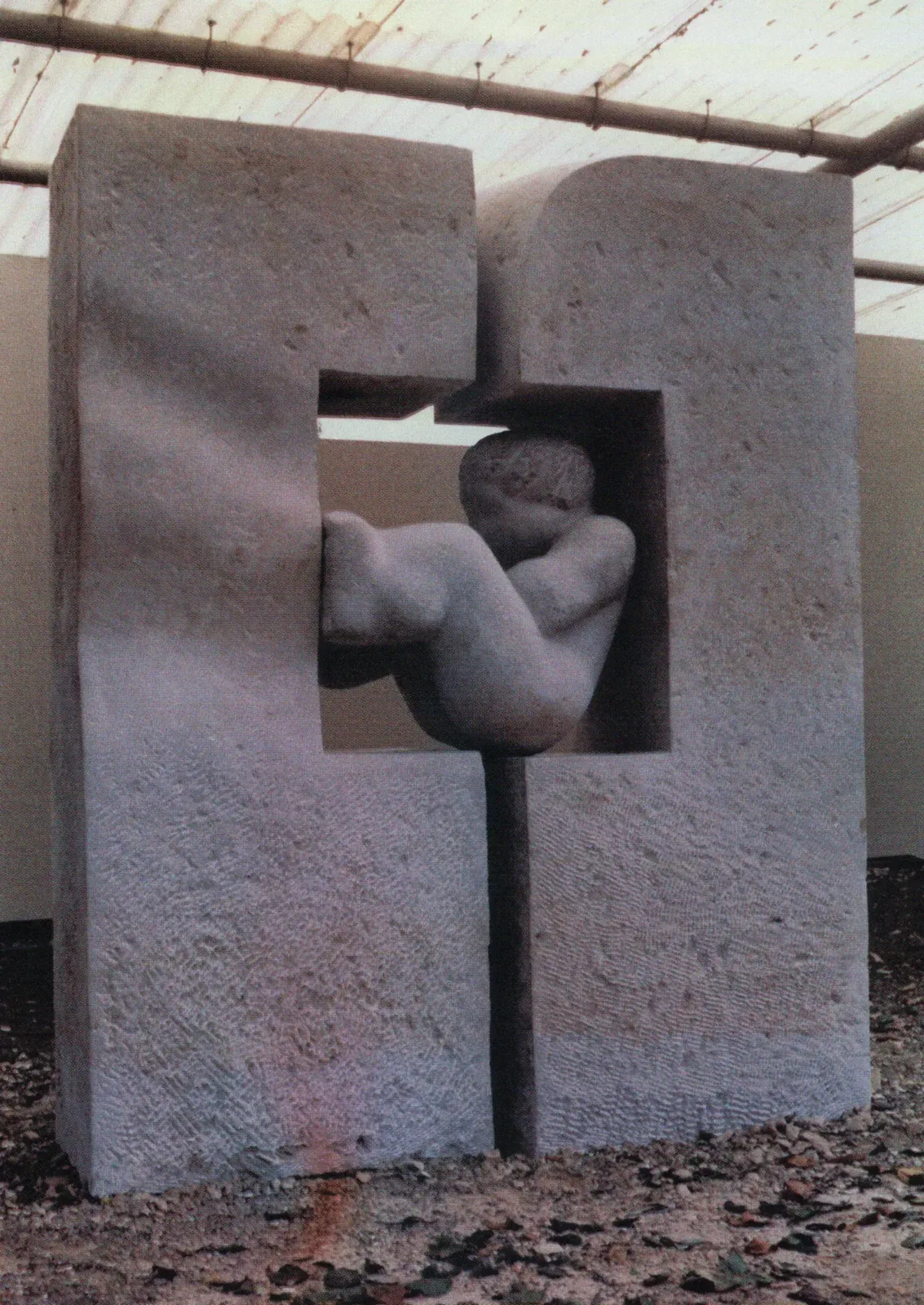
A block of sandstone two metres tall, divided into two volumes; at the centre a square window, and in the window a crouched human figure, polished like a river stone. The stone is rough, the man is smooth: civilisation is the block that contains him — shelter and enclosure in the same gesture.
It is born in the summer of 1977 at the international symposium of Hoyerswerda, in East Germany, in an open-air studio set up inside the town’s zoological garden, and it was made for the town. In German it is not called Civilisation: it is called «Leben», life. It is the work that opens the diptych of the Civilisations, and one of the best documented in the archive: the German chronicle following the works, the drawings signed on the spot, the family photographs of the carving.
The first Civilisation
The sandstone just finished, still under the canopy of the worksite: the two volumes, the window and the figure gathered in it.
The worksite of the Lied vom Glück
Hoyerswerda · August–September 1977The Hoyerswerda symposium is an open-air studio, and literally so: eight sculptors from seven countries work from the beginning of August to the end of September inside the Tiergarten, the town’s zoological garden, invited by the artists’ union of East Germany and by the municipality. It is directed by the local sculptor, Jürgen von Woyski; the theme is taken from Brecht — the «Lied vom Glück», the song of happiness. Antonina is the Polish guest.
It is not her first German worksite. The year before she had been at Reinhardtsdorf, in the sandstone massif the Elbe crosses at the Bohemian border, and from that stay had come a two-lobed form that stands today in Berlin, on the bank of the Spree. It is the same stone: the Hoyerswerda blocks come from those mountains, and it is von Woyski himself who explains it.
Das Material, das den Bildhauern zur Verfügung steht, ist Sandstein und kommt aus dem naheliegenden Elbsandsteingebirge. The material at the sculptors’ disposal is sandstone, and it comes from the nearby Elbe Sandstone Mountains.
For the local sculptors, von Woyski adds, it is a stone of tradition, while the foreigners mostly meet it for the first time. Not Antonina: she had carved it the year before. Time, on the other hand, is short for everyone — two months, so the work goes head-down.
Hoyerswerda lies in Lusatia, and the symposium is also covered by the daily of the Sorbs, the Slavic minority of the region: in their language the town is called Wojerecy, and the article runs under the headline «Mjezynarodna rězbarska dźěłarnja we Wojerowskim zwěrjencu» — an international sculpture workshop in the town’s zoological garden. It is to that paper that Antonina says, as she begins, what she wants to make: a work representing joy, rest, free time.
On 25 August the German chronicle describes the same stone, and reads it the other way round:
Bei Wysocka-Janczak drückt der halb liegende Mensch mit Kopf und Füßen gegen wuchtige Wände, die seine Erlebnisfähigkeit, seine Verwirklichung einzuschränken scheinen. In Wysocka-Jonczak the half-reclining human figure presses with head and feet against massive walls, which seem to limit his capacity to live and to fulfil himself.
Joy and rest on one side, constraint on the other: the two readings lie on the same stone, and neither is wrong. The block that shelters is also the block that presses, and the figure gathered in the window is at once protected and compressed. The title the artist gives it — Civilisation — holds them both.
Of that summer the archive also keeps two drawings marked «Hoyerswerda 1977» beside the signature, and the family photographs of the carving: Antonina at the mallet over the block, in the stages in which the figure surfaces little by little from the stone.
- Antonina Wysocka-Jonczak «Leben» poland
- Elmira Gusseinowa «Familienglück» ussr
- Katalin Samu «Lesender Junge» hungary
- Ladislaw Chochole «Mann und Frau» czechoslovakia
- Bogomil Shiwkow «Liebespaar» bulgaria
- Nicolae Fleissig «Antiqua» romania
- Bernd Wilde «Große Liegende» gdr
- Jürgen von Woyski «Glückliche Stadt» gdr
Eight sculptors from seven countries, from the beginning of August to the end of September, in the zoological garden of Hoyerswerda. Each answered the theme in their own way: happiness as a city, as a family, as a couple, as reading, as rest. The eight stones stand together today in the old town park that carries von Woyski’s name.
The «Lied vom Glück» is not a single poem. It is a song Brecht wrote in 1952 with Hanns Eisler for a film, «Frauenschicksale» by Slatan Dudow: the ship crossing the sea and the sailor dreaming of dry land, the child in the cradle asking for milk because it cannot stay small, the seedling that becomes a tree and the foundation stone that becomes a house. Every stanza says the same thing in a new image: happiness does not come by itself, it has to be won.
The eight sculptors also made one work together, a single one: a stele carrying the last stanza of the song carved into it. On the back are their signatures.
Und weil uns unsere Mütternicht für das Leid gebornhaben wir alle gemeinsamglücklich zu leben geschworn The second Civilisation
Rostock · 1978The second Civilisation begins at a birthday. In September 1977 the director of the Rostock zoological garden, Dr Dieter Schwarz, goes to bring his good wishes to a friend — Günter Peters, gardener of the zoo and a painter — and through him comes into contact with the summer’s sculpture seminar. Among the works of the artists who took part, the one that stays with him is Antonina’s, for what he calls its “philosophical statement of universal value”; and the wish arises to show in the Rostock zoo, as he writes, “this symbol of our great endeavour”.
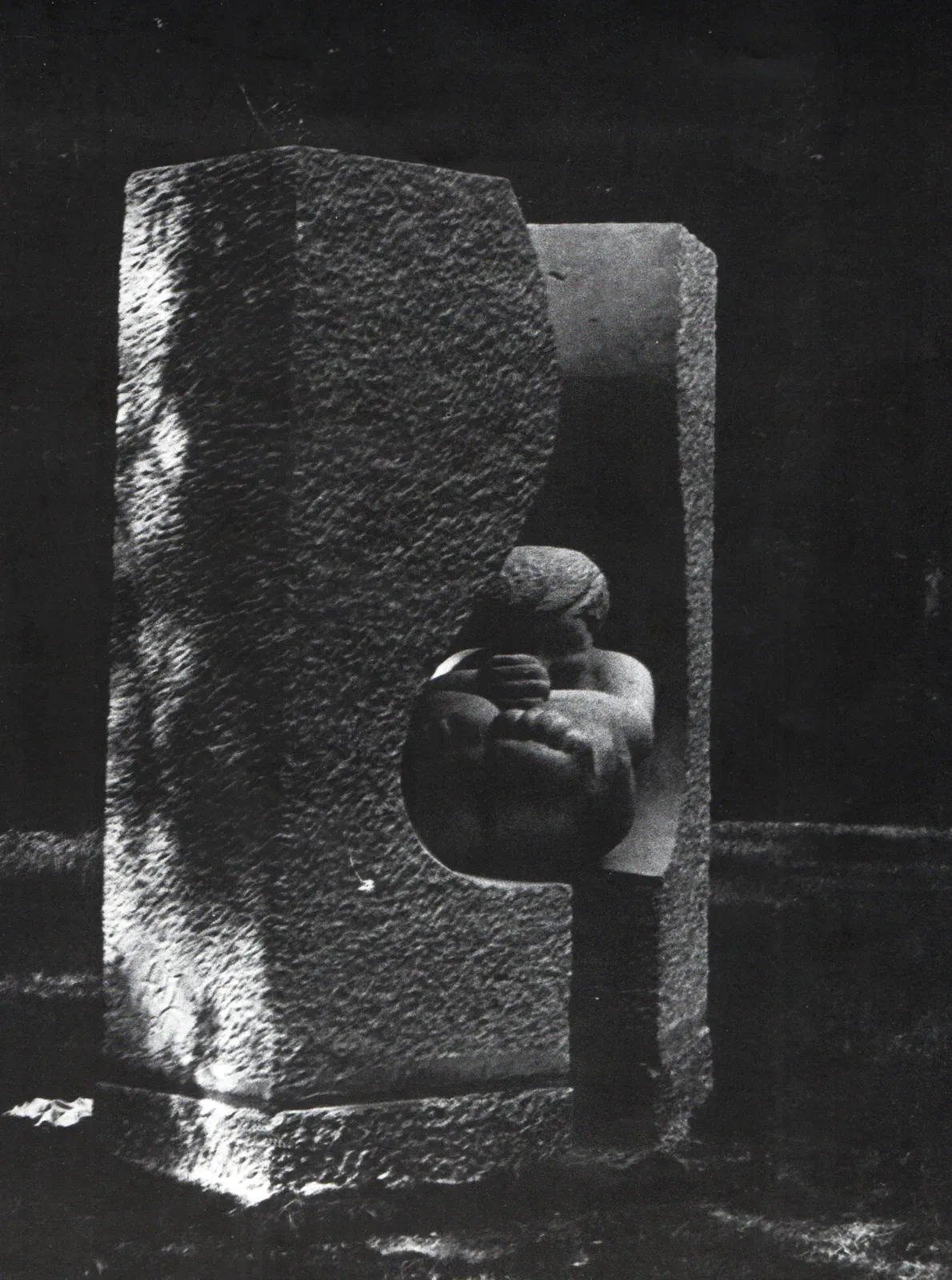
The blocks arrive from the mountains near Dresden: two sandstones two metres tall, more than two tonnes each. Antonina works from mid-June to mid-August 1978, with hammer and chisel, in the open, on a meadow of the zoo in front of the waterfowl pond. She rounds the two blocks into curves that shelter, and between them a third, smaller block takes the shape of an almost embryonic child. She works with the support of Peters, of the town council for architecture, of the district council and of the men of the zoo’s technical staff, who move the stones for her.
The work is unveiled on 15 August, with a small ceremony: there is a photograph of that day in which she stands before her stones with a bunch of flowers in her hand. In German the work takes the name the Rostock papers give it in the days of the unveiling: «Entstehung des Lebens», the coming into being of life — while the zoo’s director, when he writes about it, heads his article «Verantwortung für das Leben», responsibility for life. She places it in a cycle she calls, in Polish, «Powstanie życia — ochrona życia»: the birth of life, the protection of life. In the middle of those two months she flies to Moscow, for the inauguration of the relief of the new Polish embassy, and then returns to the stone.
The man who commissioned it says himself how it should be looked at, in a two-page article written after the unveiling: the two heavy stones are the elements that protect, and between the two columns stands a much lighter stone, “a small human being with embryonic features, which nonetheless radiates an elastic strength”. The columns and those features, he writes, give together the feeling of shelter — “in the form of protecting hands” — and of open possibilities, which is to say also of dangers. It is responsibility for life, he adds, shaped here not for an animal nor for a plant, “but quite consciously for the human being”.
The two Civilisations are thus both born inside a zoological garden — two cities that gave a sculptor a meadow and the time to carve on it —, and as she often did for the monumental works Antonina had first modelled the plaster in small: the large sculpture seen at the design stage.
But the real difference, in Rostock, is the public. In other years the zoo set finished sculptures along the oak avenue; that summer, among the passing people, the exhibition is the work itself — and the chronicle says it well:
 Open the catalogue entry →
 Cywilizacja II
Civilisation II1978 · sandstone · h 200 cm
Rostock (Germany)Commissioned by the Rostock city council for the zoological garden.
„Plastik im Grünen“ einmal anders. […] diesmal hatten die Zoobesucher Gelegenheit, das Entstehen eines Kunstwerkes unmittelbar mitzuerleben. “Sculpture in the green”, but in another way. […] this time the zoo’s visitors had the chance to witness at first hand the birth of a work of art.
The worksite notebook
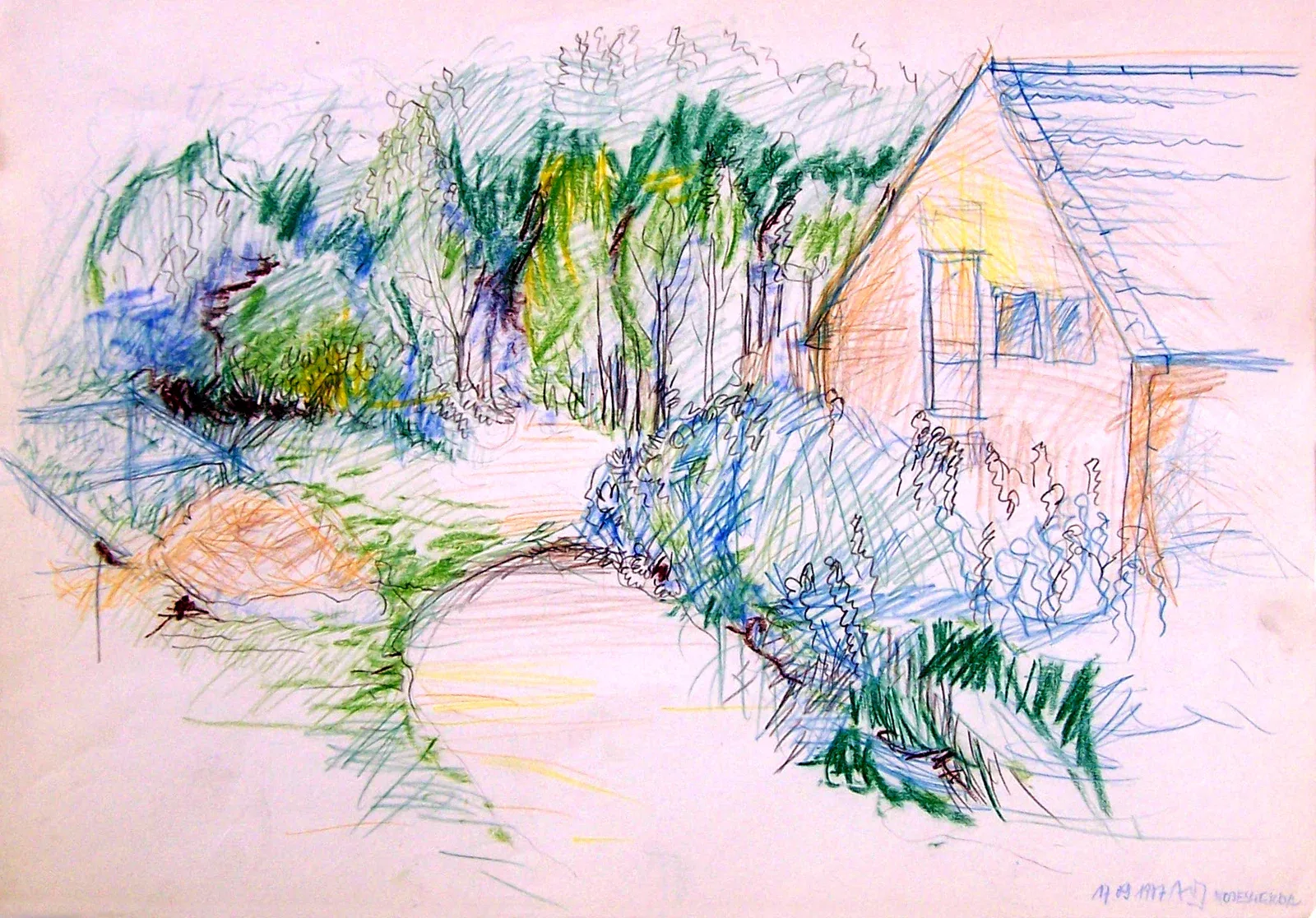
Hoyerswerda, summer 1977Eight weeks with hammer and chisel on a block of two and a half tonnes do not fill the days. That same summer, in Hoyerswerda, Antonina draws: a house with a pitched roof traced in blue line, a row of trees, the bank of a ditch — coloured pencils on pink paper, the work of half an hour.
The sheet carries the name of the place in its title and, at bottom right, the full date: 11 September 1977. It is the day, not the season — the stay can be dated to the week, and this sheet falls at the tail of the eight weeks of the worksite, when the stone is done.
And it is the earliest proof of a habit her path will repeat for thirty years: wherever she goes to carve, she paints. After Hoyerswerda will come the sheets signed Zamość, Turośl, Sarnówek, and the two open-air painting workshops of the Reymontówka. The stone and the paper travel together.
 Open the catalogue entry →
 Szkic, Hoyerswerda
Sketch, HoyerswerdaDrawn on the spot on 11 September 1977, at the tail of the eight weeks of the worksite.