Etiuda
Étude · Pole Mokotowskie, Warsaw, 2010
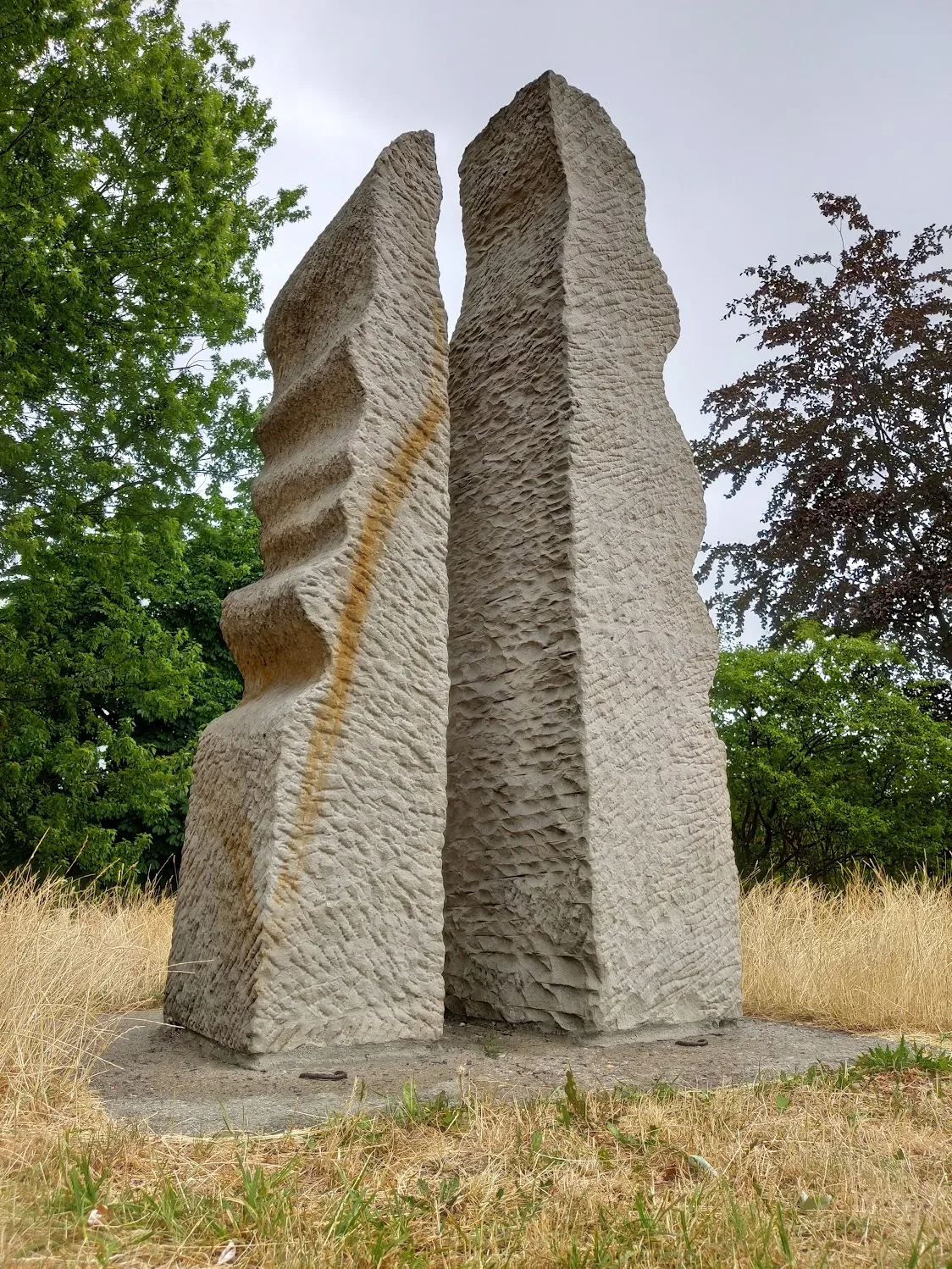
Two steles of pale sandstone, more than two metres tall, planted side by side in the grass. A narrow fissure runs between them, and the two edges that bound it answer one another: where one draws back, the other stands proud. They stand together like the two halves of something opened along a sinuous line, and set upright again a hand’s breadth apart.
Etiuda means étude, in the sense musicians give the word: a short piece, made on a single difficulty, and complete. It has stood in the Pole Mokotowskie, the great park of Warsaw, since the afternoon of 26 September 2010.
The work
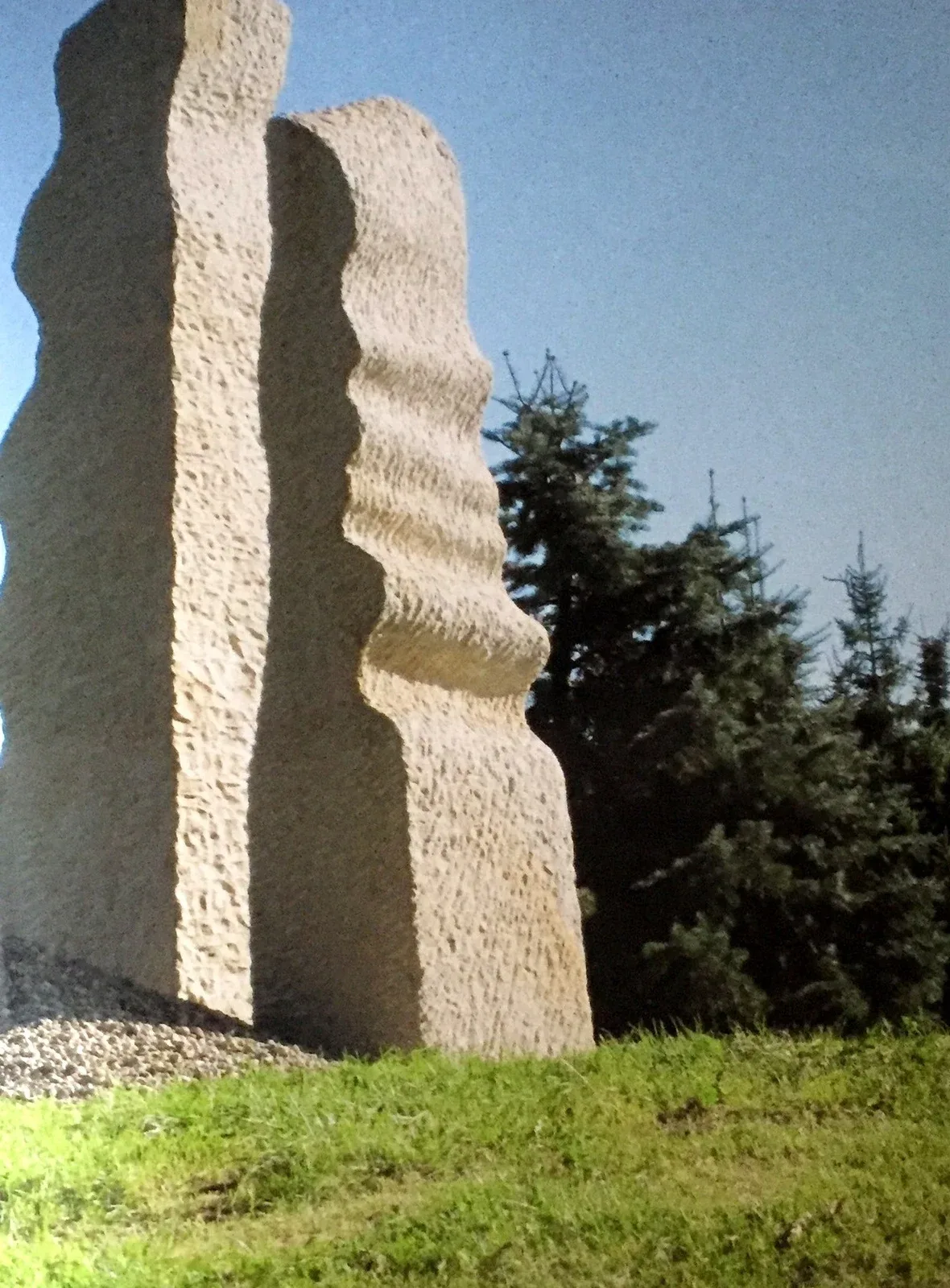
The two steles head-on and close to, and newly finished — seen from below against the sky.
The opened block
Art Konfrontacje · Warsaw, 2010The work is made at a sculpture symposium in the Pole Mokotowskie. The banner stretched over the field says it in full: «Art Konfrontacje — Plener rzeźbiarski. Sztuka w przestrzeni publicznej», art in public space. The sculptors work in the middle of the grass, inside an enclosure of tape, the blocks resting on pallets and people stopping to watch; the sculptures of that edition are unveiled on 26 September 2010, at three in the afternoon, in the park itself. No gallery, no indoor opening: the inauguration is an autumn afternoon on the grass.
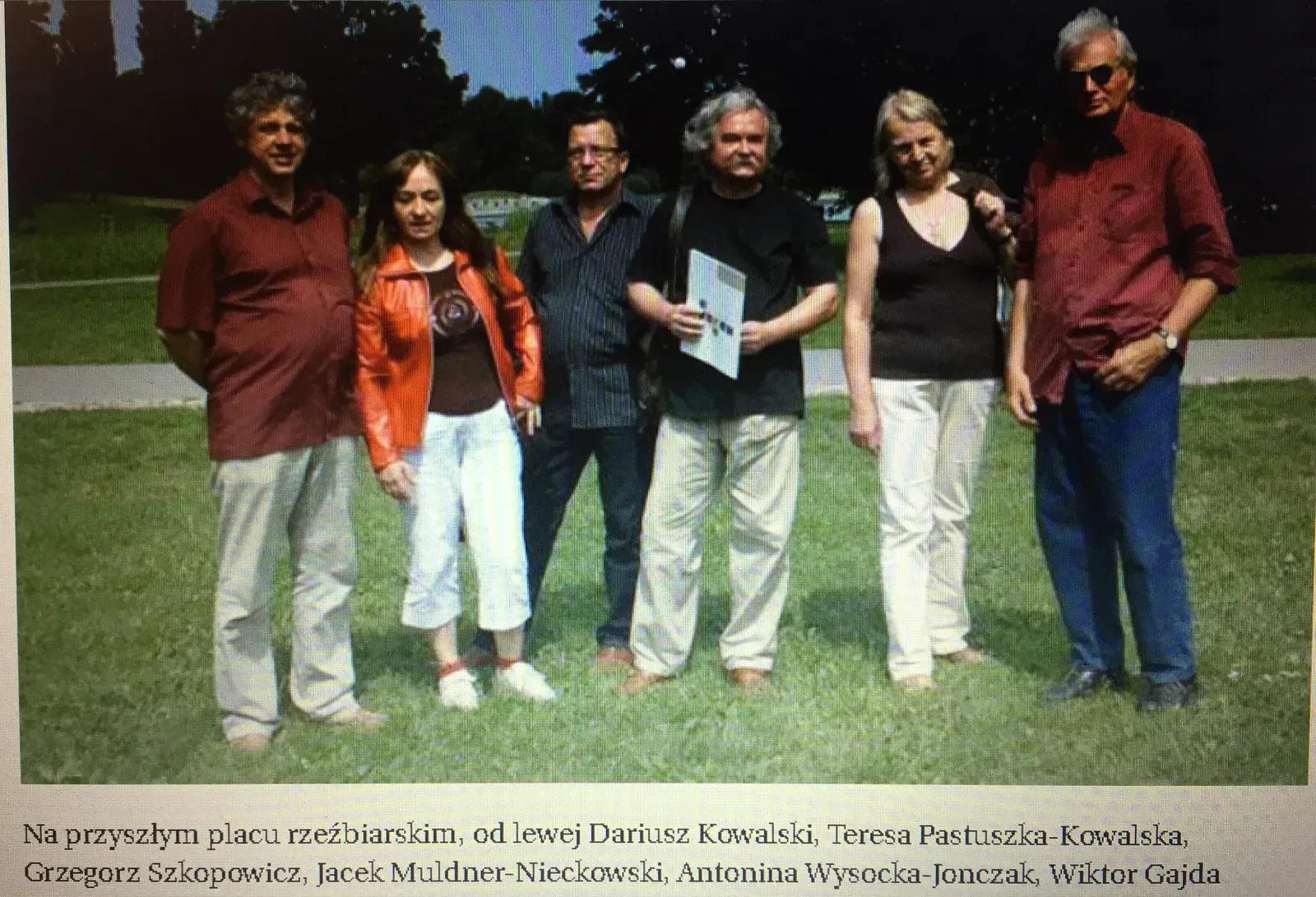
Antonina is one of the six sculptors of the edition — the city daily photographs them together on what it calls «the future sculpture square» and names them one by one: Dariusz Kowalski, Teresa Pastuszka-Kowalska, Grzegorz Szkopowicz, Jacek Muldner-Nieckowski, Antonina Wysocka-Jonczak, Wiktor Gajda. At the foot of the finished work a red plate remains, engraved with her name, the title and the name of the event.
It is the last of her open-air worksites, and the closest to home: after Slovakia, Slovenia, Germany, Austria, Sardinia and the Apennines, the last block she opens is in Warsaw, in a park where people walk the dog.
And the form is the form of a cut. The two edges that face one another correspond wave for wave: where one draws back the other stands proud, and between them a fissure of light remains as wide as a hand. But the line is no accidental fracture, it is drawn — on the one it descends in broad, regular waves, on the other it takes them up in the negative. The outer faces are worked with a close point, rough and even; the inner profiles are the clean part, the part one looks at. Whoever walks past them sees two figures facing one another; whoever walks around them sees a single thing, reopened.
Five weeks
The worksite, from arrival to unveilingThe photographs the family takes at the symposium, time after time, set the work of that last summer in order: the arrival at the field, the stone opening, the two halves drawn together to check that they answer one another, the crane, and the afternoon on which the work stays.
- Open the catalogue entry →
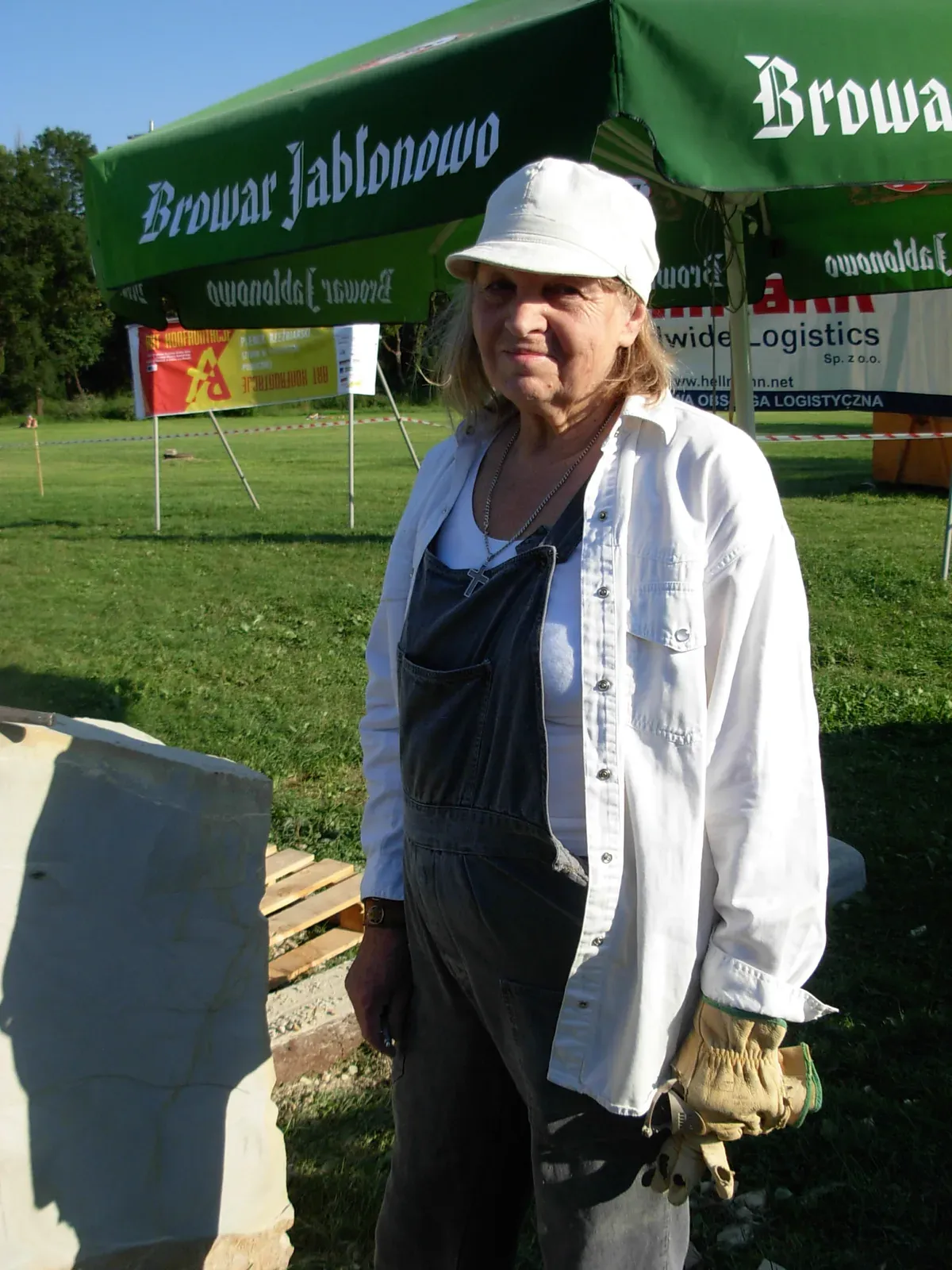
21 August. Antonina at the worksite, gloves in hand. Behind her the banner of «Art Konfrontacje». - Open the catalogue entry →
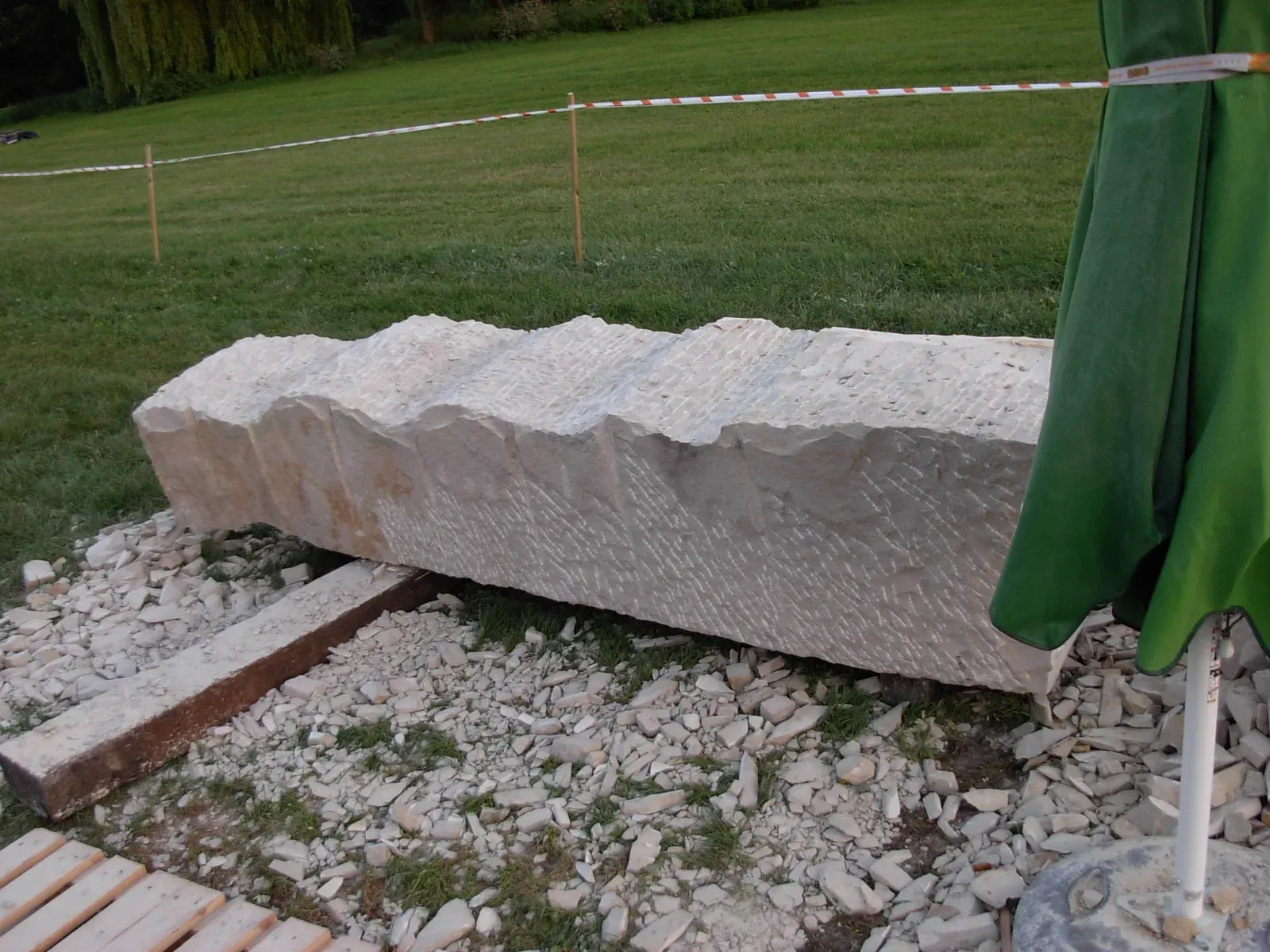
24 August. The block lying on the pallets: the wave profile is already cut the whole length of the flank. - Open the catalogue entry →
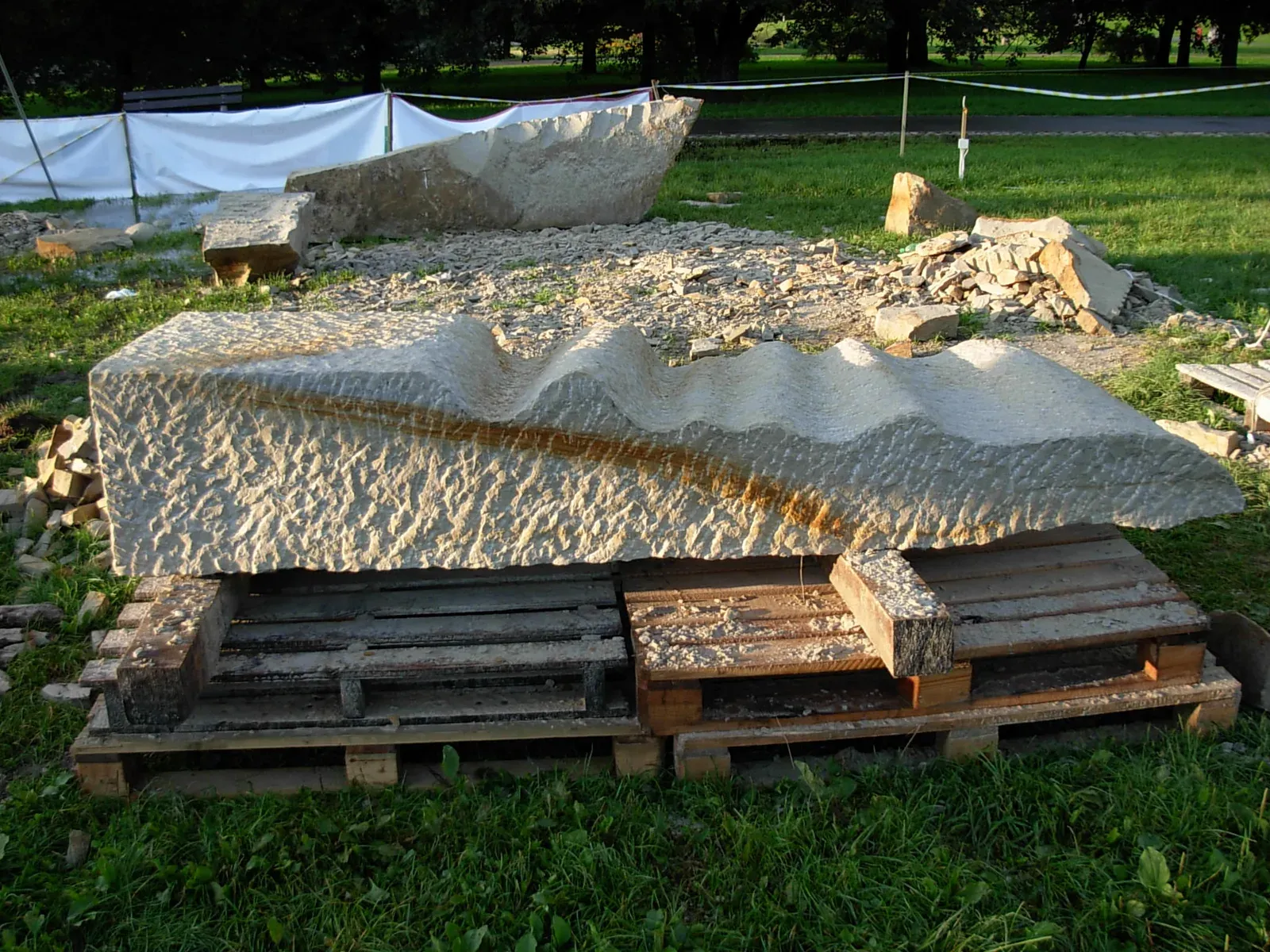
7 September. The two stones drawn together: the profiles are checked one against the other. - Open the catalogue entry →
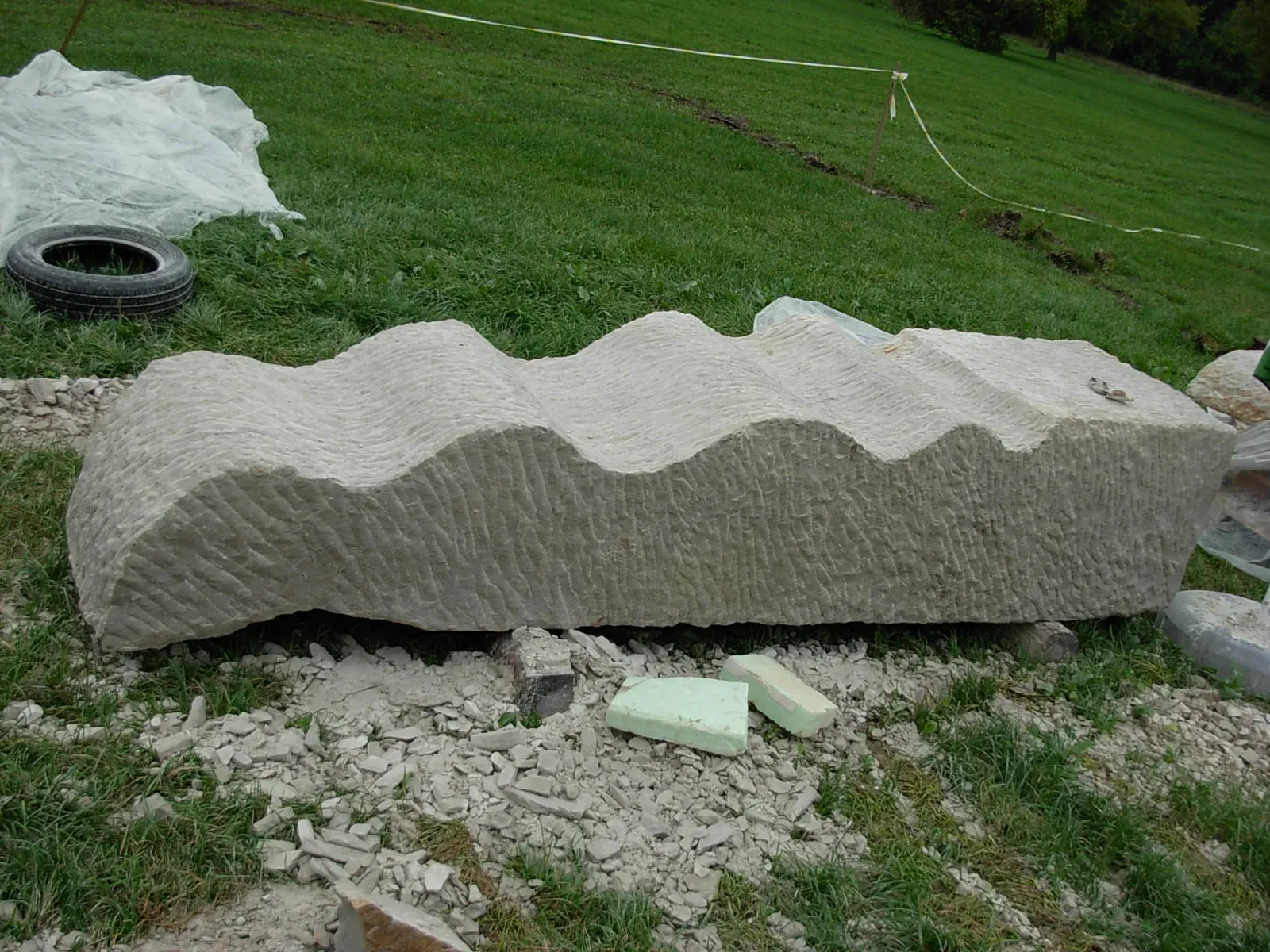
11 September. The work is done, the stone is still lying on the grass. - Open the catalogue entry →
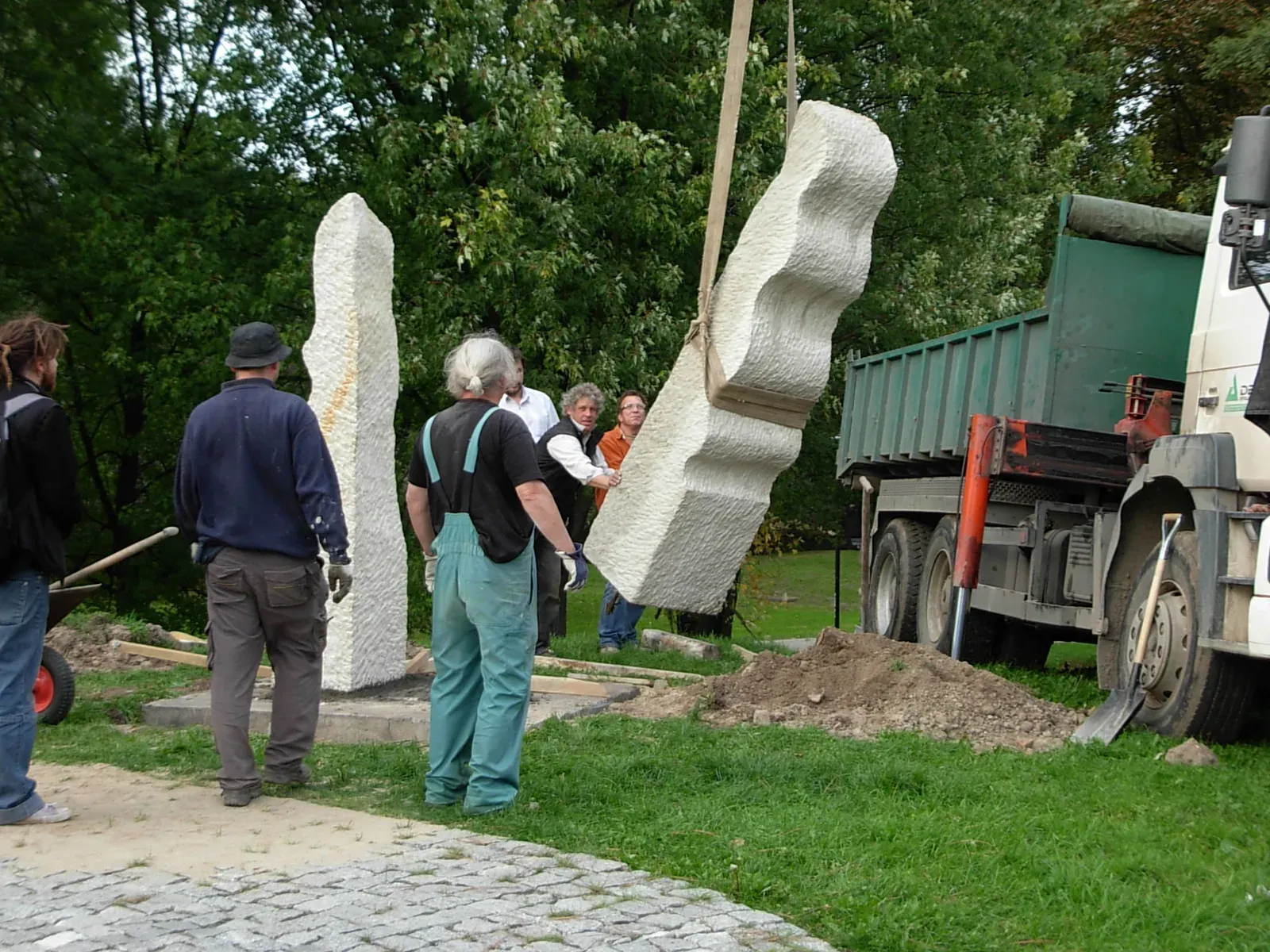
20 September. The setting: one stele already stands, the other comes down from the crane. - Open the catalogue entry →
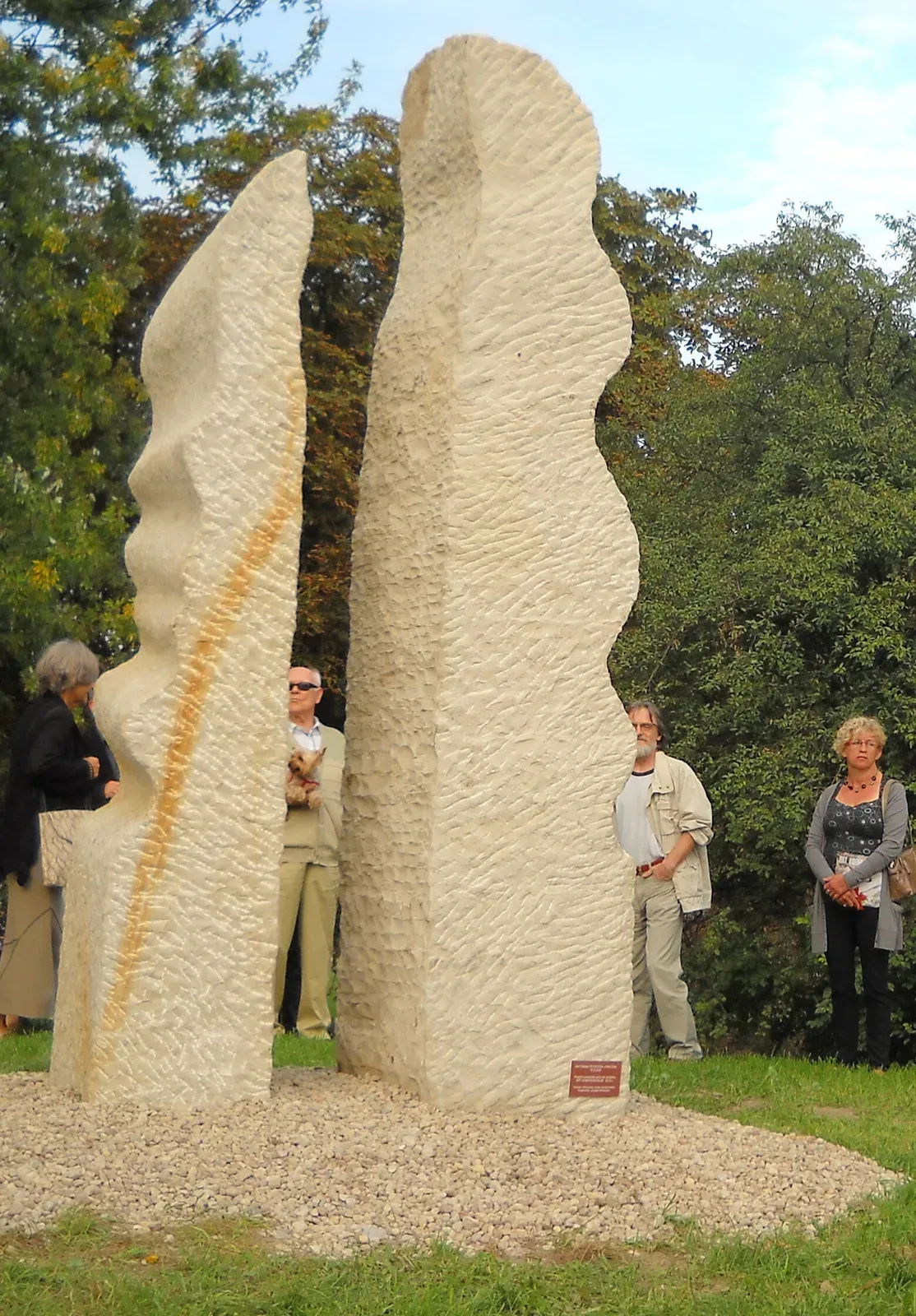
26 September. The work is unveiled, on its bed of gravel, with the plate at its foot.
The last stone
2010, and a second handEtiuda is the last of her large outdoor works. Forty years of open-air worksites begun in the wood at Moravany — the timber of Slovakia, the stone of Germany, the marble of Austria, the granite of Sardinia — close on this block, in a park in Warsaw, a few kilometres from the studio. Afterwards the sculpture goes on but changes scale: the wooden pieces of 2011 stand on a table.
It was brought to completion by her sister, Teresa Celestyna Wysocka.
The two stones stand side by side, a hand’s breadth apart. The fissure makes it possible to follow how the edges answer one another: where one draws back, the other stands proud.