Hiroszima
Four elements · 1969
Four tall wooden boards, standing side by side. In each of them a human figure has been taken away, not added: what one sees is the void the body has left — a silhouette cut clean through the thickness, which depending on the light reads as a person or as an absence.
It is the shape of a precise fact. At Hiroshima, after the explosion, the shadows of the people who had been vaporised remained on the surfaces. Hiroszima dates from 1969, the year after Wygnanie: they are the two groups with which, a little over twenty years after the war, Antonina opens her work.
The work
The group newly made, out of doors, and the group today in a gallery: the same boards, the same row, forty years apart.
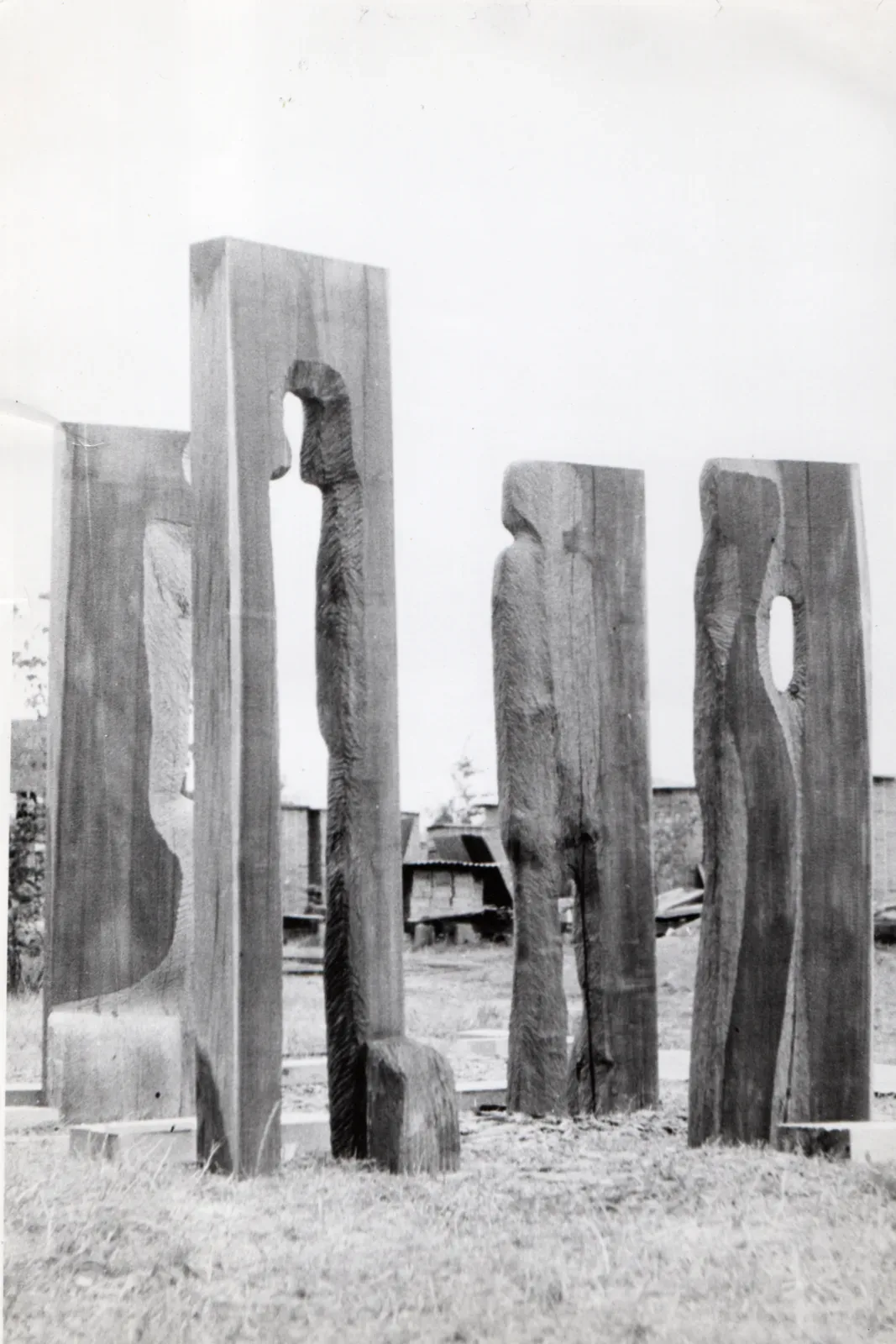
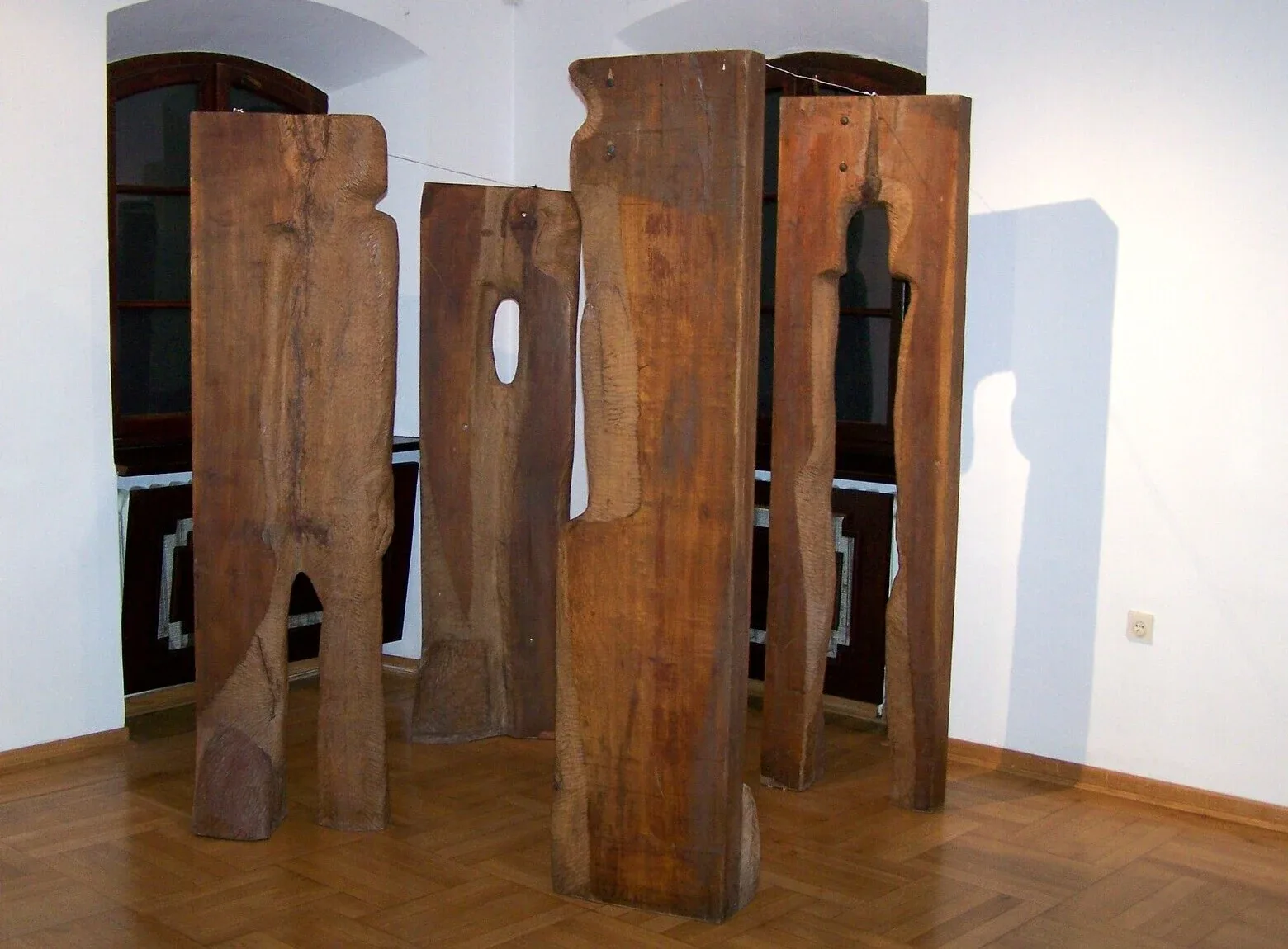
Why not Auschwitz
The artist’s words · 2009The group does not come from a commission. These are years in which the theme of martyrdom is everywhere — in the group shows, in the competitions, in the catalogues —, and forty years later, introducing her own solo exhibition, Antonina explains why she chose to steer clear of the name everyone expected.
Ciągle był to czas powojenny. Dużo było wtedy tematów, związanych z martyrologią. I żeby nie robić „Oświęcimia” […] pomyślałam o Hiroszimie. Tam też było umieranie, i tak samo były ofiary wojny. […] A mi – poprzez fakt zagłady człowieka – stała się wtedy bardzo bliska. It was still the post-war time. There were many subjects then bound up with martyrdom. And so as not to make an «Auschwitz» […] I thought of Hiroshima. There too there was dying, and there were the victims of a war just the same. […] And to me — through the fact of the annihilation of a human being — that place became very close.
The evil she speaks of has no nation and no border, and to say so the artist chooses the farthest point she knows — a city on the other side of the world, where a new weapon erased people and left their outline.
The wood says it better than stone would. The catalogue of the 1974 solo exhibition — the one closest to the work — lists mansonia and mahogany: mansonia is an African wood the trade calls African walnut, and it is almost certainly the same wood the later lists call simply walnut. It has a long, visible grain, and the silhouette taken out of it runs across that grain as a shadow runs across a wall.
Two days before
The boards on the floor · June 2008Forty years on, the group goes back on show. Three family photographs, taken two days apart, say what it means to set a sculpture made of separate pieces back on its feet.
On 21 June 2008 the boards are still lying on the floor of a gallery, side by side, the silhouettes facing upwards: seen from above they read all at once, and the absences line up like words along a line. Antonina is kneeling on the parquet, passing a cloth over them, one board at a time. She is sixty-five, and the wood she is cleaning she carved forty years before.
Two days later, at two in the afternoon, the boards are standing in the corner of the gallery, drawn up together the way people stand together in a queue.
-
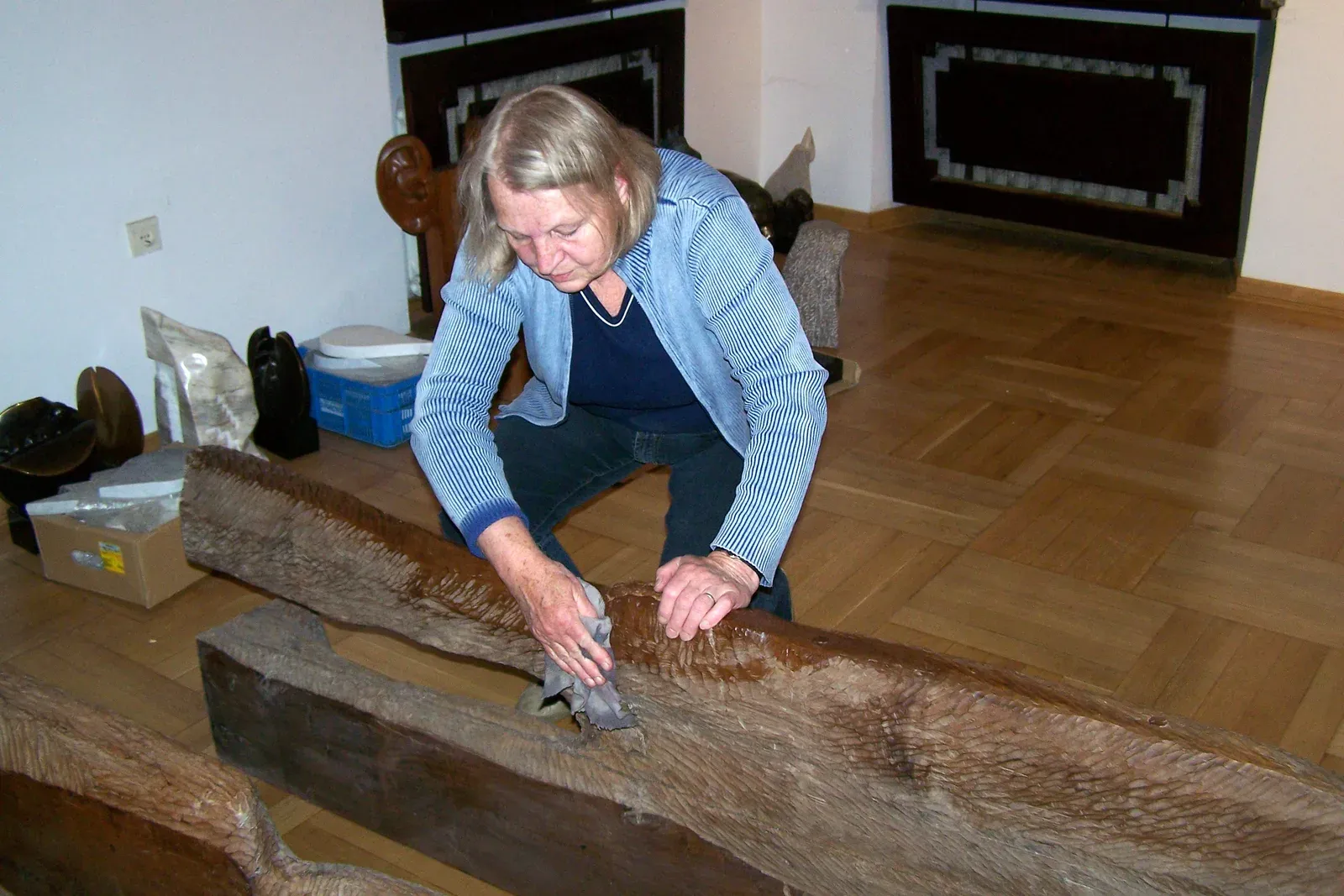
21 June. One board at a time, with a cloth. -
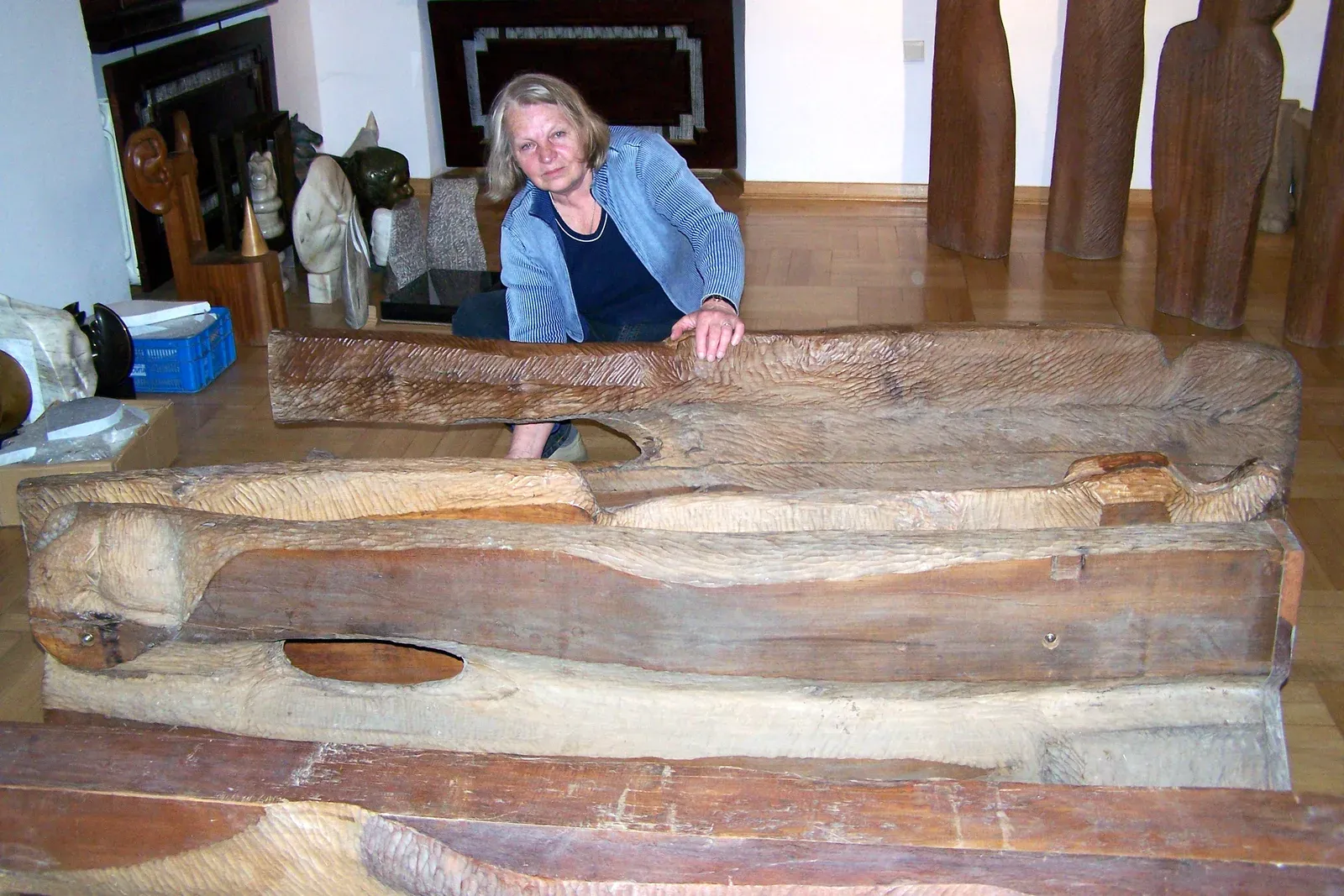
21 June. The group on the floor; at the back, the first boards are already standing. -
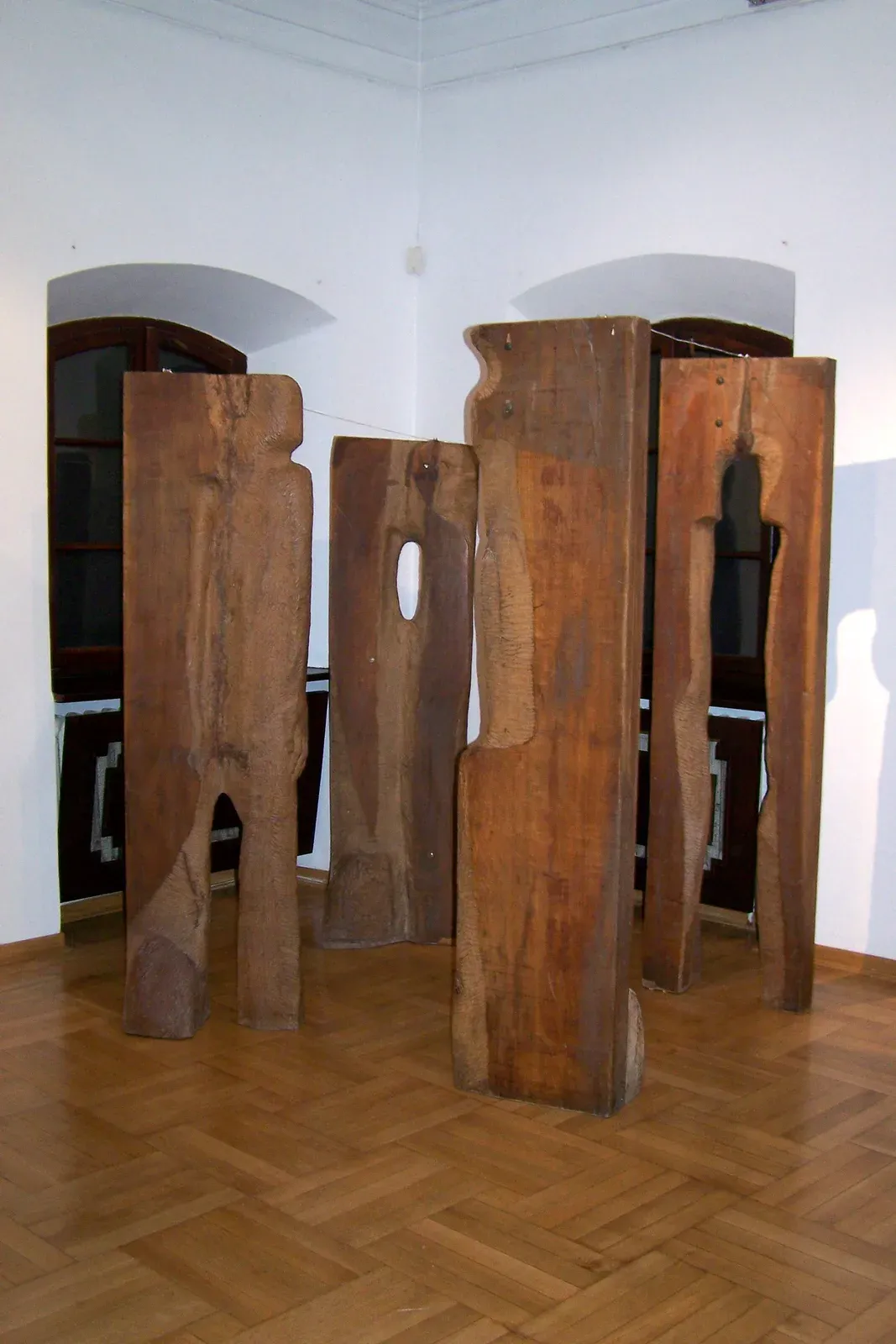
23 June. Standing in the corner of the gallery, one against the other.
The negatives
What the critics read · 2011In 2011, introducing the Orońsko solo exhibition, the curator returns to the group and gives it the most precise reading that has been written: she says what those missing silhouettes are, exactly — and why they are silent instead of crying out.
Tam, na miejscu, po wielkim wybuchu, zostały cienie ludzi, którzy wyparowali. Artystka ślady po nich odcisnęła w fakturze drewna – to negatywy postaci […], krzyczące swoim tragizmem mocniej niż dynamiczna ekspresja. There, on the spot, after the great explosion, the shadows of the people who had evaporated remained. The artist has pressed their traces into the grain of the wood — they are negatives of figures […], crying out their tragedy more loudly than any dynamic expression.
It is the exact reverse of the craft: a sculptor adds a figure to the world, and here the figure is subtracted. The group is looked at in a row, and in a row the absences line up like a crowd that is no longer there — the same idea as Wygnanie, where a crowd walks, turned to the negative.
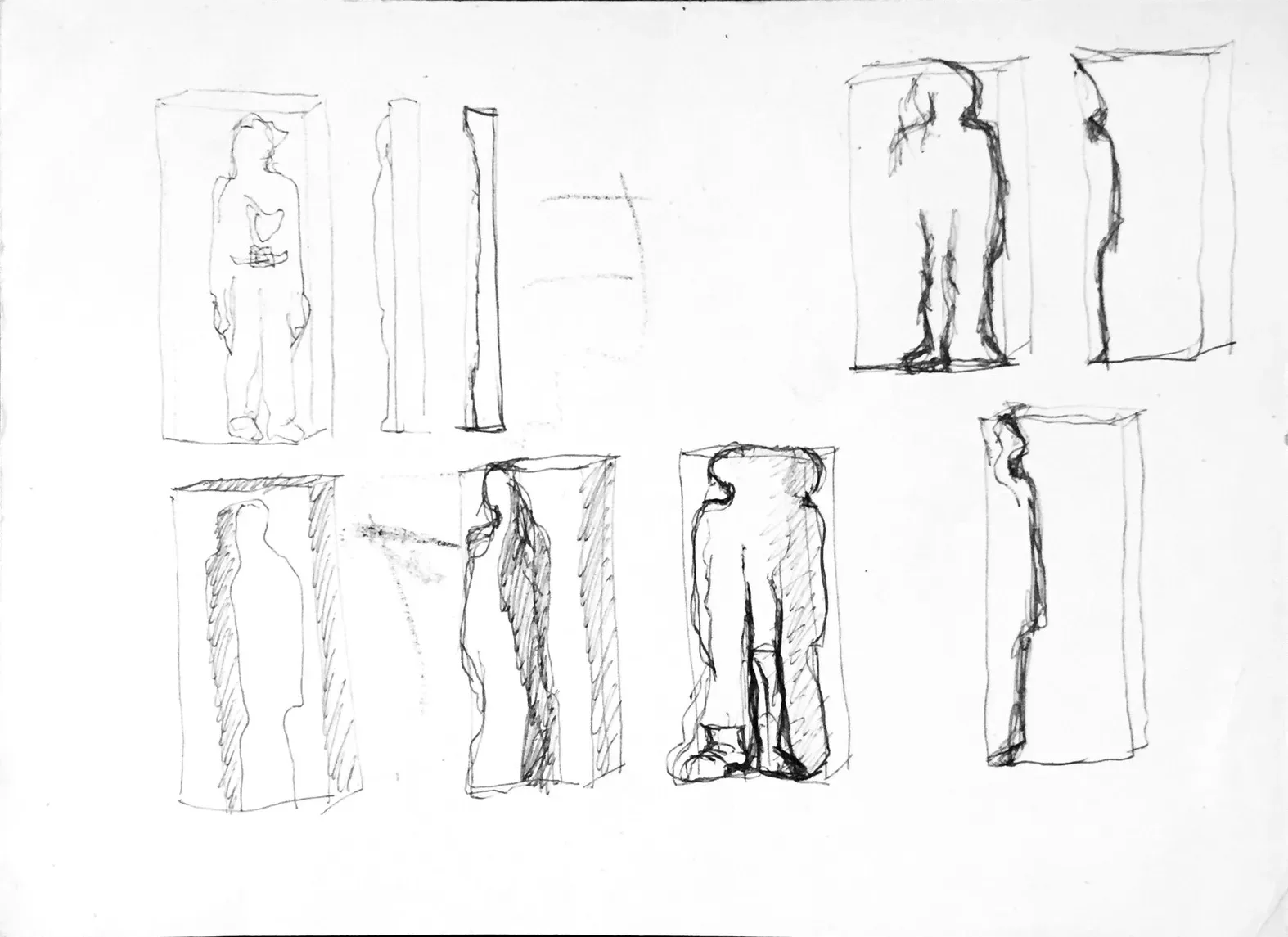
That passage exists on paper too. A sheet in ballpoint runs through it in nine studies set out in rows: it begins with a standing figure inside a rectangular opening, drawn in outline; then the figure thins and the block turns on its corner to show its own thickness; at the end the body is no longer drawn — it is left white, and what is densely hatched is the wood all around it.
The sheet carries no date and does not say which of the two groups it is looking at: the subtraction is the same here and in Wygnanie. The only reason to read it beside these boards is that in all nine studies the rectangle stays — whereas in Wygnanie the slab ends by taking on the outline of the figure itself, and the feet come away and go to the ground.
- Stara Kordegarda solo exhibition · warsaw, 1974
- «Przemijanie» regional museum · siedlce, 2009
- «Zatrzymana w drodze» centrum rzeźby polskiej · orońsko, 2011
The documented exhibitions of the group: the Warsaw solo exhibition of 1974, which prints its materials and dimensions for the first time, and the two large solo exhibitions of 2009 and 2011. The work is today in the museum at Siedlce.