Matka z książką
Mother with a book · stainless steel, 1979 · two scales
A seated figure reduced to a slab and a ribbon of steel: behind, a tall vertical plane; in front, a surface that ripples like a body in profile, with an empty circle in place of the head; below, the lap, and on the lap two books.
Two versions of 1979 exist, and they are the same thing at two scales: one for the table, which lives at home and goes to the exhibitions; the other at the scale of the square, which since 1979 has stood before the municipal library of Mielec and has never moved.
The model
The indoor version, in polished stainless steel: the design entire, at table scale.
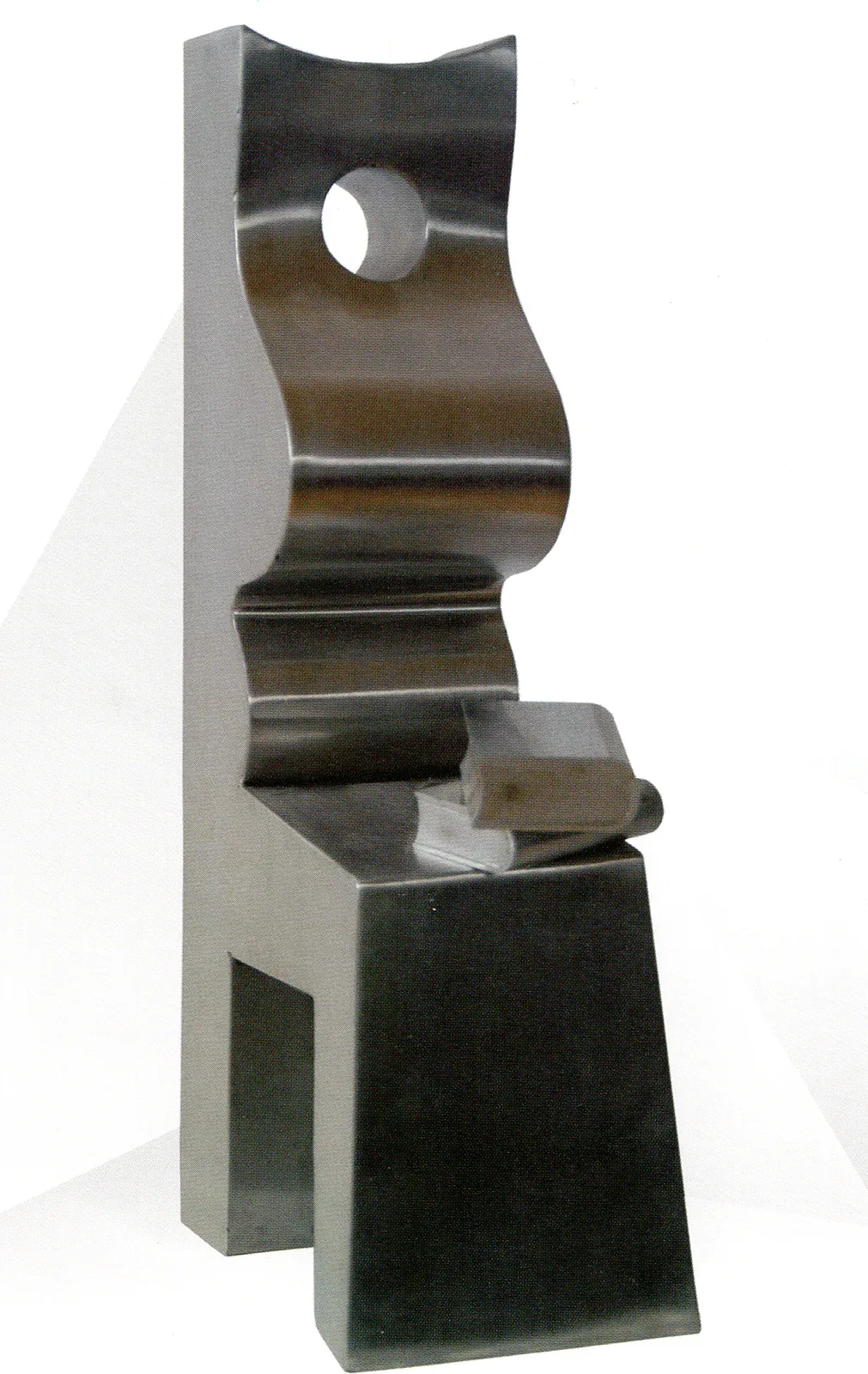
Photograph: family archive.
The book, and the steel
The two choices that hold the workIn the figure nothing can be recognised: not a face, not a hand, not a fold of cloth. The head is a hole, the body a wave, the legs a trapezoid. The only thing rendered for what it is are the books: two volumes resting on the lap, with the spine, the cut of the pages and the protruding cover.
It is a way of working that returns in these years: a form kept abstract and, within it, a single thing carved from life. In 1970 it is a child seated in a mahogany recess, in 1977 two human ears at the top of a board; here it is two books, and they stand before a library.
The second choice is the material. Stainless steel appears in the whole catalogue only here: everywhere else Antonina works wood, stone, bronze, plaster. For a work that must stand in a square and has no carved surface to show, steel does something none of those materials would do — it reflects the sky and the green around it, and changes with the light of the day.
The monument
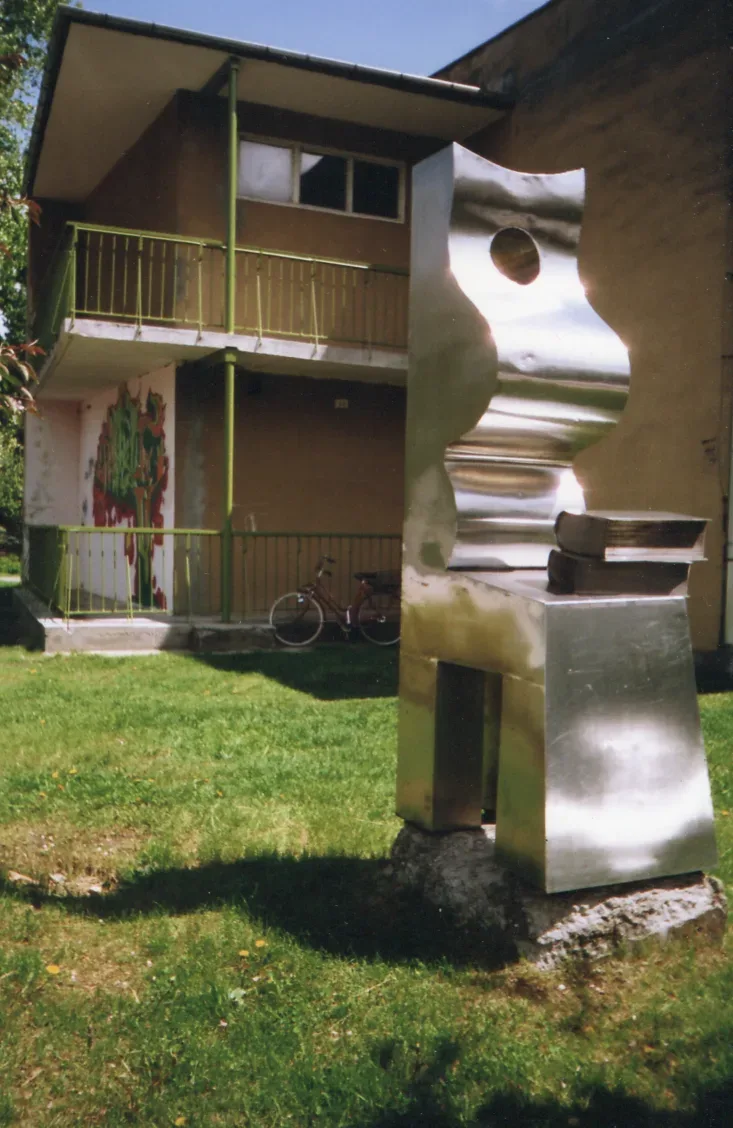
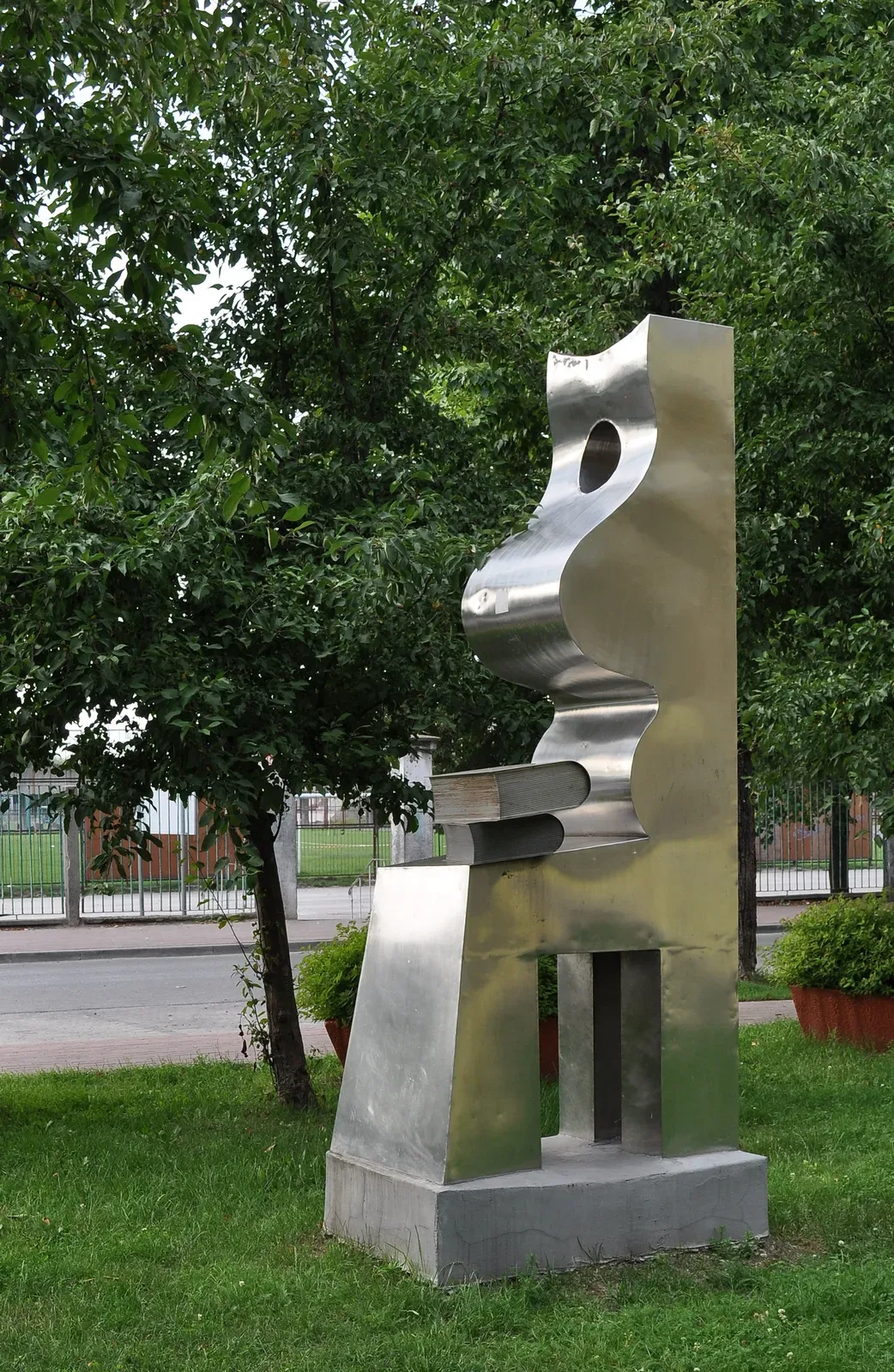
Mielec, the library squareThe same design, brought to the scale of the square. At Mielec the figure rests on a block of rough, barely squared stone, which lifts it from the lawn: the polished steel against the living stone, and it is the work’s only contrast of materials.
At the scale of the square the profile does a different job. Up close, on the table, it reads as a figure; from afar, amid the grass and the cars, it reads first as a seated silhouette and then as a chair — and the books remain the signal that says what this is about.
The two photographs the archive keeps take it from two sides and at two moments. In one, from the family archive and undated, the sculpture stands beside a low building with a green railing and a bicycle leaning on the wall; in the other, from July 2011, it is on the lawn among the flowering trees, with the cars parked behind. The steel, in between, has not changed.
One of the six
The list written in her own handTowards the end of the eighties Antonina fills in two questionnaires — one French, one for an international yearbook — and in both there is the same question: where can her works be seen. She answers with a list of six places.
They are the Ujazdowski Park of Warsaw for «Ab ovo», the Treptower Park of Berlin for «Zbliżenie», Hoyerswerda and the Rostock zoo for the two «Civilisations», the hall of the Polish embassy in Moscow for the relief of the eagle — and the library of Mielec, for the mother with the book. Six works in four countries, written by hand in her own script.
The model, meanwhile, keeps travelling: in 1980 it goes to «Dialog», the exhibition joining Warsaw and Berlin; around 1988 it is in Kraków; in 2009 it is still in a showcase in Siedlce. The monument, no: it has stayed where it was set.