XXV lat TPSP
The medal of the twenty-fifth year · Warsaw, 1984
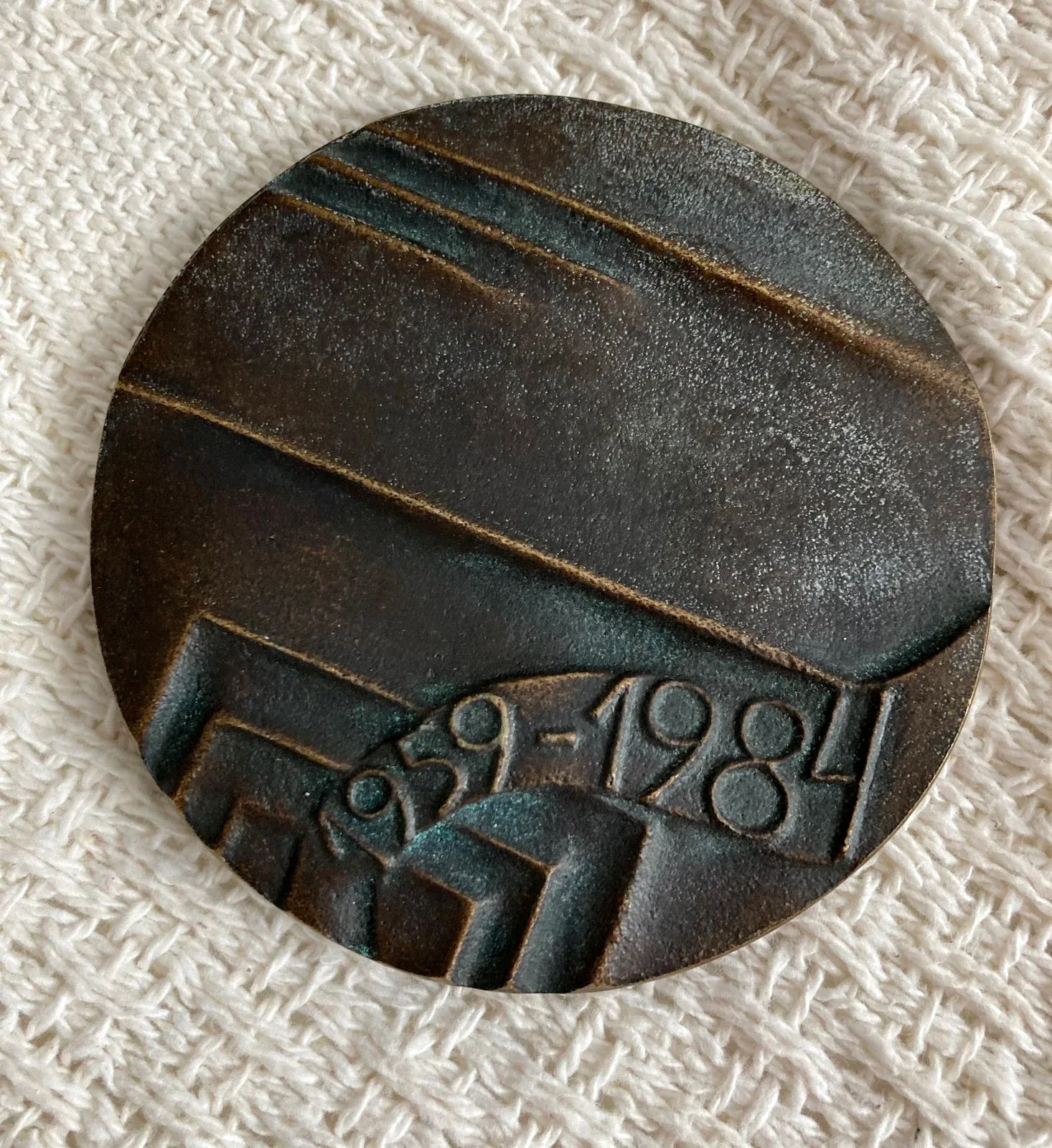
A disc of bronze as wide as a palm. Above, long parallel bands cross the field diagonally, like strata or like the folds of a ribbon; below, a meander of square steps descends to the right, and across the field runs a wavy ribbon carrying a double date in relief: 1959 – 1984. It is the medal for the twenty-five years of the Society of Friends of the Fine Arts in Warsaw.
Antonina made medals all her life — she begins as a student, winning a competition in her fifth year — but of almost all of them the piece alone survives. Of this one everything survives: the scrap of paper where the idea first appears, the eleven trials, the two finished versions, the caption the artist writes in her own hand beneath a card. It is the only case in the whole archive in which one can stand and watch a form while it is being searched for.
The work
The face that was photographed: the bands above, the stepped meander below, and on the ribbon the two dates that give the anniversary.
Photograph: the family archive.
November 1983
The client, and a medal received earlierThe Towarzystwo Przyjaciół Sztuk Pięknych — the Society of Friends of the Fine Arts — is the association that holds artists, collectors and public together in Warsaw: it organises exhibitions, awards prizes, buys works. In 1984 it turns twenty-five and has a medal struck for it.
When the commission comes, Antonina has already had two dealings with this Society. In 1974 her solo exhibition at the Stara Kordegarda receives the Society’s prize for the best exhibition of the year. And in December 1979, for its twentieth anniversary, the Society presents her with its own medal: that time she receives one. Four years later it falls to her to design one.
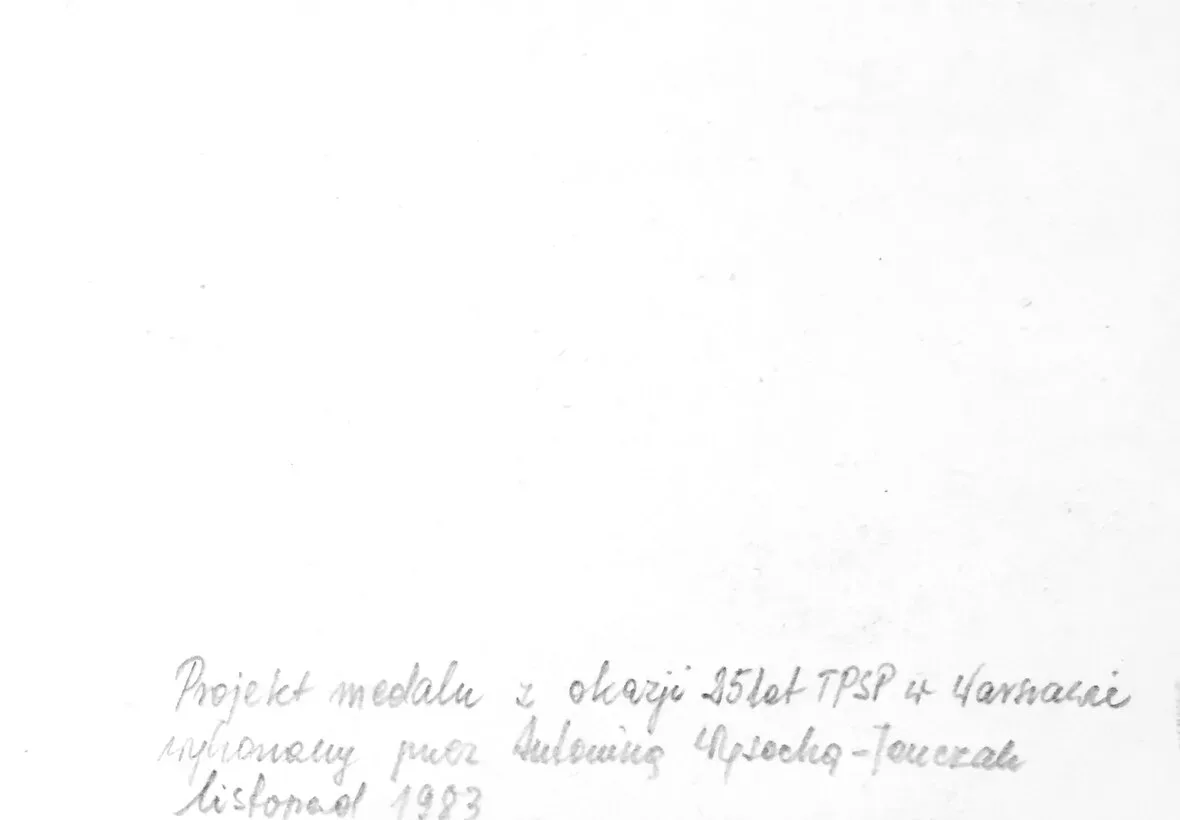
On two cards the artist writes in pencil, in the third person, what those sheets are: «Projekt medalu z okazji 25 lat TPSP w Warszawie / wykonany przez Antoninę Wysocką-Jonczak» — a design for a medal for the 25 years of the TPSP in Warsaw, made by Antonina Wysocka-Jonczak. On one of the two there is also the month, and it is what dates all the rest: November 1983. The bronze will bear the following year.
An eye, eleven times
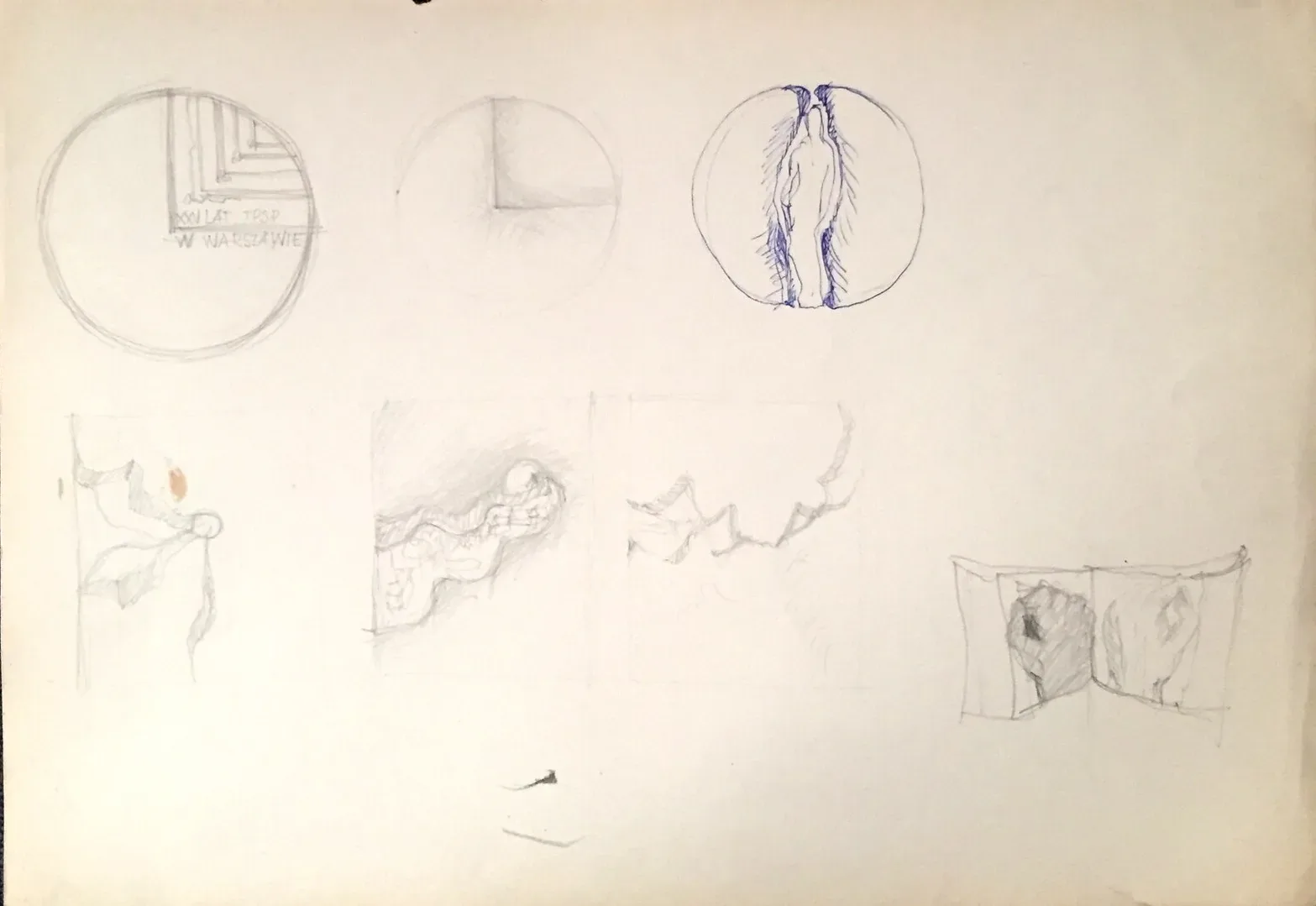
The working sheets · November 1983The first idea sits on a poor scrap of paper: three roundels traced in light pencil, one below the other, and on the topmost a diagonal ribbon carrying the two dates. There is nothing yet to choose between — there is a format and a figure.
On a second sheet the roads become three, and they are very far apart. One roundel carries a square spiral sinking into the field, like a stair seen from above, with the inscription on the step. Another reduces everything to an edge and a shadow. The third, gone over in blue ballpoint, sets at the centre a standing human figure between two wings of dense hatching.
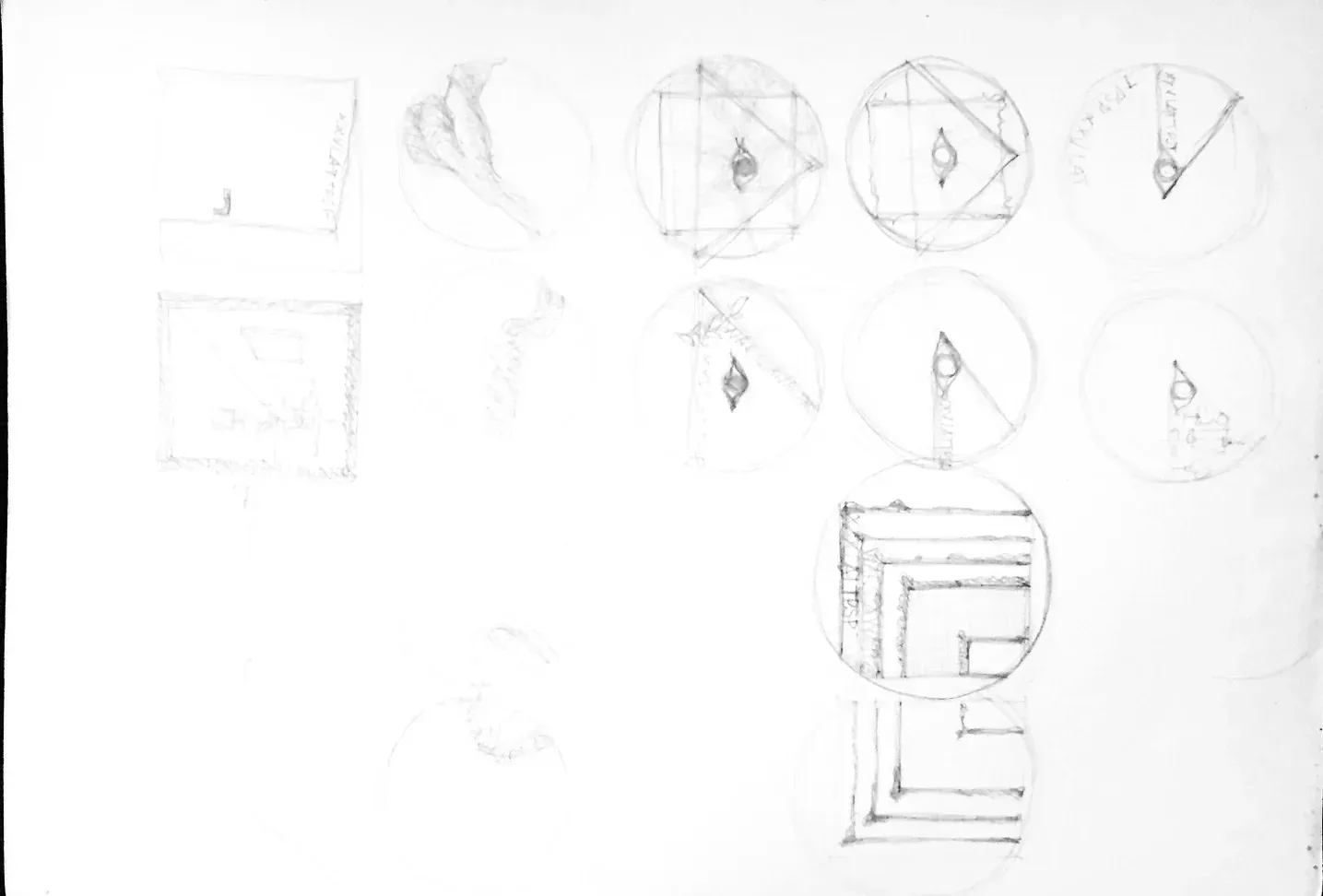
Then comes the sheet that says how she worked. Eleven roundels, all in the palest pencil, and in at least six of them the same thing: an almond with a dot at its centre, inscribed in a square or a lozenge — an eye reduced to geometry. The frame changes, the tilt changes, the place of the inscription changes; the eye stays.
It is not a motif born there. Twelve years earlier, designing the medal for the twentieth anniversary of a scientific publishing house, Antonina had already set an eye in the field of the roundel.
The one cast, and the one not
Two complete versionsIn the end the finished versions are two, and each of them stands entire on a single sheet. One has to know how to read those sheets to see it: on each there are two roundels, side by side, and the text is shared between them as on a real medal — the inscription on one face, the dates on the other. They are not two variants set against one another: they are the obverse and reverse of the same piece.
The first version is the one we know. Parallel bands, a square meander, and the undulating ribbon crossing the field, carrying on one face «XXV LAT TPSP W WARSZAWIE» and on the other «1959 - 1984». The bronze that was photographed is the right-hand disc of that sheet; the face it is missing is drawn beside it, on the same sheet.
The second is beautiful in another way. The two faces are modelled in pencil until they look like metal already: six fleshy lobes, swollen with light, open around the centre like petals or like eyelids, and in the middle there is a half-closed human eye, drawn entire — the lid, the iris, the cut. Below, in an arc, the same inscription; on the other face, the same dates.
Of this version no casting is known. It is the more resolved of the two, and it is the one that stayed on paper: the Society received the medal with the bands, and the eye remained a drawing.
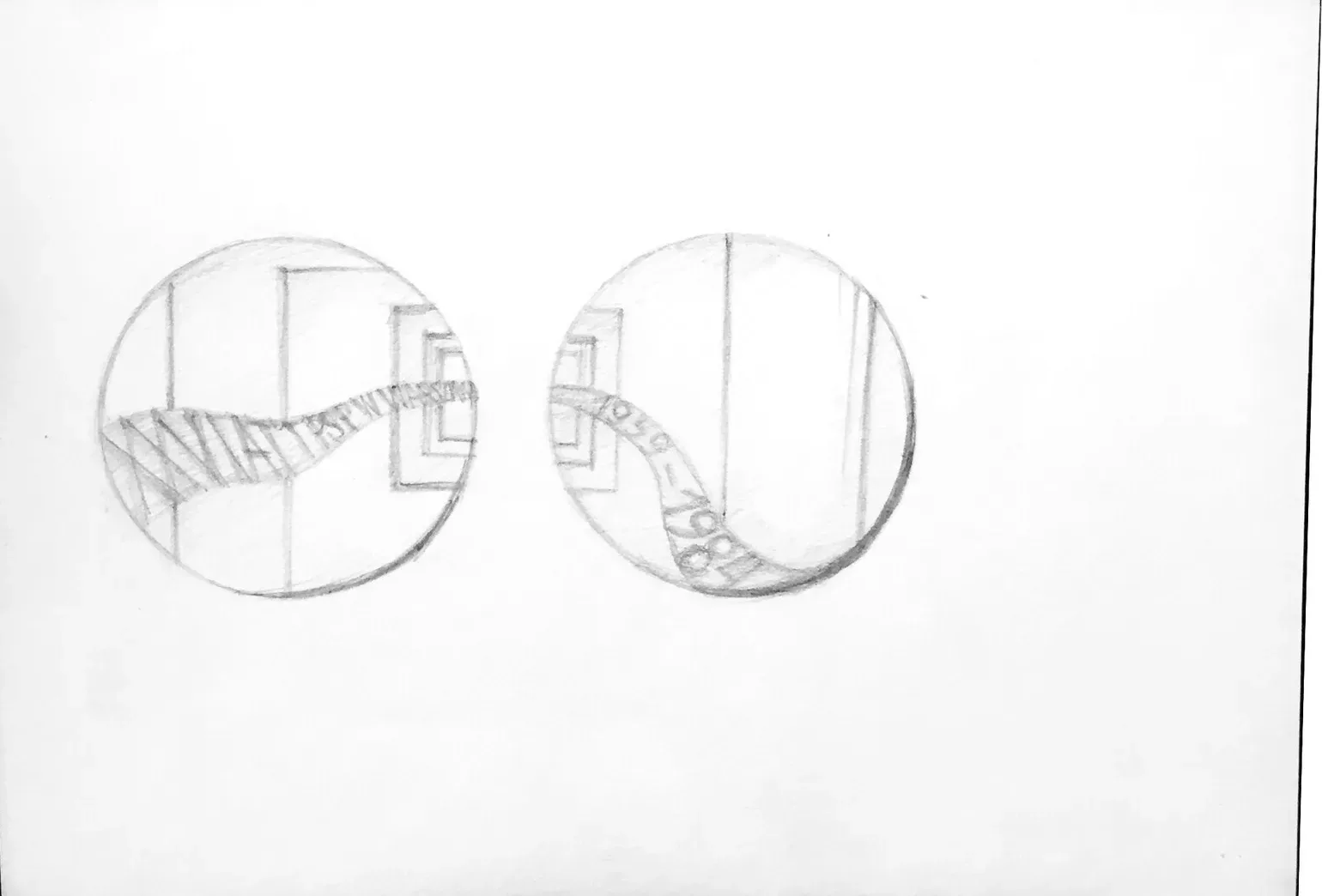
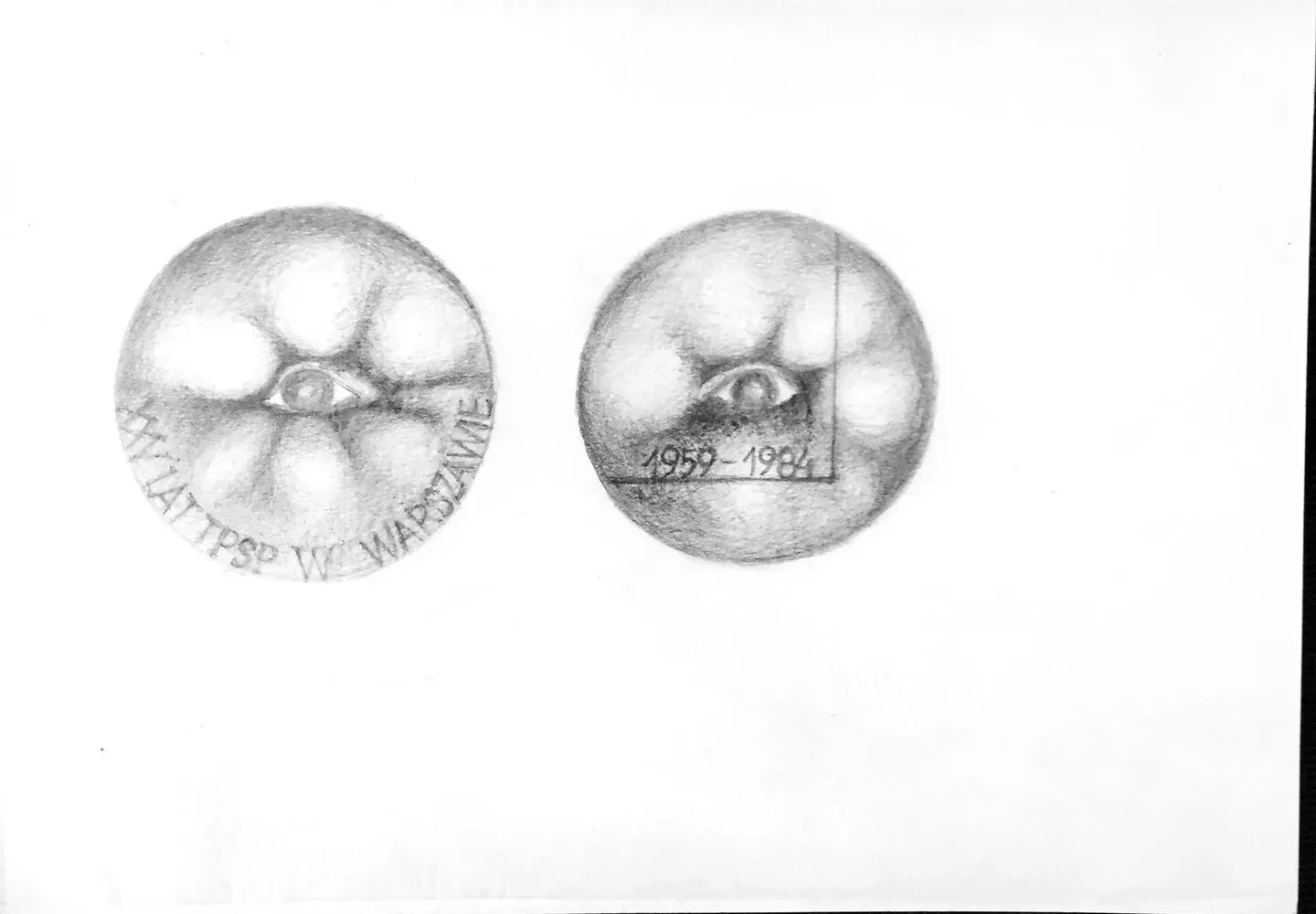
The medal was going to a society of people who look at pictures. Which of the two faces said so better was decided by whoever commissioned it.