Pomnik Hymnu Narodowego
Winning design · plac Dąbrowskiego, Warsaw, 1999
Four offset forms rising in a spiral like banners taken by the wind; on the second the inscription runs along an undulating line, as though the cloth were moving it; from the last, at the top, an eagle with a crown emerges. Inside the bronze, a carillon: every day, at a fixed hour, the monument would have played the *Mazurek Dąbrowskiego*.
The design by Henryka Strąk and Antonina Wysocka-Jonczak won the competition for the Monument to the National Anthem, to be raised in plac Dąbrowskiego, in the centre of Warsaw. On 29 September 1999 the foundation stone was laid. The monument was never built.
The model
Of the monument one thing alone exists: the plaster model, photographed by the newspapers in the days of the ceremony. Here it is taken on the square, in front of the musicians in historical uniform, and in the studio, in the hands of one of its two authors.
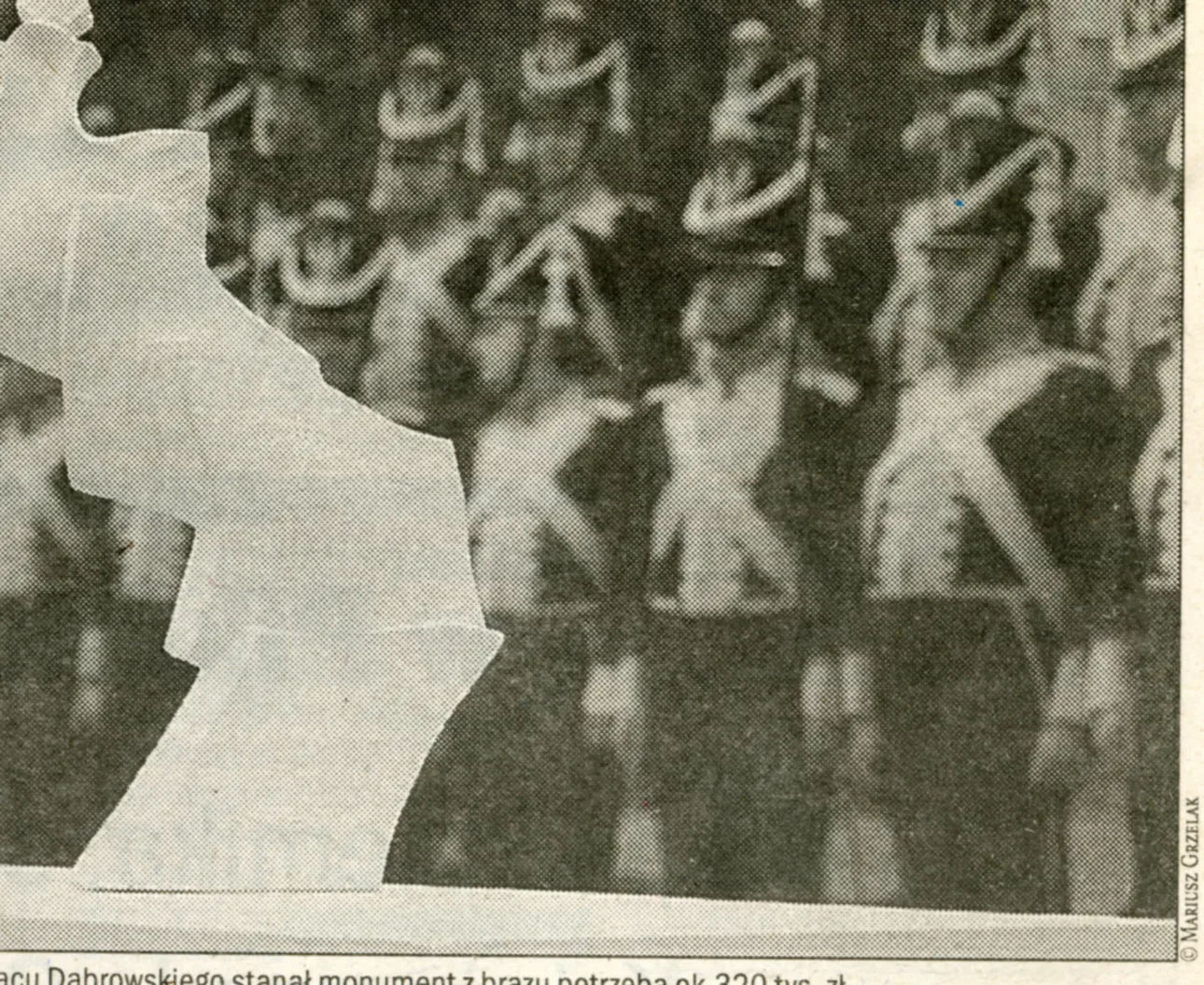
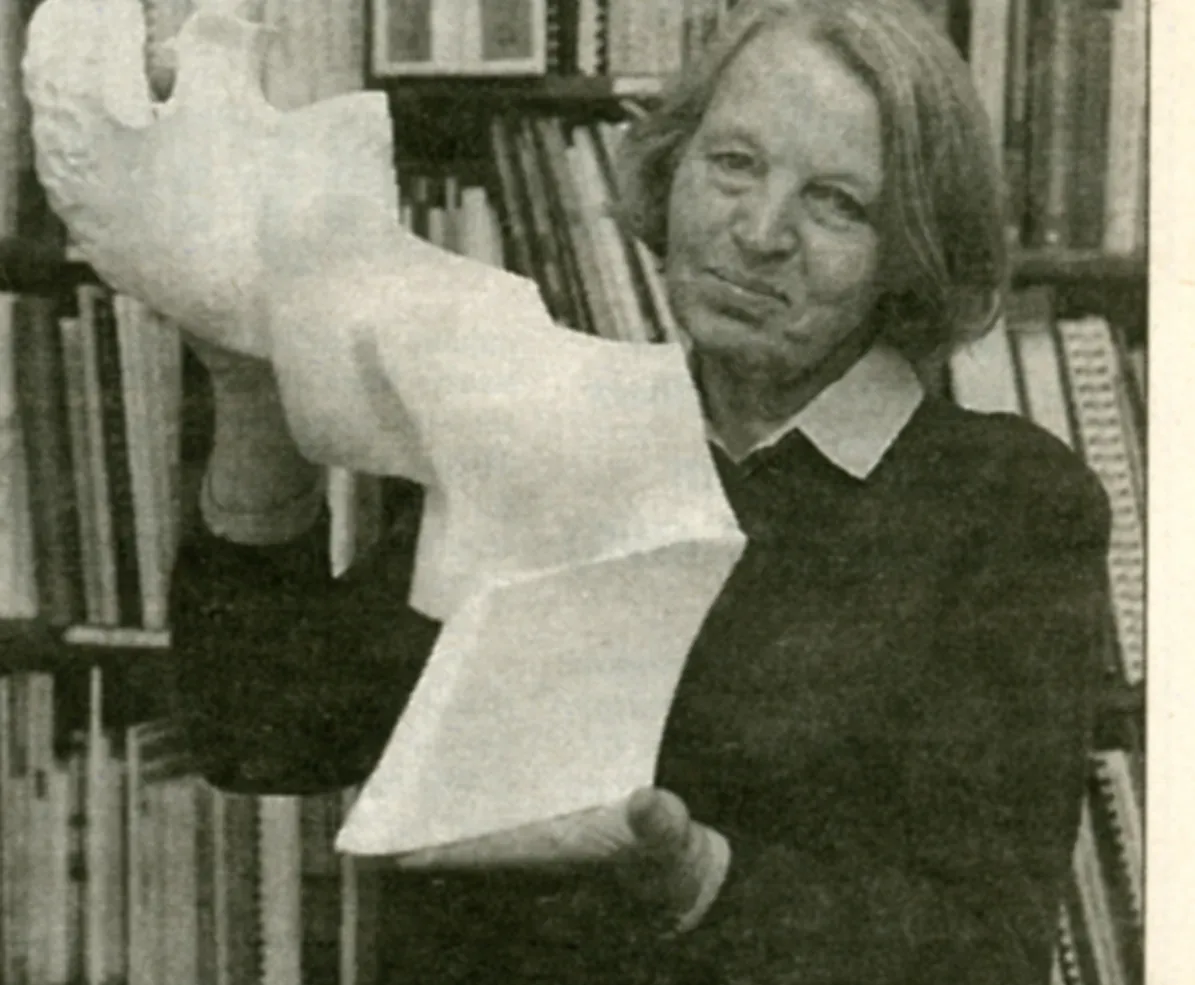
Four banners and an eagle
The competition, and the project report signed by both authorsThe monument reaches plac Dąbrowskiego by elimination. The Society had wanted to raise it on the axis of the Tomb of the Unknown Soldier, and the provincial conservator of monuments said no; it then proposed a tall spire with the eagle at its summit, and it was the councillors of the Centrum district who would not have it. Only afterwards, a little over a year before the ceremony, was this square named — and for the square a sculpture competition was announced.
Ten designs arrived. The jury, chaired by Cezary Leżeński, vice-president of the Society, chose the one by Henryka Strąk and Antonina Wysocka-Jonczak, and said why: they are banners rising upward, crowned by the eagle, and the conception is beautiful, simple and light, modern and expressive. Three designs were commended, and set in a row they show what set the two sculptors’ monument apart: a carved spire by Tadeusz Łodziana, with an eagle gripping the medallion bearing Wybicki’s portrait; a triumphal arch by Waldemar Raniszewski; and a figure of Józef Wybicki, from the waist up, growing out of the plinth, by Kazimierz Ryszko. Three monuments that depict; the fourth, the one that won, depicts nothing — it sets a movement on its feet.
The archive keeps the typescript in which the two authors describe the work for the competition, signed at the foot by both of them beneath the word «Autorki». It is the document that says, in a few lines, everything the monument was to have been.
The four forms are banners climbing; along the second runs the inscription, bent into a wave so that it should look as if it were stirring; the last draws the eagle with the crown. On the first, at the back, two stanzas of the anthem were to go — and the small plates of those who had paid. Bronze, cast. Around it, a pavement of granite setts twelve by twenty, with a band of black granite marking the perimeter. The lighting, what was already there, plus a few small spots.
The press added the rest: four and a half metres, the text of the anthem reproduced from Józef Wybicki’s manuscript, and the inscription «To Józef Wybicki, author of the National Anthem, on the bicentenary of the Mazurka of Dąbrowski — the Society». Inside the bronze an electronic music box with a loudspeaker was to stand: «it will be the only monument that plays», one of the promoters told the reporter, and every day at noon it would strike up the *Mazurek*.
Antonina explained the form in a single sentence, which the paper printed beneath her photograph: the monument will seem to be rising. And of the eagle born from the last banner she said that it is the Polish spirit, the one that through the Mazurka of Dąbrowski released a strength in the people. To another reporter she put it in a way that holds for all her sculpture: the point was to give an image to the metaphor of the Mazurka of Dąbrowski, the one that gave independence its shape.
POMNIK — jest opracowaniem symbolicznym, składa się z czterech form przesuniętych tworzących spirale, które przedstawiają sztandary pnące się w górę. […] Ostatnia forma zarysowuje kształt orła z koroną i jest odniesieniem do ducha polskości. THE MONUMENT is a symbolic treatment, composed of four offset forms that make a spiral and represent banners climbing upward. […] The last form sketches the shape of an eagle with a crown and is a reference to the Polish spirit.
The twenty-ninth of September
The laying of the foundation stone, 1999At three in the afternoon of 29 September 1999, in plac Dąbrowskiego, before a few hundred people, the foundation stone was set with the act of foundation inside it. The plaster model stood beside it, so that the rest could be imagined.
-
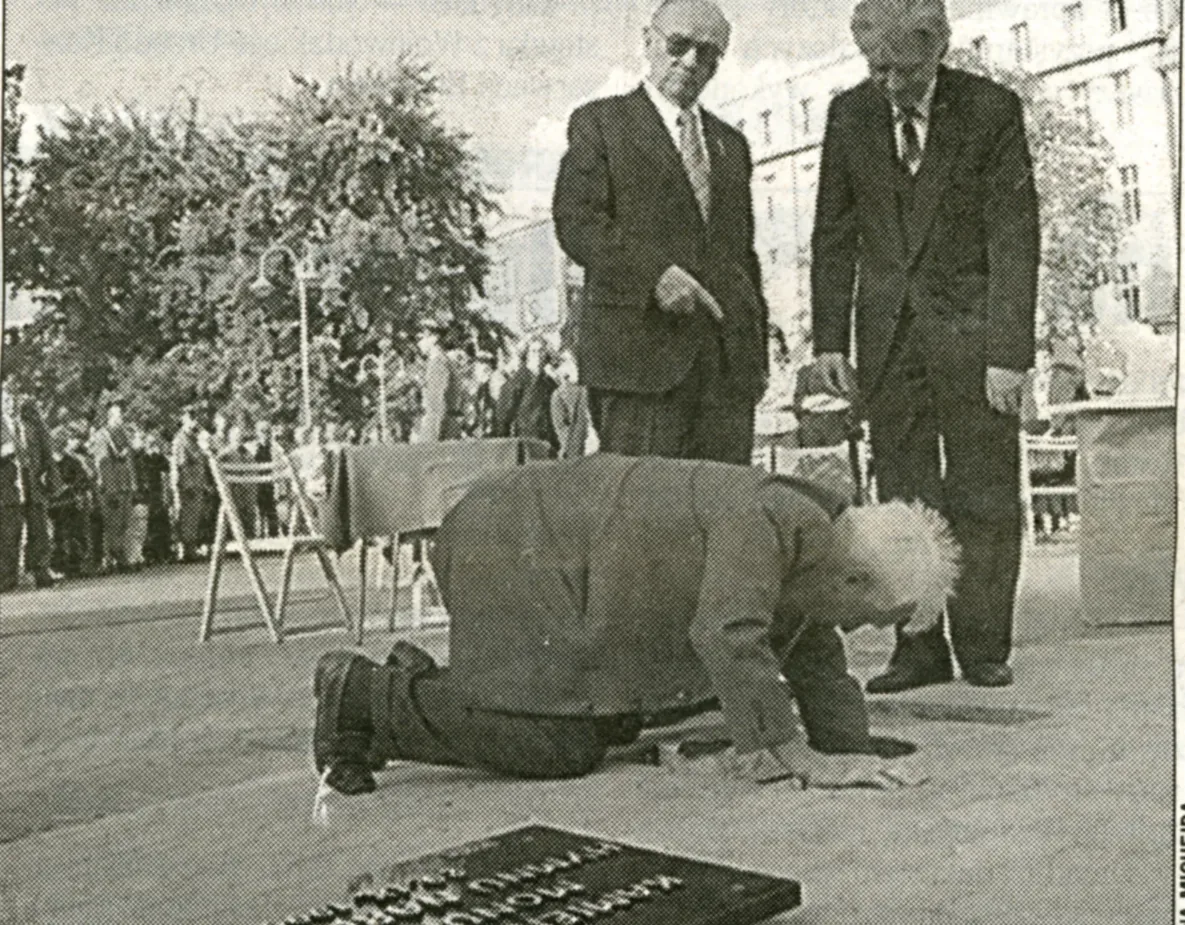
The laying of the stone: the bronze letters of the inscription, still loose, waiting to be fixed. -
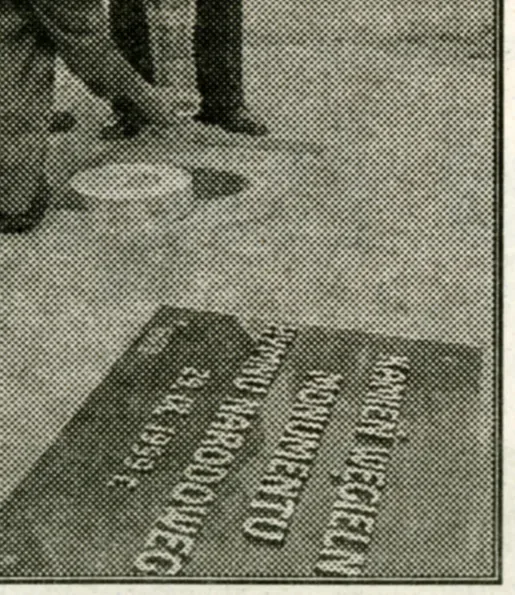
The stone, finished: «Kamień węgielny monumentu Hymnu Narodowego · 29 IX 1999».
The Representative Orchestra of the Polish Army and the Central Artistic Ensemble played; the stone was blessed by Father Jerzy Syryjczyk, vicar general to the military bishop. The surround of the stone and the niche that holds the act were made by the soldiers of the 2nd Masovian Engineer Brigade. It was set in place by those who had fought for the monument for years: Zbigniew Nosek, president of the Society, Janusz Osiński, his deputy, and Mieczysław Lewandowski, commissioner of the competition.
Among the few hundred people on the square the reporter stopped one woman, Regina Bardzan, who told him one thing only: when she went to school, before the war, every day began with the singing of the anthem, and so it was until 1939. It is the only voice from the public that survives of that afternoon, and it is the reason they were standing there.
The act of foundation lists the whole of Poland looking on — the Pope, the President of the Republic, the Marshal of the Sejm, the Prime Minister, the mayor of Warsaw — and defines the work: the monument is to be a symbol of all the Polish surges towards freedom, from the Constitution of 3 May 1791 to the years of Solidarność, and a homage to the author of the song, Józef Wybicki, and to those generations who by the sacrifice of their lives and by their work carried that Song Full of Homeland through to the times of a free and independent Poland.
The chronicle of the following day came out under a two-word headline: «Stanie pomnik». The monument will rise. In the article the spokesman of the Society said that the design, fortunately, aroused no controversy, and that the unveiling was expected in November 2000. Construction was estimated at between three hundred and twenty and four hundred thousand złoty, and the bank account for donations was printed in the papers.
What is there today
plac Dąbrowskiego, the southern partThe Society did not manage to raise the money, and it ended with the foundation stone. November 2000 passed, and then all the others. There is no monument to the national anthem in plac Dąbrowskiego.
In the southern part of the square a slab remains, its inscription by now ruined, saying that on this spot, on 29 September 1999, the foundation stone of a monument to the national anthem was set. It is all of this work that one can go and see: a piece of stone announcing something that never came.
There remains too, in the archive, the sheet on which the two authors describe it, with the two signatures at the foot; and there remain the photographs of the plaster model, barely longer than an arm, which in the days of the ceremony the newspapers set beside the military band and in the hands of the woman who had made it. Of all the works in the catalogue this is the only one whose form, whose size, whose material and whose sound we know exactly — and which never existed.