Pomnik Nauczycieli
Monument to the Teachers of the Clandestine Schooling 1939–1945 · Warsaw
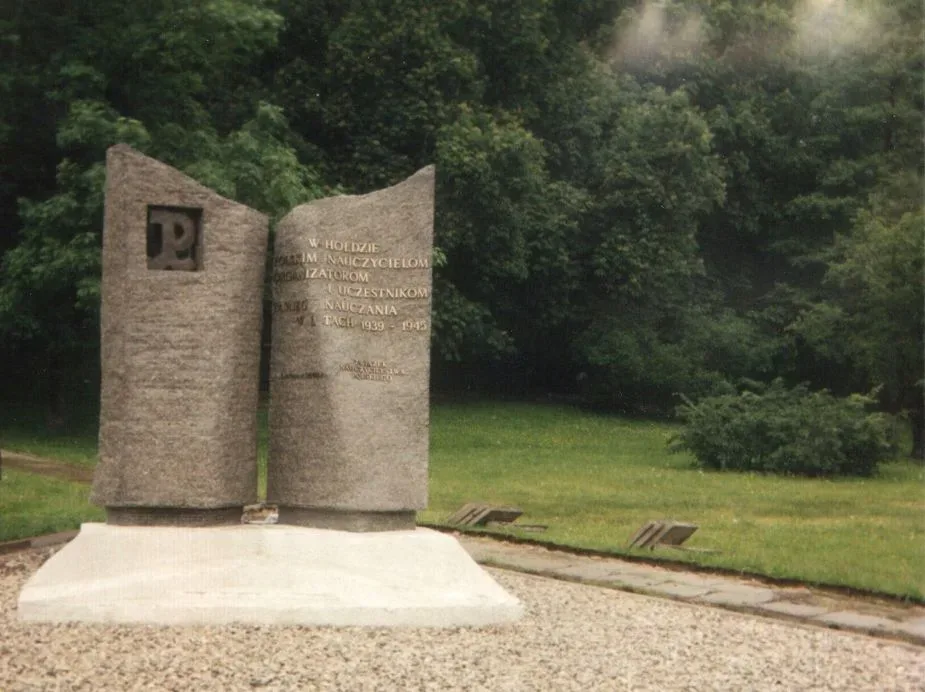
In Park Kazimierzowski, below the escarpment that runs down towards the Vistula, two slabs of granite stand open like the pages of a book three metres tall. A window is cut into the left-hand page; in the window, in black granite, the sign of Fighting Poland. It is the monument to the Polish teachers of the clandestine schooling, and Antonina signs the design and follows its execution, from the stonemason’s workshop to the setting in the park.
This is the first monographic room of the archive: the work whose arc survives most completely — the competition, the study sheets, the photographs of the worksite, the chronicle of the unveiling. A story that can be told from beginning to end.
The monument
The open book of granite, photographed from the front: the window with the black sign inside it, the gilded inscription on the right-hand page.
The window
Occupied Warsaw · 1939–1945With the occupation, the Polish school officially ceases to exist: schools closed in the territories annexed to the Reich, secondary schools and universities suppressed in the General Government. In October 1939 the teachers answer by founding the Tajna Organizacja Nauczycielska, the clandestine organisation which, within the Polish Underground State, organises the komplety — the hidden classes — in almost every province. Teaching is forbidden; they teach anyway. Nearly ten thousand teachers pay for it with their lives.
The lessons are held in private homes, and the homes speak a code: the position of a curtain, a vase moved on a windowsill tell the pupils whether it is safe to come. It is this signal the monument carves — in the open book of knowledge, a window cut clean through; and inside the window, the black sign of Fighting Poland.
The design is hers. The idea comes from Jerzy Szczurowski, son of a TON instructor; the commissioning body is the Polish Teachers’ Union; the funds are raised by a national committee chaired by Jerzy Wiśniewski, and paid in large part by the teachers themselves. The motif has a name, which the artist writes in her own hand on the study sheets: okno — the window. She will go on numbering its variants for years, long after the monument is standing.
From the design phase there survives a handwritten report, in block capitals throughout. In it Antonina fixes the place — the small square on Browarna street, with access from Wiślana and the view of the escarpment —, the 1:10 scale model, the dimensions, the materials, the granite slabs for the surrounding ground. Then she describes the form:
Pomnik jest opracowaniem symbolicznym, przedstawia okno, z ułożonymi książkami tworzącymi literę V, w środku litery V umieszczony jest znak Polski Walczącej. The monument is a symbolic composition: it represents a window, with books arranged to form the letter V, and at the centre of the V is placed the sign of Fighting Poland.
The window is there, and so is the sign. The books arranged in a V are not: the executed monument is an open exercise book, and the window is a square opening cut into the page. Between the sheet and the granite the form simplifies — the signal stays, the letter falls away.
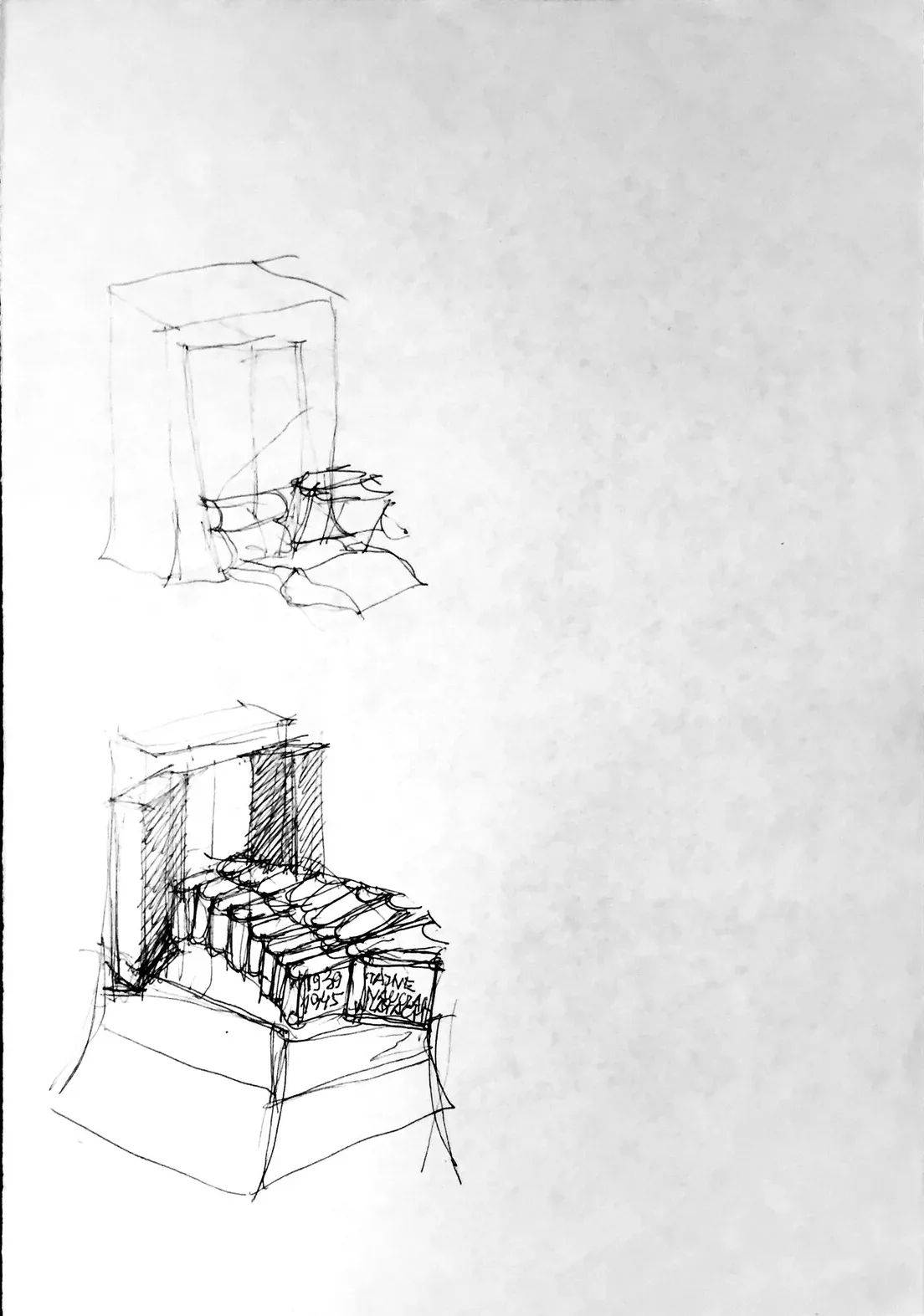
Of the same form there is also a drawing, in ballpoint, on an undated sheet. Below, a squared stele cut by a slit that opens it from side to side; in front of the slit, on a shelf, a row of books lying one beside the other; and on the front of the shelf two inscribed panels — in the first «1939 1945», in the second «TAJNE NAUCZA…», the third line written over the second and now illegible. Above, the same idea, barely sketched.
There is the window, there are the books, and there is the inscription exactly on the plinth, where the report says it must stand. There is no letter: the books still lie in a row. Whether the sheet comes before the report or stands beside it as a variant cannot be proven; what can be seen is that the form passes through at least three states — and that the open exercise book of the granite is in neither of the first two.
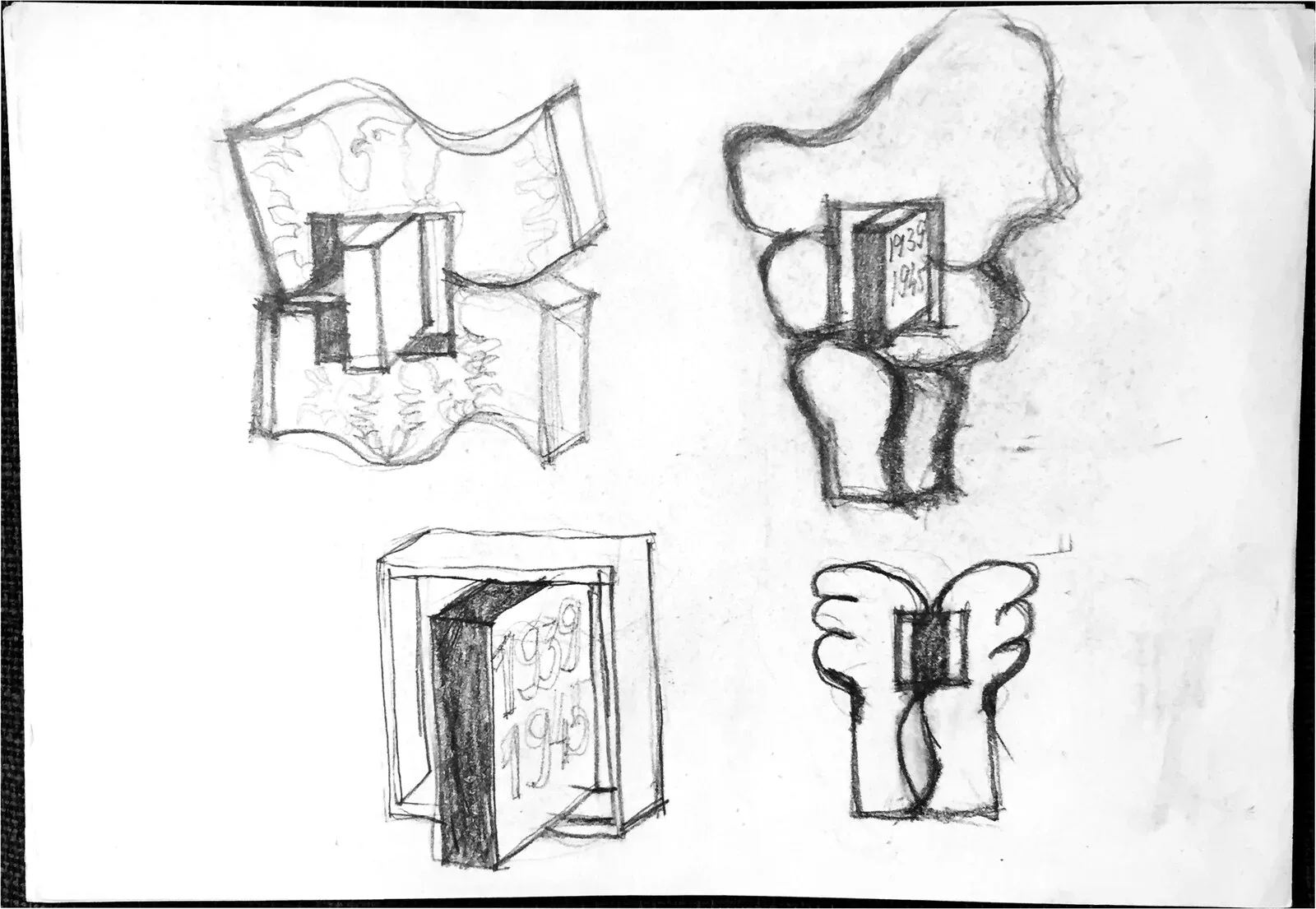
The same search is tried four times on a second sheet, in pencil. Four different monuments — a boulder with an irregular outline, a slab rippled like a page, a squared frame, two hands facing each other — and in all four, at the centre, a rectangular opening cut clean through, with an open book inside. On two of the four, the dates are written on the book’s pages: 1939, 1945.
In the granite the book will become the monument itself, and the window will open in its left-hand page. But the three elements are already all here, on a single sheet.
W HOŁDZIEPOLSKIM NAUCZYCIELOMORGANIZATOROM I UCZESTNIKOMTAJNEGO NAUCZANIAW LATACH 1939–1945ZWIĄZEK NAUCZYCIELSTWA POLSKIEGOLISTOPAD 2000
The worksite
Autumn 2000The family archive keeps the photographs of the execution: the workshop where the pages take shape and the letters are gilded, the journey, the crane lowering the stele into the park. Antonina follows every step.
-
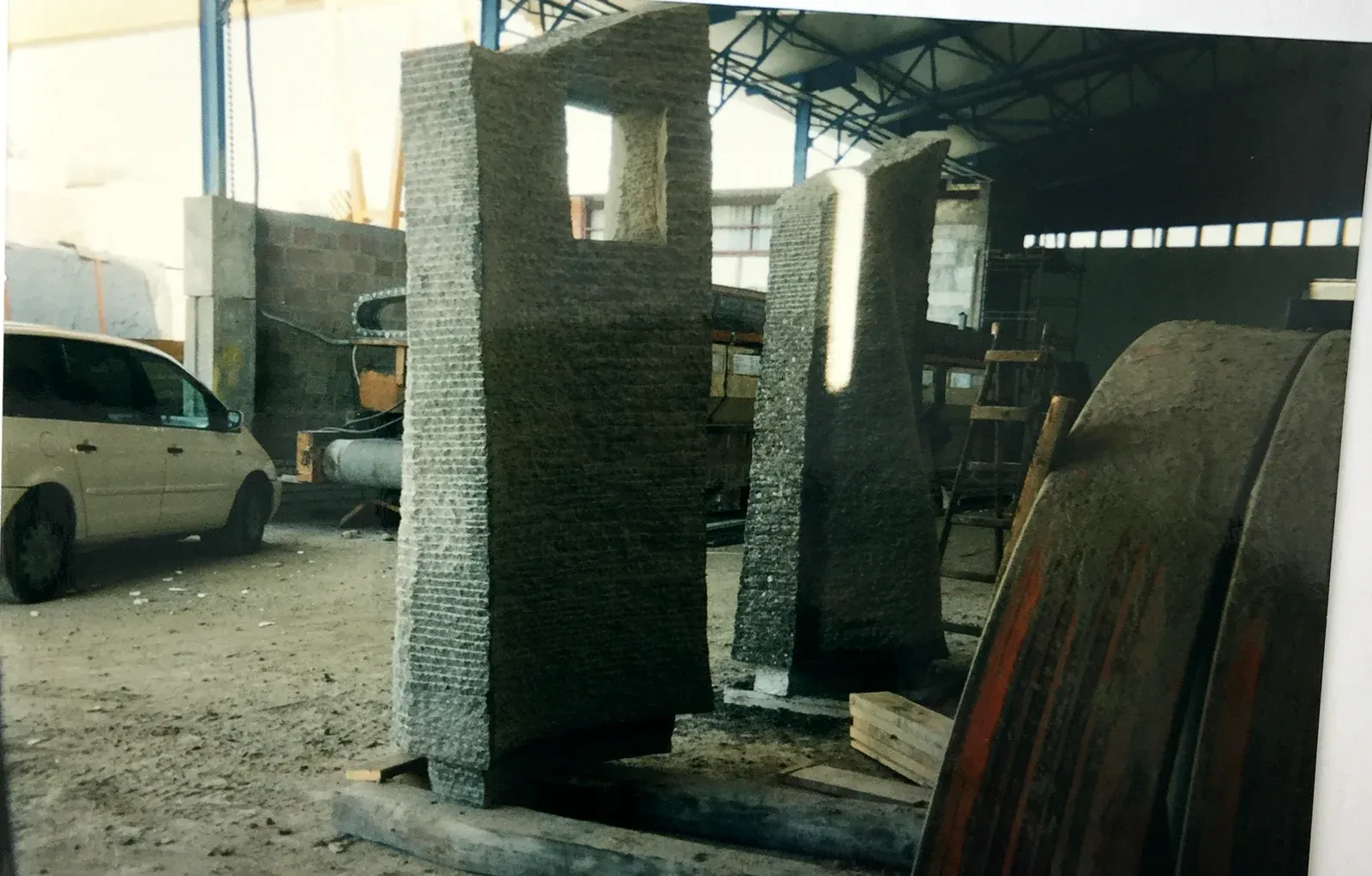
The two granite pages in the workshop, the window already opened in the slab. -
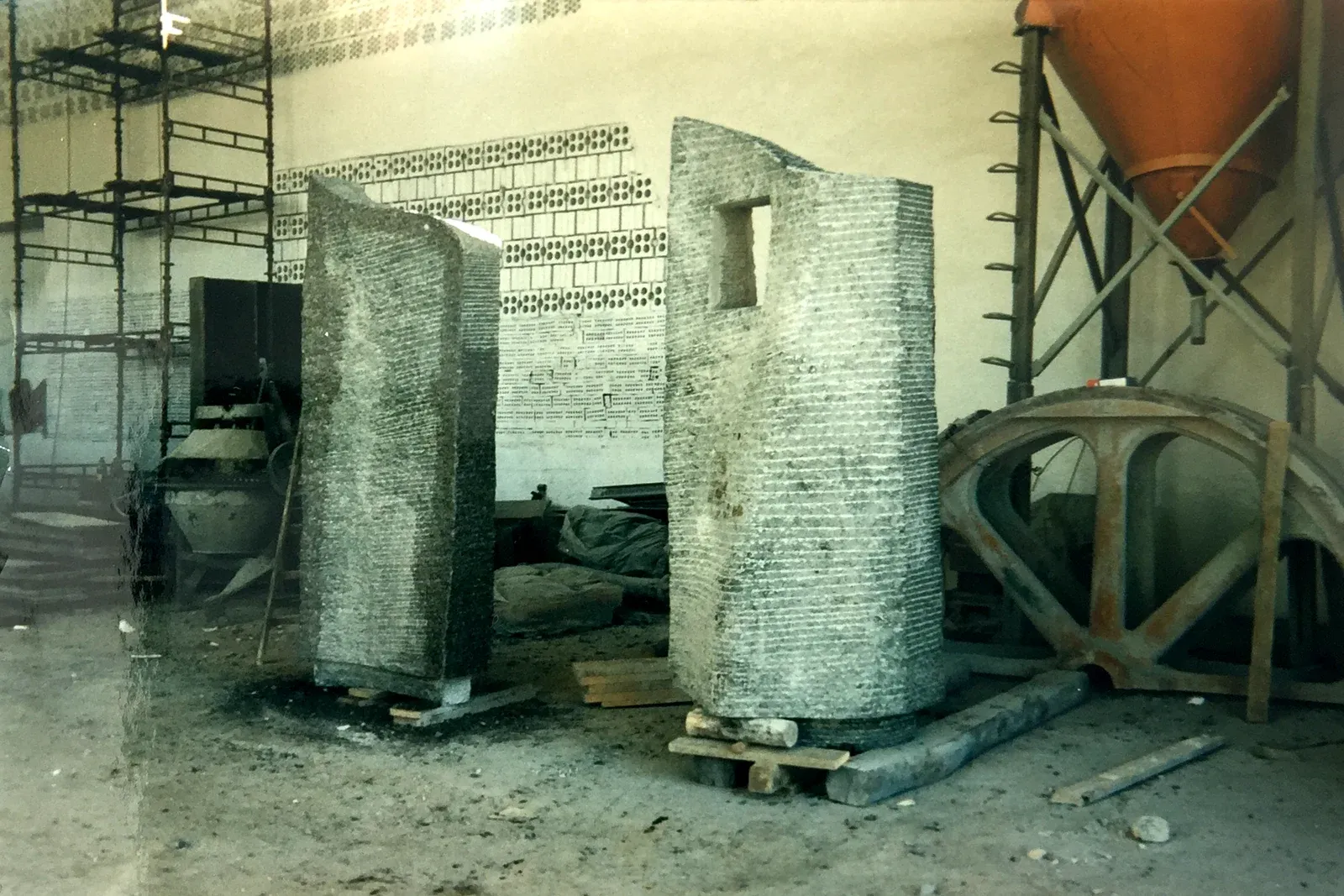
The two granite pages side by side in the workshop, being finished. -
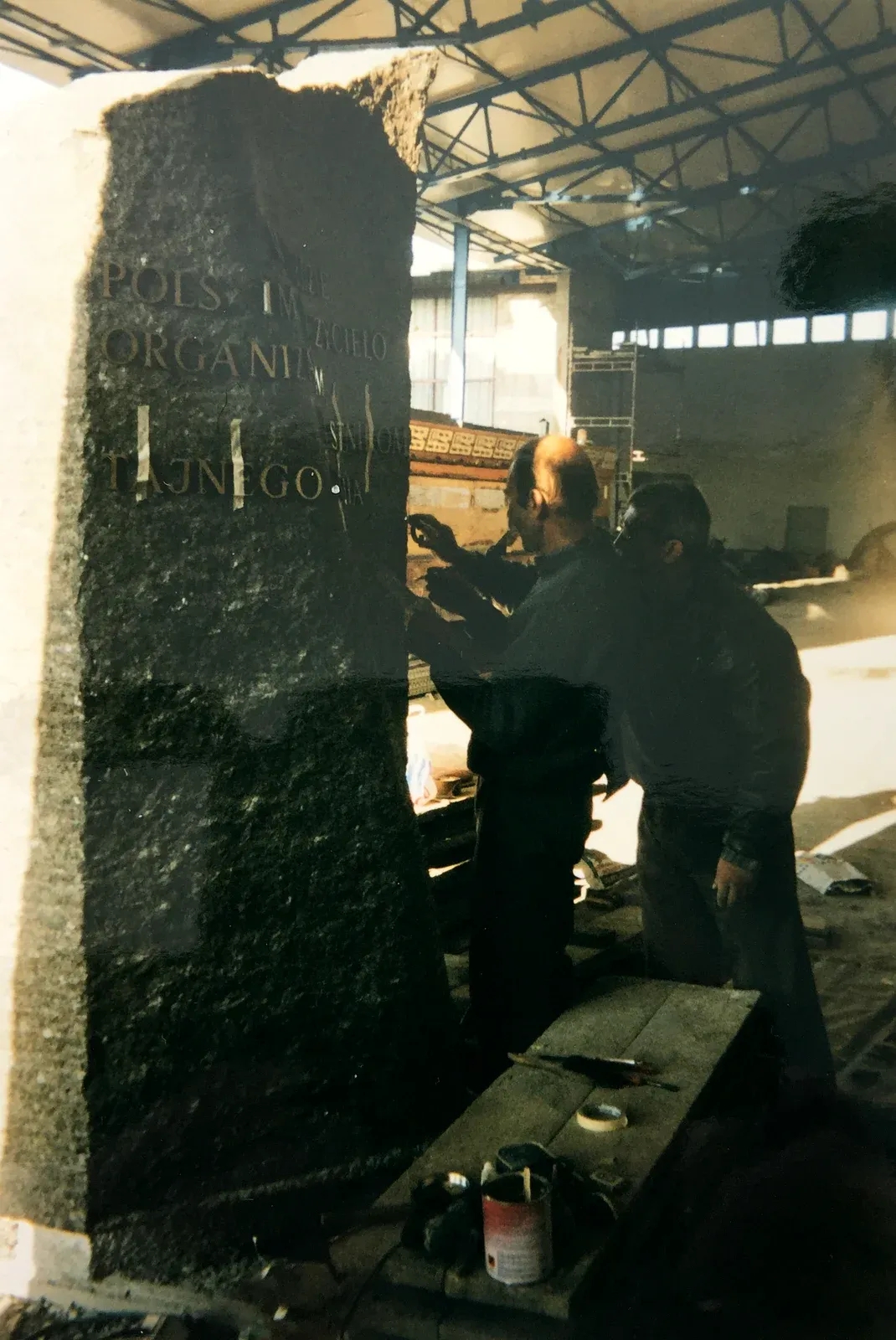
The black granite stele standing: the letters are being gilded. -
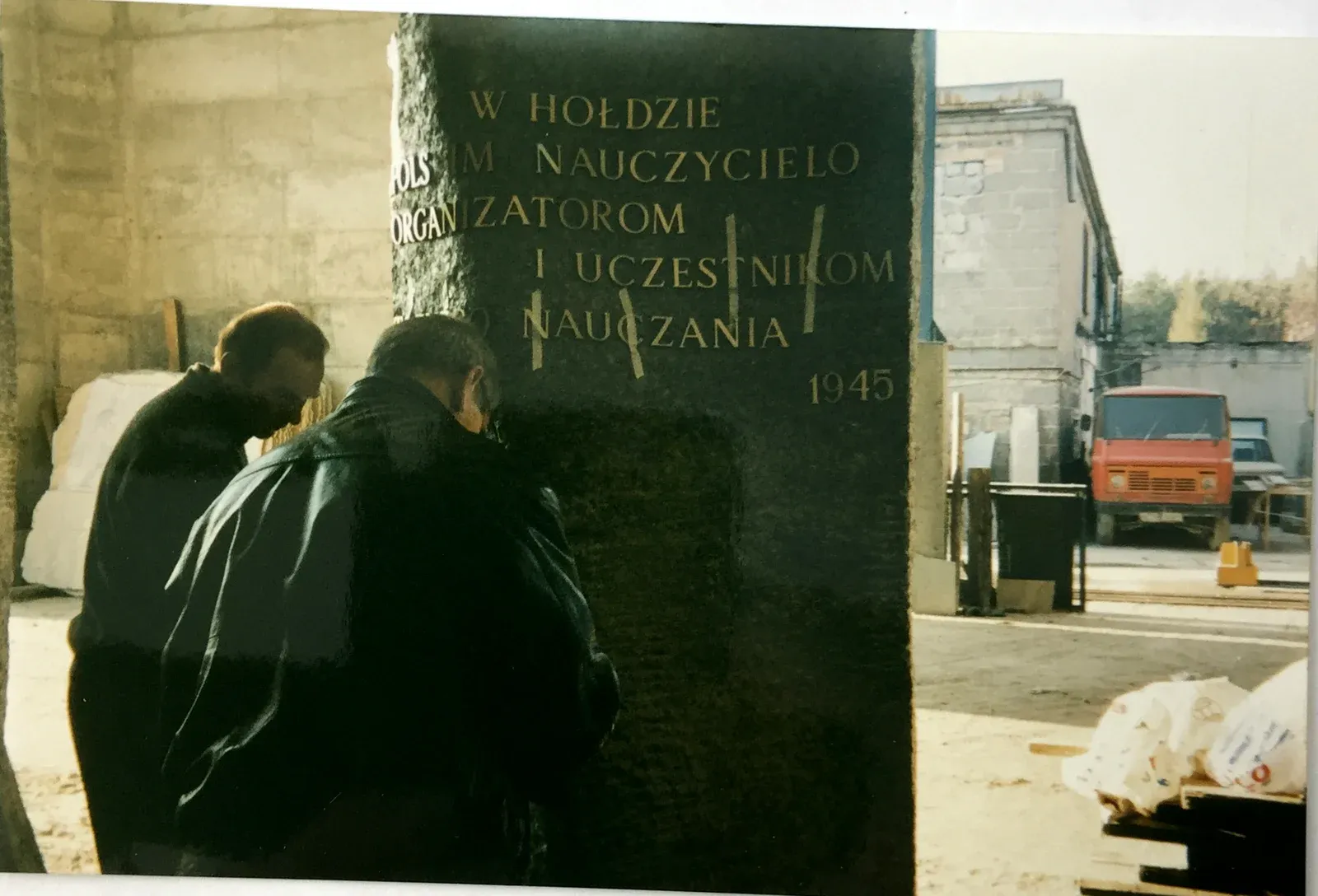
The inscription «W hołdzie…» takes the gold, letter by letter. -
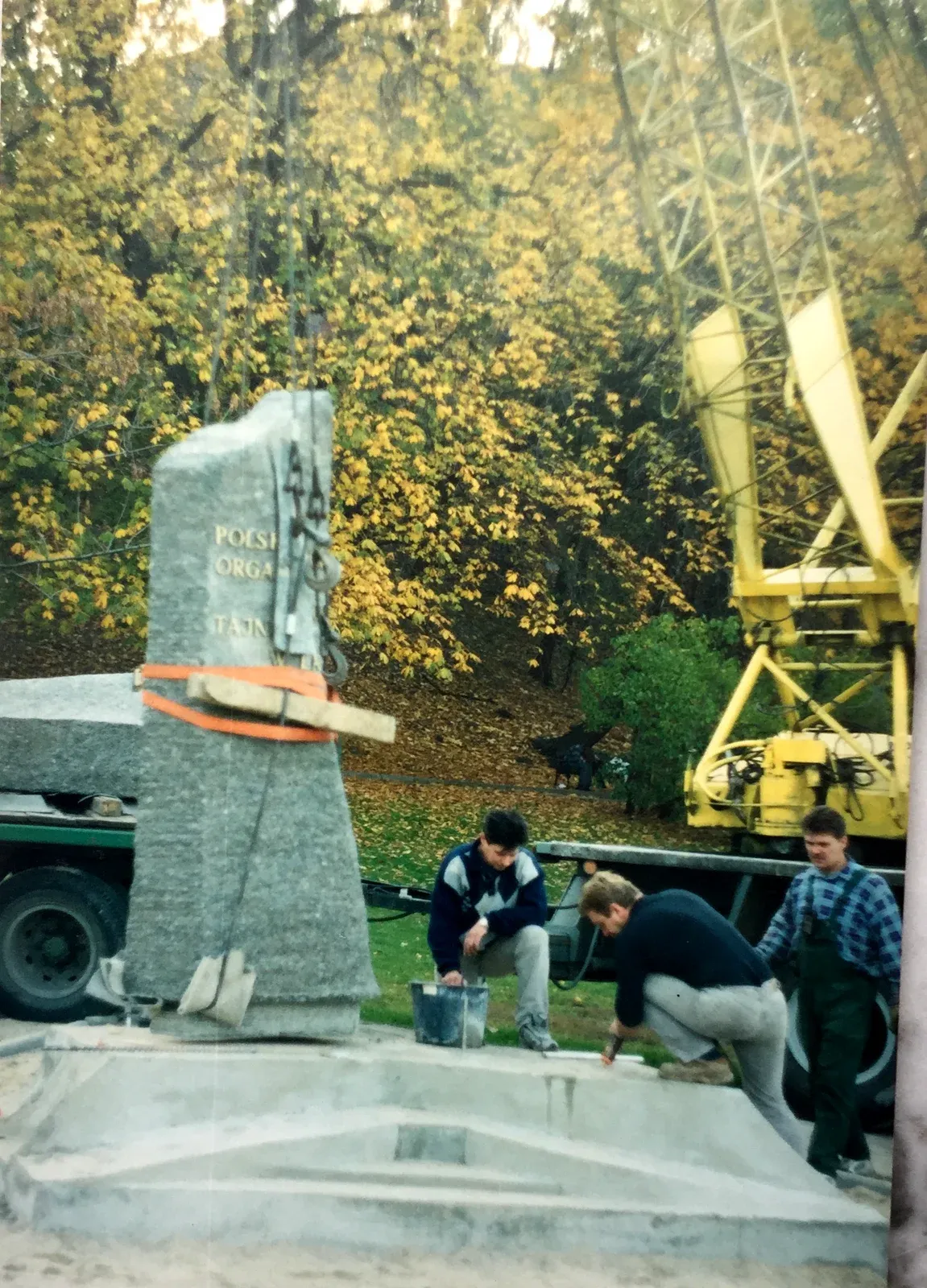
Autumn 2000: the crane lowers the stele onto its base, in the park. -
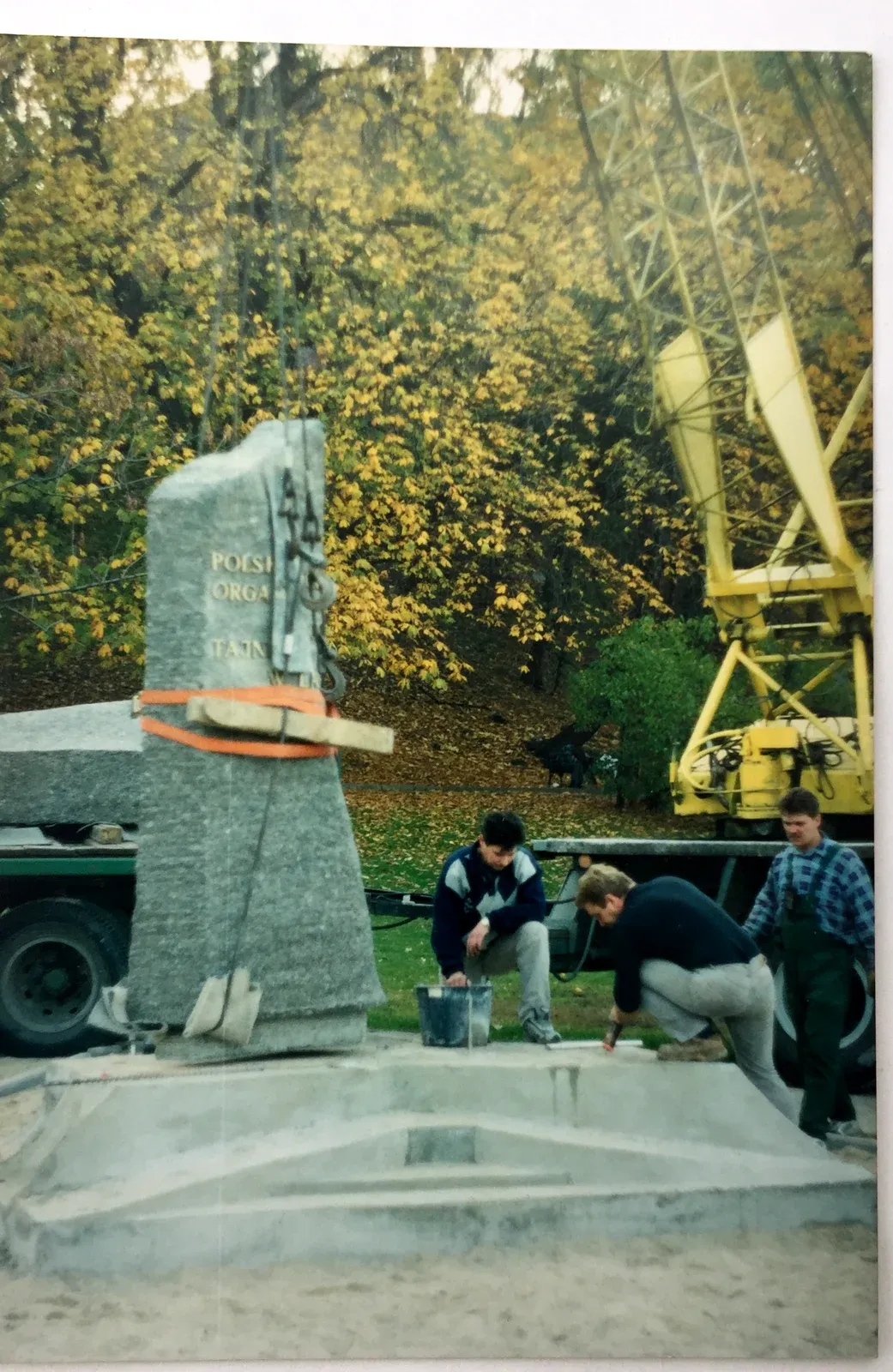
The setting: the monument finds its final place.
The park, every day
Autumn 2000In the same months in which the monument takes shape, the artist’s son is in hospital. Antonina divides her days between the ward and Park Kazimierzowski, where the worksite advances: it was the daily visits to that piece of granite, she recounted years later, that carried her through the hardest time of her life.
She speaks of it for the first time in 2009, to a weekly that devotes a portrait to her. Of her son she says one thing, and says it like this:
Pamiętam, jak na dwa miesiące przed śmiercią syna, podziękował mi za to, że go urodziłam i podarowałam tak fantastyczne życie. I remember how, two months before, my son thanked me for bringing him into the world and for giving him such a fantastic life.
The monument she was finishing is dedicated to teachers who had taught at the risk of their lives, and the work served her as an anchor: it was, in those months, the thing that went on. In the same year she begins to paint angels — the first sheet of the cycle carries her son’s name in its title.
The ninth of November
The unveiling · 2000The monument is unveiled on 9 November 2000, closing the celebrations for the sixtieth anniversary of the TON. The veil is drawn by Maria Grabowska, an eighty-seven-year-old teacher of the clandestine schooling, beside Sławomir Broniarz, president of the union, and Jerzy Wiśniewski, president of the foundation that raised the funds. The government and parliament are there, the city, the teachers, the veterans and the young.
The President of the Republic, Aleksander Kwaśniewski, honorary patron of the work, sends a letter, which is read out before the newly unveiled monument:
Pomnik, który odsłaniamy, jest materialnym wyrazem hołdu dla rzeszy pedagogów uczestniczących w akcji tajnego nauczania. Lecz trwalszy pomnik niż monument z kamienia i brązu wznieśli sobie oni sami swym czynem. The monument we unveil is the material expression of homage to the multitude of educators who took part in the action of clandestine teaching. But a monument more lasting than one of stone and bronze they raised for themselves, by what they did.
The next day the chronicle is headlined «Księga w hołdzie», a book in homage, and gives an account of the form: an open book, symbol of knowledge, the work of the sculptor. Gazeta Wyborcza tells the teachers’ story under the headline «Uczyli z narażeniem życia» — they taught at the risk of their lives.
Since then, every autumn, the teachers’ union holds the TON remembrance day there, with banners and wreaths. Antonina had foreseen it: the project report leaves it in writing that further inscriptions and plaques may be added as needed. And for the rest of the year the monument does what windows do: it lets the light through.
- «Księga w hołdzie» a book in homage
- «Uczyli z narażeniem życia» they taught at the risk of their lives