Sen nocy letniej
A midsummer night’s dream · mahogany and maple, 1977
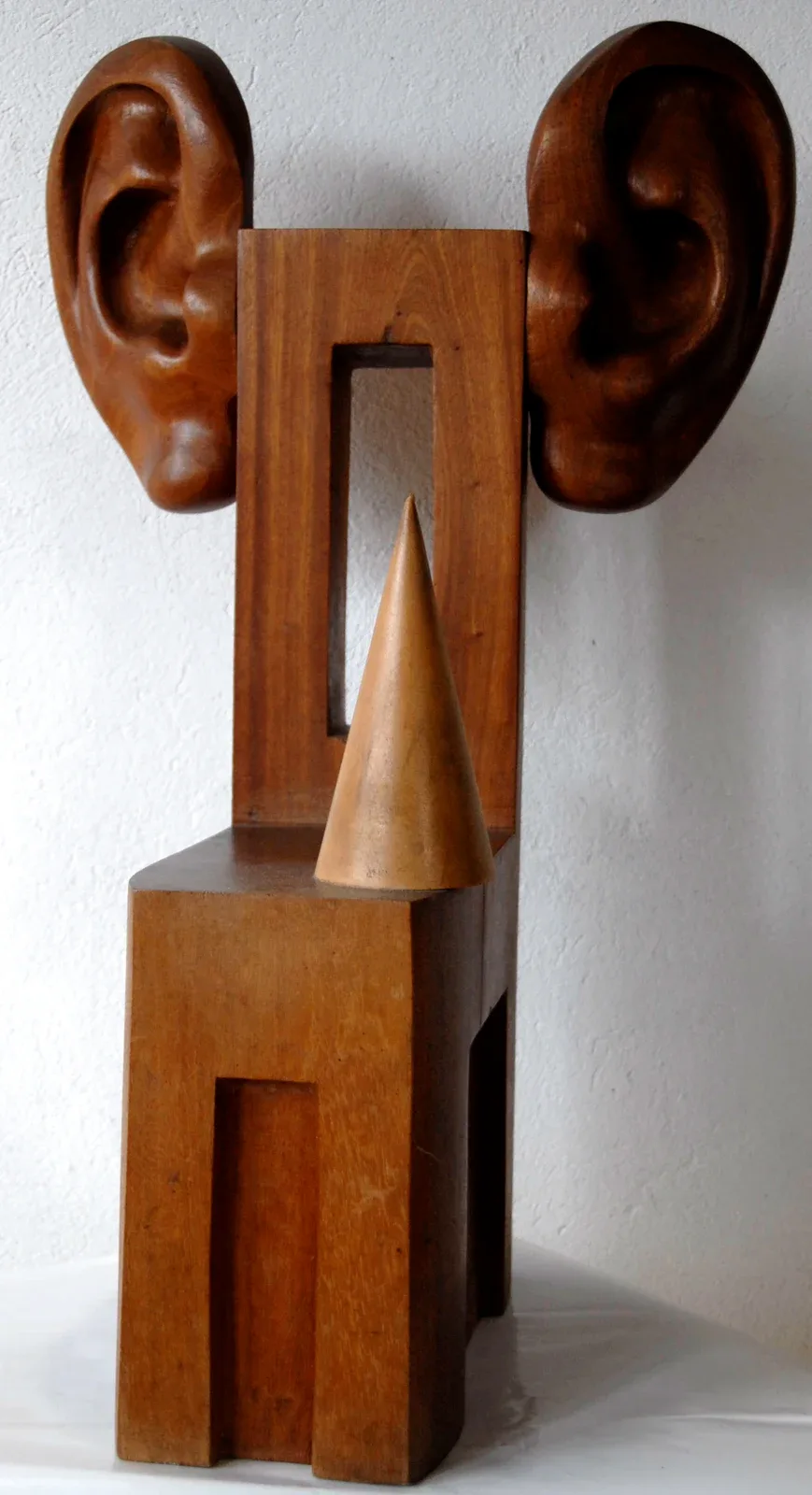
A block of mahogany with two rectangular recesses sunk into its flanks; from its top rises an upright board, pierced by a window one can see through. At the sides of the board, near the top, two great human ears. In front, on the top, a cone of pale wood.
The title is Shakespeare’s. Among the table-sized sculptures this is the one Antonina keeps showing longest: in 1979 she has it reproduced in the catalogue of a national survey at the Zachęta, in 1988 she shows it in Kraków, in 1991 she sends it to The Hague as one of her three works, in 1999 it is given a plate in the catalogue of the retrospective, in 2009 it is still in the gallery at Siedlce. And in 1981, in the middle of all that, she paints it.
The work
The view from the front: the two ears at the sides of the board, the window that crosses it, the pale cone in front.
Photograph: the family archive.
Everything is squared, except the ears
Four pieces, two ways of carving, two ways of lookingAll the rest is made of planes and edges. The body is a rectangular solid with two rectangular recesses hollowed into its flanks, the top is a slab, and above it rises a board pierced by a rectangular opening one can see through. The cone too is a pure solid, and of a paler wood at that: maple against mahogany.
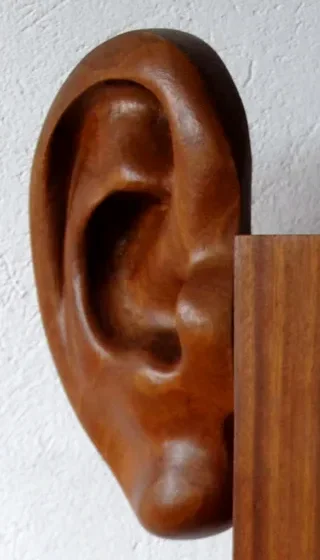
The ears are not. They are carved as one carves from life — the helix turning and folding back, the concha in shadow, the tragus, the heavy lobe — and at the scale of a face they are enormous. In all the rest of the work there is not a single curved line.
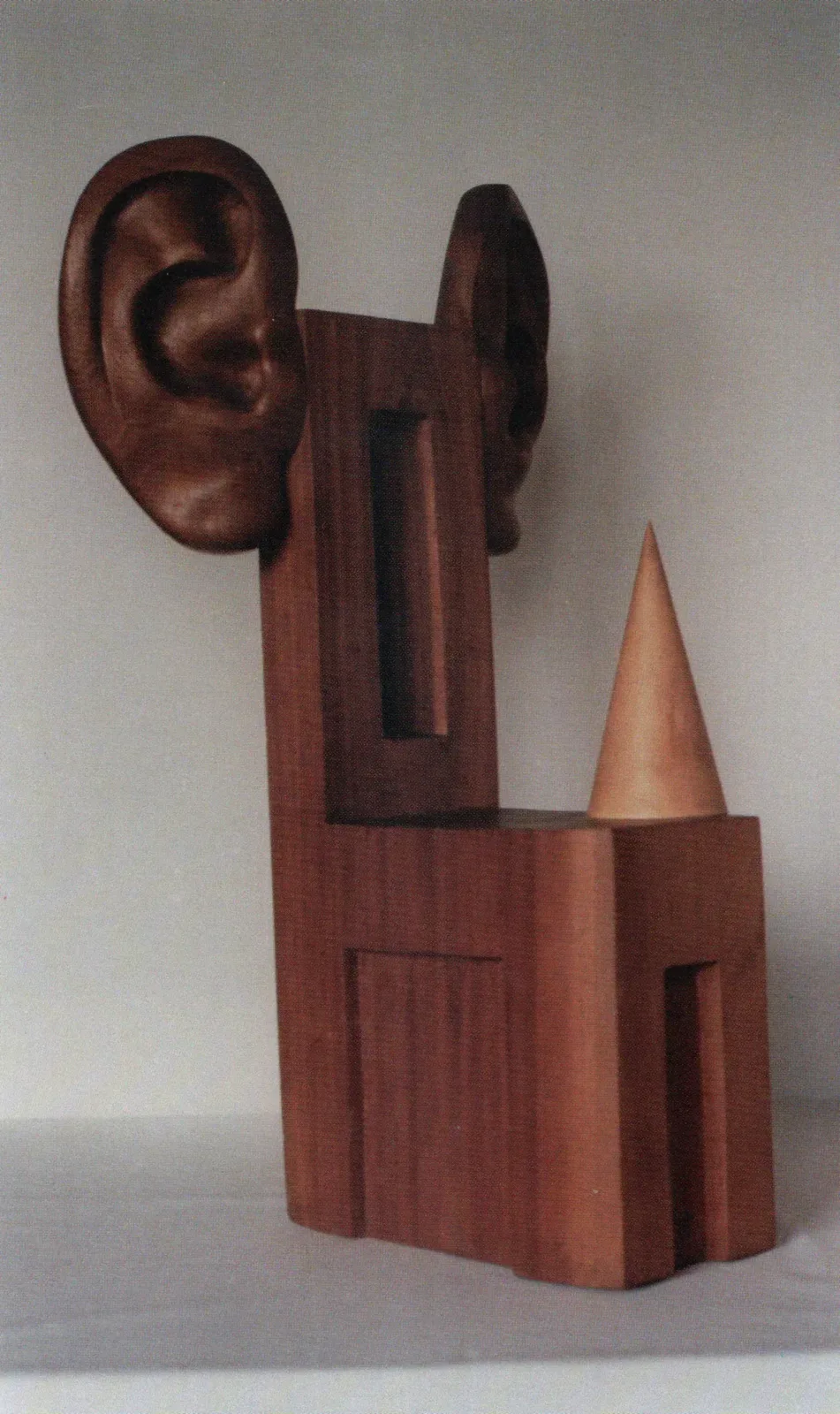
And the object changes with the point you look at it from, as the two photographs the archive keeps make plain. From the front it is a head: the ears at either side, the cone in front like a muzzle — and the title licenses it, since in Shakespeare’s comedy a man falls asleep and wakes with the head of an ass. From three quarters it is a chair: one sees the top on which the cone rests, and the board rising from its back edge like a chairback.
The count of the pieces comes from the checklist of the 2009 Siedlce exhibition: four. The body, the two ears, the cone — carved separately and assembled together.
Always out
Zachęta 1979 · Kraków 1988 · The Hague 1991 · Siedlce 2009In 1979 the Zachęta in Warsaw takes stock of five years of Polish art. On Antonina’s page, below her CV, three works are reproduced, and this is the second: «Sen nocy letniej, drewno, wys. 70».
In 1988 it is on the list of the solo exhibition at the KMPiK in Kraków, among twenty-five sculptures. Three years later it crosses the border: at the Pulchri Studio in The Hague, at the exhibition of Polish art in May 1991, Antonina shows three works in all and this is one of them — in the Dutch catalogue it is called «Midzomernachtsdroom».
The catalogue of the 1999 retrospective gives it a plate. And the last that is known of it is 2009: at the solo exhibition «Przemijanie» at the Muzeum Regionalne in Siedlce it stands in the east gallery, together with the large wooden pieces.
And in 1981 she paints it
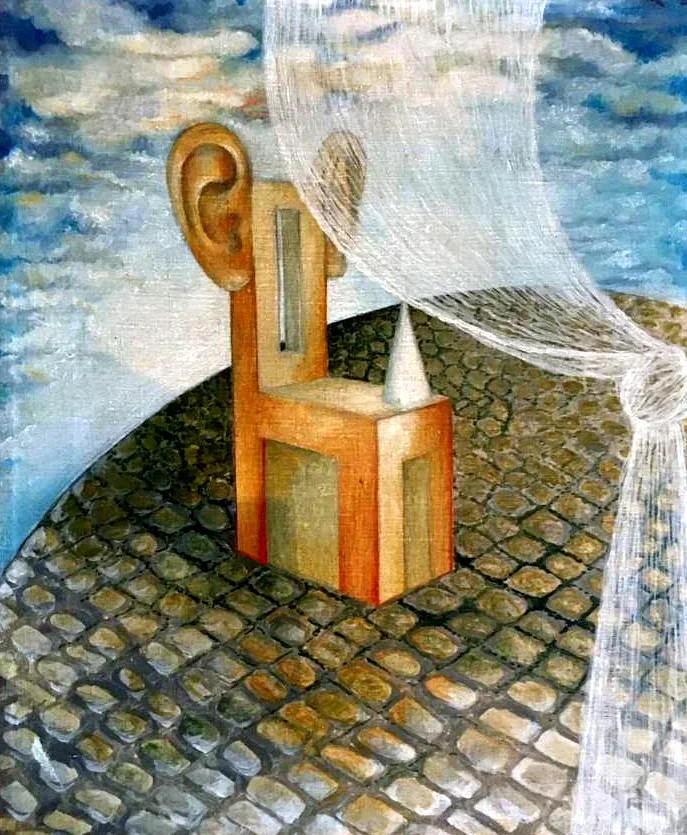
Oil on canvas, the same titleFour years after carving it, Antonina paints this work in oil on canvas and gives the picture the same title. It is not a variation on a theme: it is the object, recognisable piece by piece — the window in the board, the two recesses sunk in the block, the pale cone on the top, the ears above. And she sees it from three quarters, that is, from the side on which it is a chair.
What changes is where it stands. In the painting it is out of doors, on a circular platform paved with cobbles, under a sky of clouds; from the right a great white veil crosses the scene and knots itself below. The cobbles give it a scale the object does not have: on the canvas it is large.
It is not the only case in which a painting portrays one of her sculptures — a pastel portrays the disc «Zbliżenie» —, but it is the most literal, and the only one in which the sculpture is carried outside, onto a base, into a landscape that does not exist.