U progu życia
On the threshold of life · mahogany, park of Płock, 1970
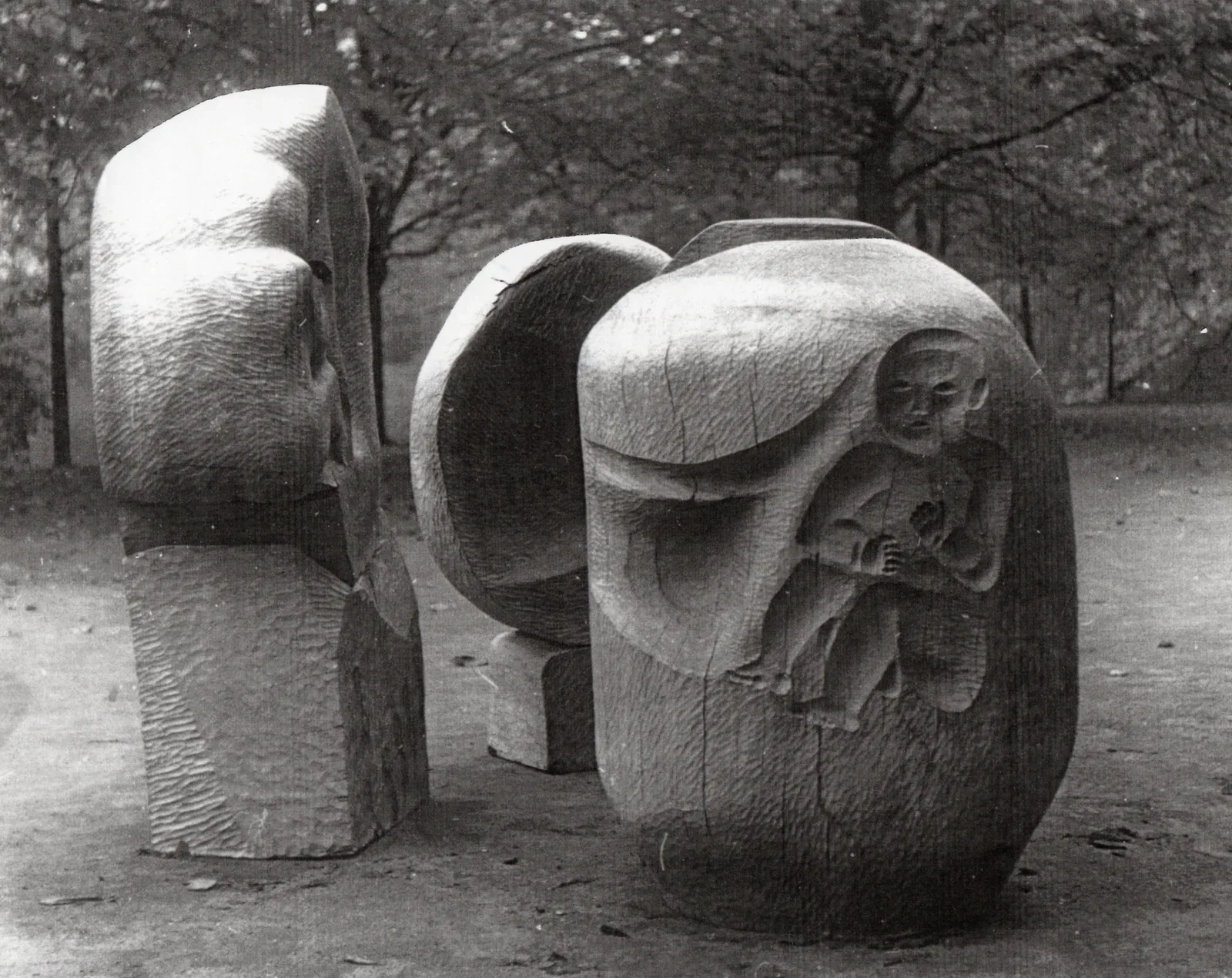
In the city park of Płock, three great masses of mahogany set on the beaten earth. They are full, closed forms, each hollowed in a different way; in one of them the wall opens, and in the opening a seated child is carved.
It is the first work Antonina leaves out of doors, and the beginning of everything the atlas of this site tells. It is also the first appearance of the form she will return to for decades: a closed volume that opens and holds someone.
The work
The group in the park, in a period print from the family archive: the three masses in a row, and on the right the one that opens.
Photograph: the family archive, period print.
Three masses on the earth
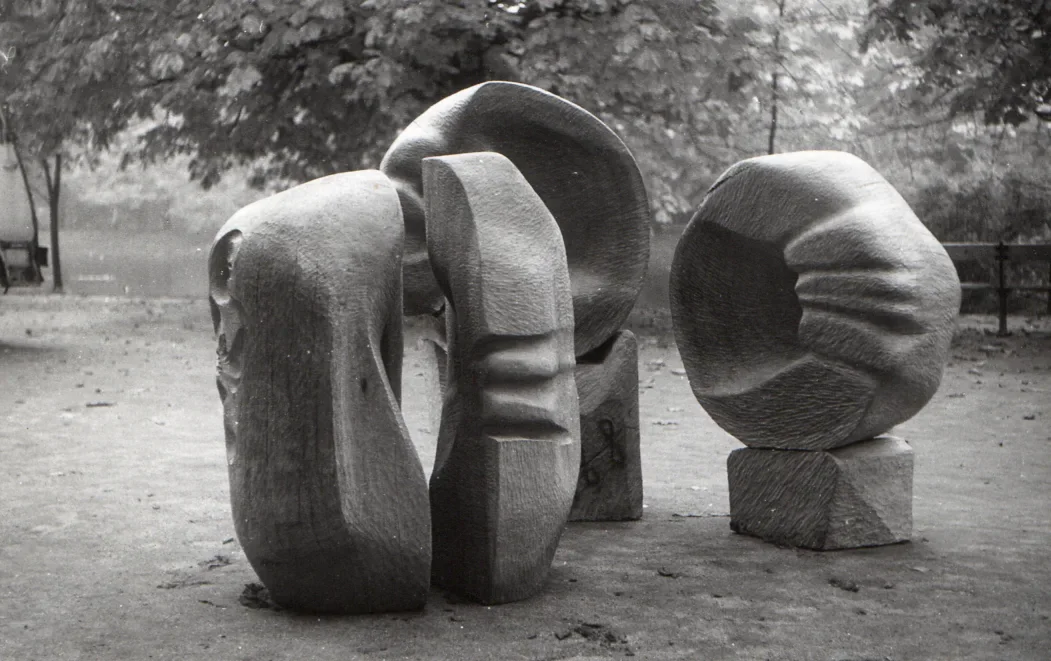
How they are madeThe three forms have no principal face: they are full volumes, as wide as boulders, and from every side they show a different profile. Each is hollowed in its own way — one bends forward over a fissure, one opens into a deep basin that crosses its flank, the third rolls in on itself like a shell. Some rest on squared wooden blocks, others directly on the earth.
Close to, the working shows: the great curves are smoothed, while the surfaces that join them carry the strokes of the gouge, dense and parallel like hatching. It is the same hand that in those same years hollows the great indoor wooden pieces, carried to the scale of a park.
And the wood works. Already in the period photographs long splits run down the masses, following the grain: these are the first years out of doors, and they show.
A foot over the edge
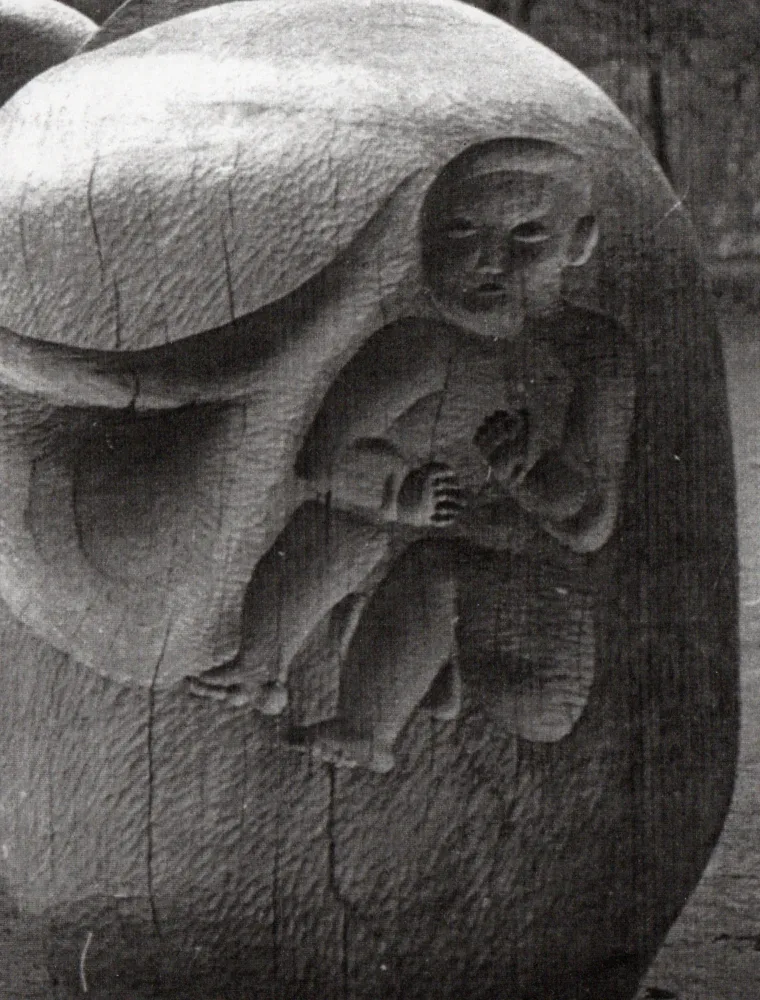
The mass that opensIn one of the three the wall parts. The upper edge rolls forward like an eyelid and beneath it a second lobe comes away; inside the opening this makes, a naked child sits, with the large head of a very young child, its hands gathered at its chest around something round.
It is the only thing in the whole group that resembles anything. Around it there is not a single detail: only volume, and the hatching of the gouge. The child, by contrast, is modelled down to the features of the face, and the flesh of the feet and hands is smooth where the wood around it is rough.
One foot, though, steps over the edge of the opening and rests outside, on the outer surface of the mass. The child is not shut inside: it is on the threshold, which is what the title says.
The first out of doors
Płock 1970, and what comes afterBefore this, Antonina’s work stands in galleries: the great indoor wooden pieces, the group exhibitions, the diploma. Płock is the first time a work of hers stays outside, exposed to the weather and to passers-by — and it is the point from which the sequence the atlas of this site travels begins: the Skarpa in Warsaw, Zamość, Mielec, the Praga district, Nieporęt, and then the symposia abroad.
In 1974 the group is in Warsaw. It appears in the list of works of the solo exhibition at the Stara Kordegarda in the Łazienki, beside «Wygnanie», «Hiroszima» and «Smętek»; that exhibition wins Antonina the prize of the Society of Friends of the Fine Arts for the best solo show of the year in its galleries.
And the form that appears here for the first time — a closed volume that opens and holds someone — never leaves again: it returns in a canvas of 1981, in the bronze of the year after, in a sphere that parts over a newborn child.