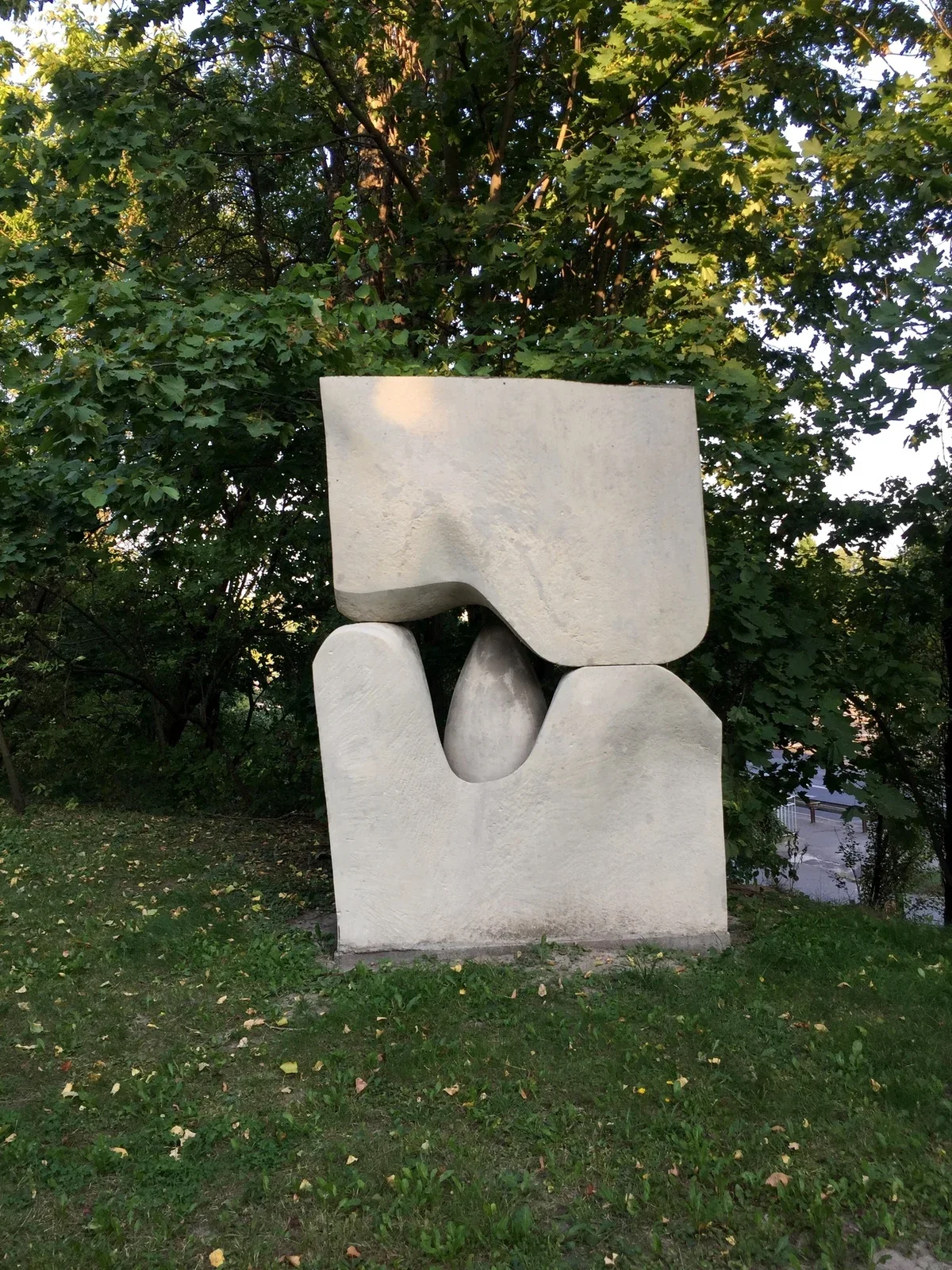
Ab ovo
Limestone, 1975 · Warsaw, the escarpment along the Trasa Łazienkowska
A block of limestone almost three metres high, cut lengthwise: the upper mass comes down in a curve, the lower one opens into a niche, and in the gap between them sits a stone egg — smooth, where everything else is left rough.
It has stood in Warsaw since 1975, on the grass of the escarpment beside the Trasa Łazienkowska, the road that in those years cut through the city towards the Vistula. It did not arrive there afterwards: a project exists written for those green slopes, and the work was made to stand in that place.
The work
The view the catalogue of the 1999 solo exhibition chooses for it: the stone on the grass, and the road behind.
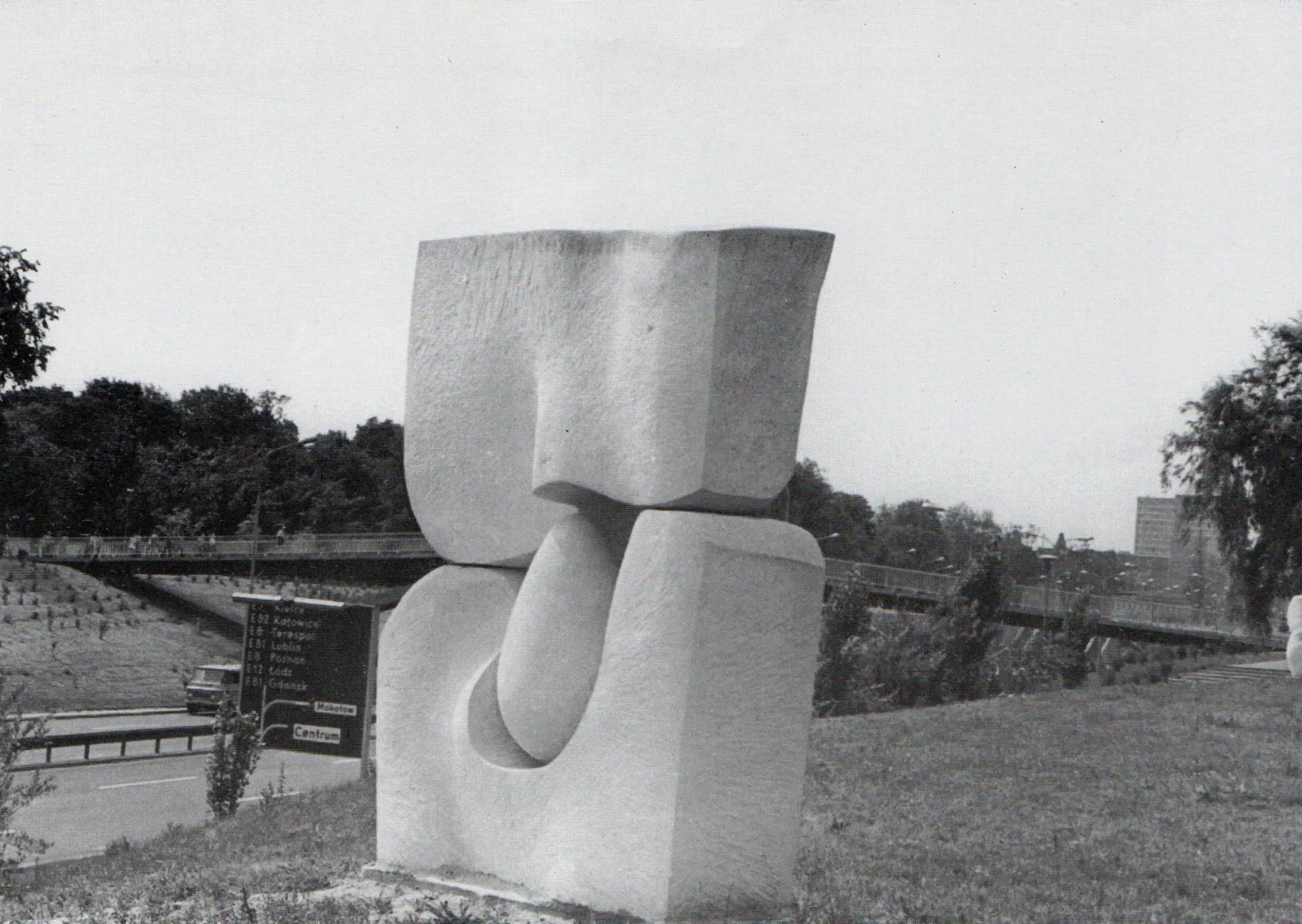
Plate from the catalogue of the Warsaw solo exhibition, 1999.
A gallery along the road
Warsaw, the Trasa ŁazienkowskaWhen the Trasa Łazienkowska opens, the stretch running down from plac Na Rozdrożu towards the Vistula becomes a new walk, and along the escarpment the Śródmieście district sets out a row of stone sculptures by Warsaw artists. With Antonina there are Tadeusz Sieklucki, Henryk Wróblewski, Władysław Trojan, Ryszard Stryjecki.
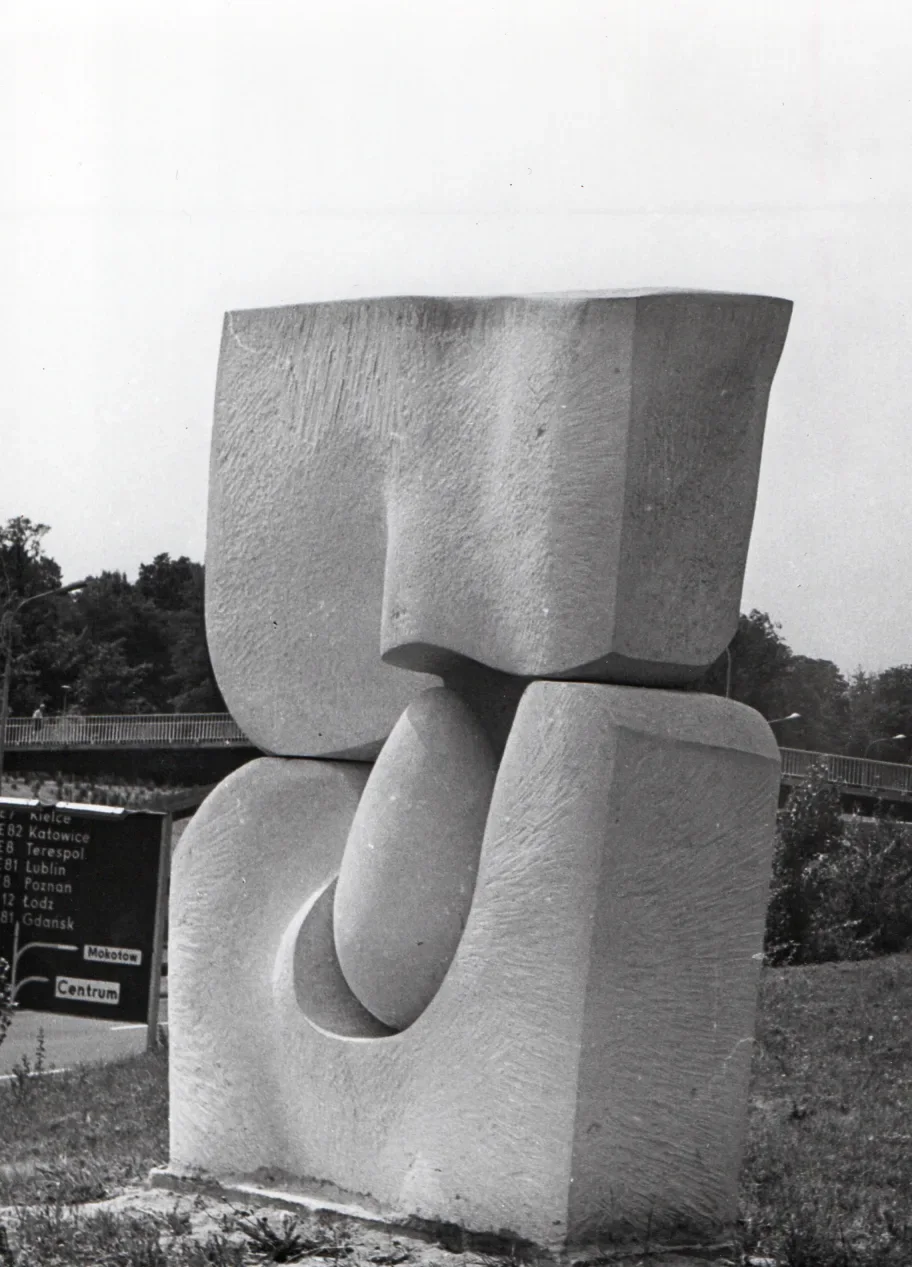
A city daily announces her sculpture before it stands, in a two-line caption: «Rzeźbę, której centralnym punktem jest jajko, proponuje warszawiakom» — a sculpture whose central point is an egg, she offers to the people of Warsaw. Then an illustrated magazine gives the row a colour feature, photographs by Henryk Jurko, and prints it with the others, numbered five, under the name that will stay with it: «Kompozycja».
This is a city commission, not a symposium: the work is not made in front of an audience over three weeks, it is made for a stretch of slope nobody looked at and that the new road had just turned into a place.
The model
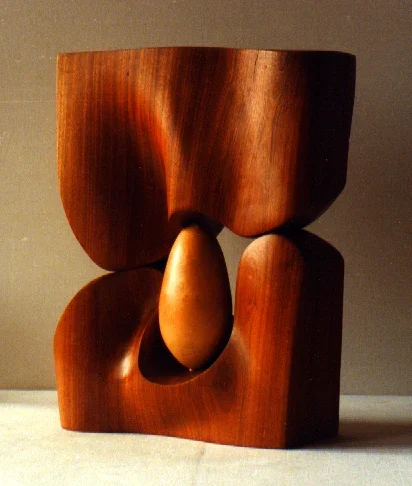
The same design in mahoganyThere is also a version to be held in the hand: the same design in mahogany, with the two masses and the egg in the gap. The wood is polished, and the egg is the palest part — worked to a shine, as the stone in the niche will be.
It is a way of working she returns to: first the small piece, turned and looked at from every side on the table, then the same form at the scale of the landscape. Between the two there is a leap that is not only one of size — in the mahogany the egg is seen at once, in the limestone you have to come close to the niche to find it.
The two names
Ab ovo, and «Kompozycja»The title the artist gives it is Latin. The name the city knows it by is the most general word there is: «Kompozycja», composition. The project already carries it — «Kompozycja, stone, for the green slopes of the escarpment» —, the magazine caption carries it, and the maps of Warsaw carry it still.
The rest has stayed where it was. The trees around have grown until they closed the sky over it, and the stone has been cleaned: the limestone is pale again, and the niche with the egg reads as it does in the photographs of the first years.