Dyskobol
Discobolus · 1976
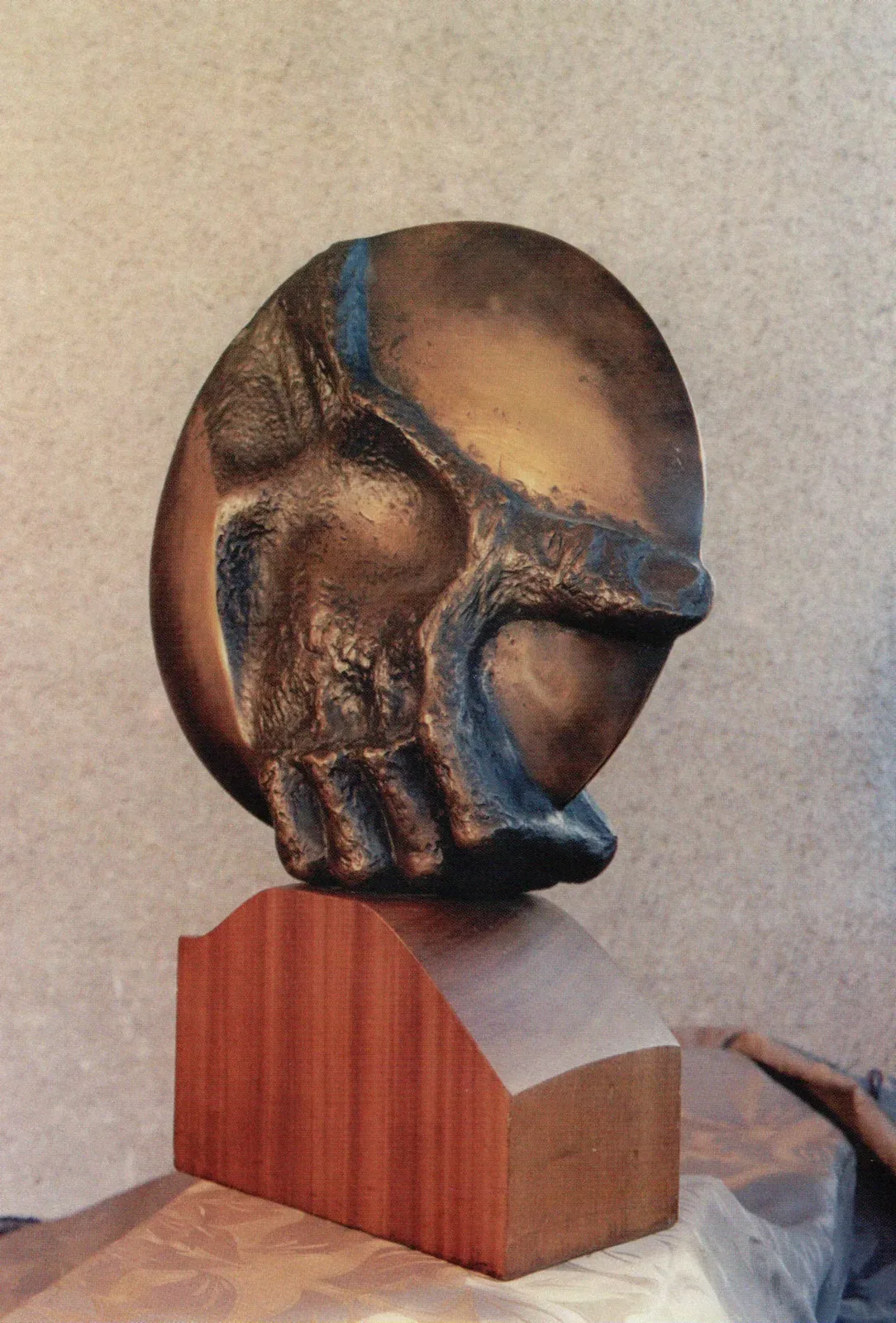
A disc of bronze, the size of a plate, standing on a mahogany base. On its face, in relief, a hand grips it from below: the fingers hook over the rim, the palm lies against the surface. Of the thrower there is nothing else — no body, no swing, no muscles.
It is the first disc in her work, and it comes out of a competition she had decided not to enter.
The work
The catalogue plate: the disc on its mahogany base, and the hand that holds it.
The no that became a yes
The artist’s words · 2009She tells the genesis of the work herself, more than thirty years later, in an interview for the Siedlce solo exhibition. She sees on the noticeboard at the artists’ union the announcement of a competition on the subject of sport, and stands there thinking that she has nothing whatever to do with sport — that she will never in her life make a sporting sculpture. Then a colleague comes up:
Podszedł kolega. Zapytał: bierzesz udział w tym konkursie? Ja na to: nie. Ale za moment się odwróciłam do niego i powiedziałam: tak. W tym momencie zobaczyłam tę koncepcję. […] Poszłam do pracowni i ulepiłam ją w glinie jeszcze tego samego dnia. A colleague came up. He asked: are you entering this competition? And I said: no. But a moment later I turned to him and said: yes. In that moment I had seen the idea. […] I went to the studio and modelled it in clay that same day.
The competition is the national survey «Sport in art», and at Katowice, in 1976, the jury gives her a distinction in the sculpture section. The diploma is still in the archive, signed by the general commissioner of the exhibition and the chairman of the organising committee; and on the printed card the word for «distinction» is set with a misprint.
The hand, not the athlete
What the critics read · 1999Twenty-three years later, at the retrospective in the Galeria Rzeźby in Warsaw, a reviewer for «Życie Warszawy» stops in front of the Dyskobol and puts his finger, in two lines, on what makes it unlike every discus-thrower we know:
Zupełnie inaczej zinterpretowała ten temat, niż czynili to np. starożytni Grecy. Dla niej najważniejsza jest ręka rzucająca dyskiem, a nie umięśniony sportowiec. She has interpreted the subject quite differently from the way, say, the ancient Greeks did. For her the most important thing is the hand that throws the discus, not the muscular athlete.
It is the right observation, and it holds beyond this work: the hand is her way of saying a whole person — the hand that grips, that opens, that is joined in prayer. Here, for once, the hand is not the subject but the instrument, and the subject is the disc about to leave it.
The disc will stay. Ten years later it returns in her work with no thrower at all: it becomes a closed field in which things happen — it buds, it cracks, it opens — and gives its name to a whole series.