For Emil B.
Two works · 1982
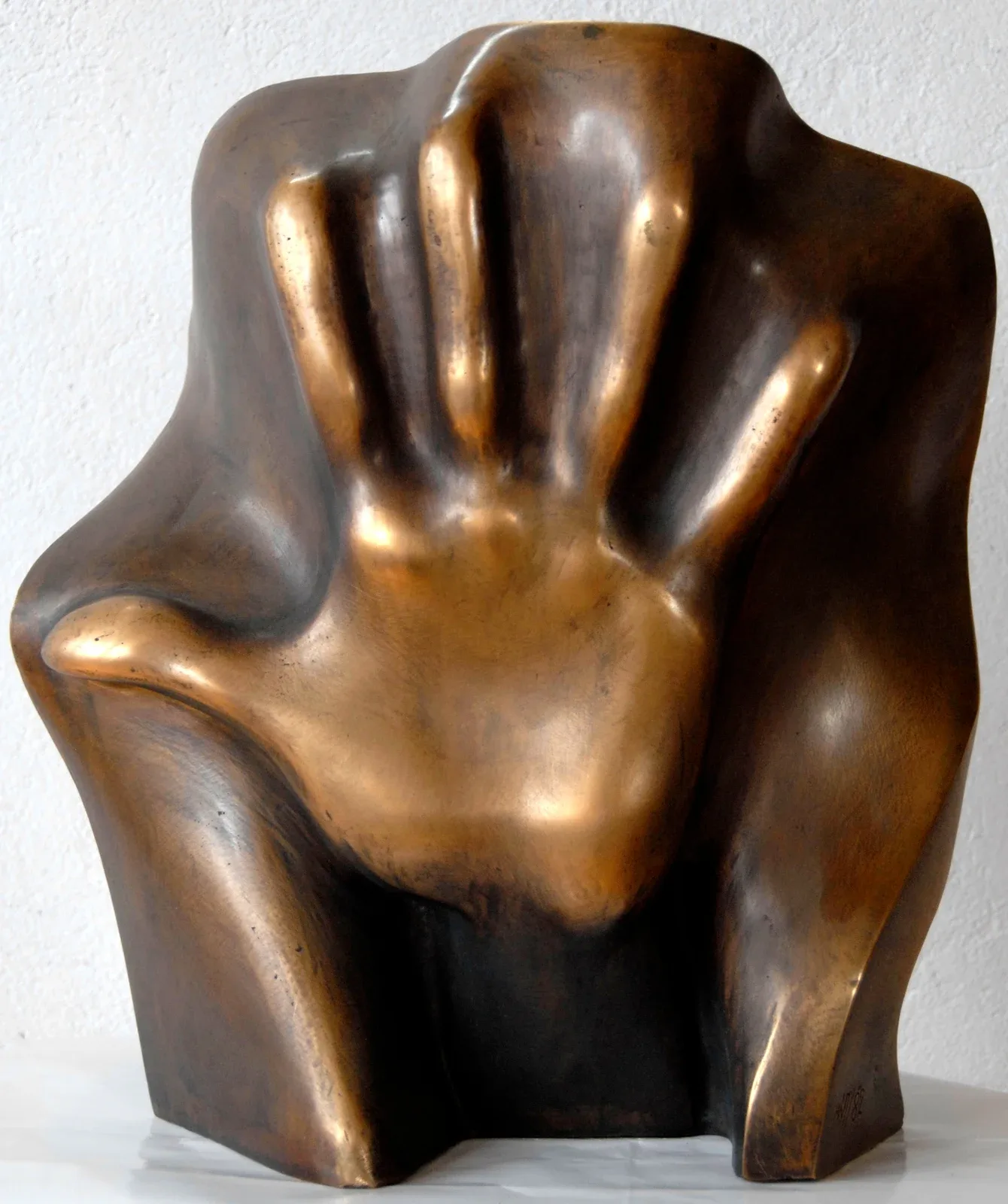
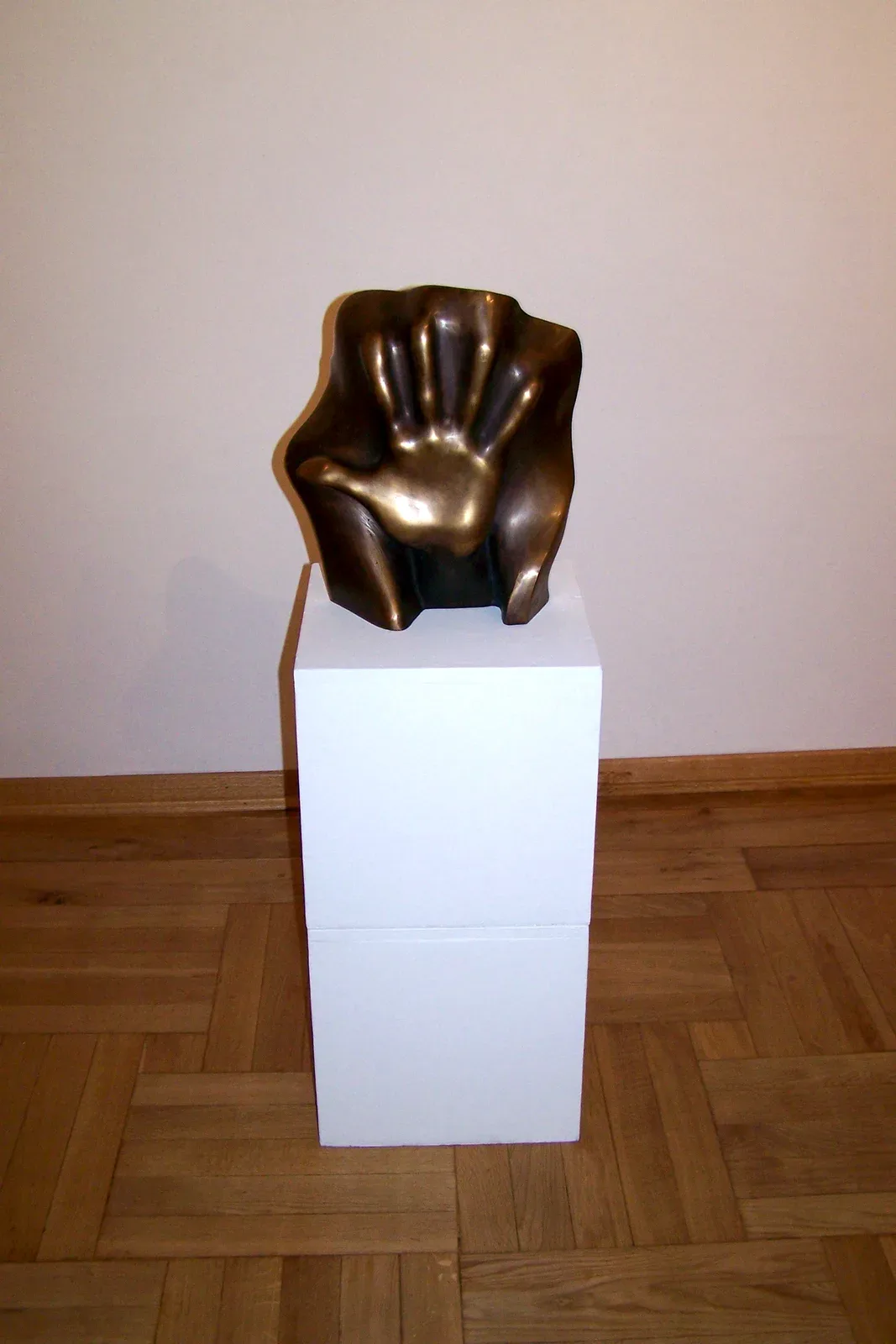
In 1982 Antonina signs two works for the same person, and they are as far apart as two works can be: a table bronze forty-two centimetres high, in which an open palm emerges from a closed mass, and a large slab of pale stone in a Warsaw cemetery, with a bare tree interlaced with a cross.
The two works stand in two different worlds — a public sculpture collection and a field of graves — and in the CVs she writes by hand she lists them separately, as two distinct commissions. One name holds them together: Emil Barchański.
The bronze
A hand opening inside the block: the palm in full light, the fingers spread, and around it the mass that has not opened. It is a work to be held in the hand — forty-two centimetres — and on a plinth it stands at the eye level of whoever comes in.
Who Emil was
Warsaw · 1982Emil Piotr Barchański was a pupil at a Warsaw secondary school, born in June 1965. He was sixteen when, on 10 February 1982 — two months after martial law was declared in Poland —, together with some schoolfellows he threw petrol bombs at the monument to Feliks Dzierżyński, in the middle of the city. He was arrested.
On 3 June, while waiting to give evidence at the trial, he left the house for the Vistula with a friend and did not come back. His body was recovered two days later, on the eve of his seventeenth birthday. The circumstances — reconstructed by the historical investigations of the Institute of National Remembrance — point to a killing by the political police staged as a drowning, and it is for this that Emil Barchański is remembered as the youngest victim of martial law.
Almost the whole school came to the funeral on 16 June: the pupils, the teachers, the headmaster. The authorities classified it as a political demonstration.
Ś. † P.EMIL PIOTR BARCHAŃSKIŻYŁ LAT 17ZMARŁ ŚMIERCIĄ TRAGICZNĄDNIA 3 · VI · 1982 What it meant, in 1982, to sign the gravestone of a boy killed by the political police, the context says better than any comment. Antonina makes it, and records it in her CVs alongside her other commissions, without a line of explanation.
The stone
Bródno cemetery, Warsaw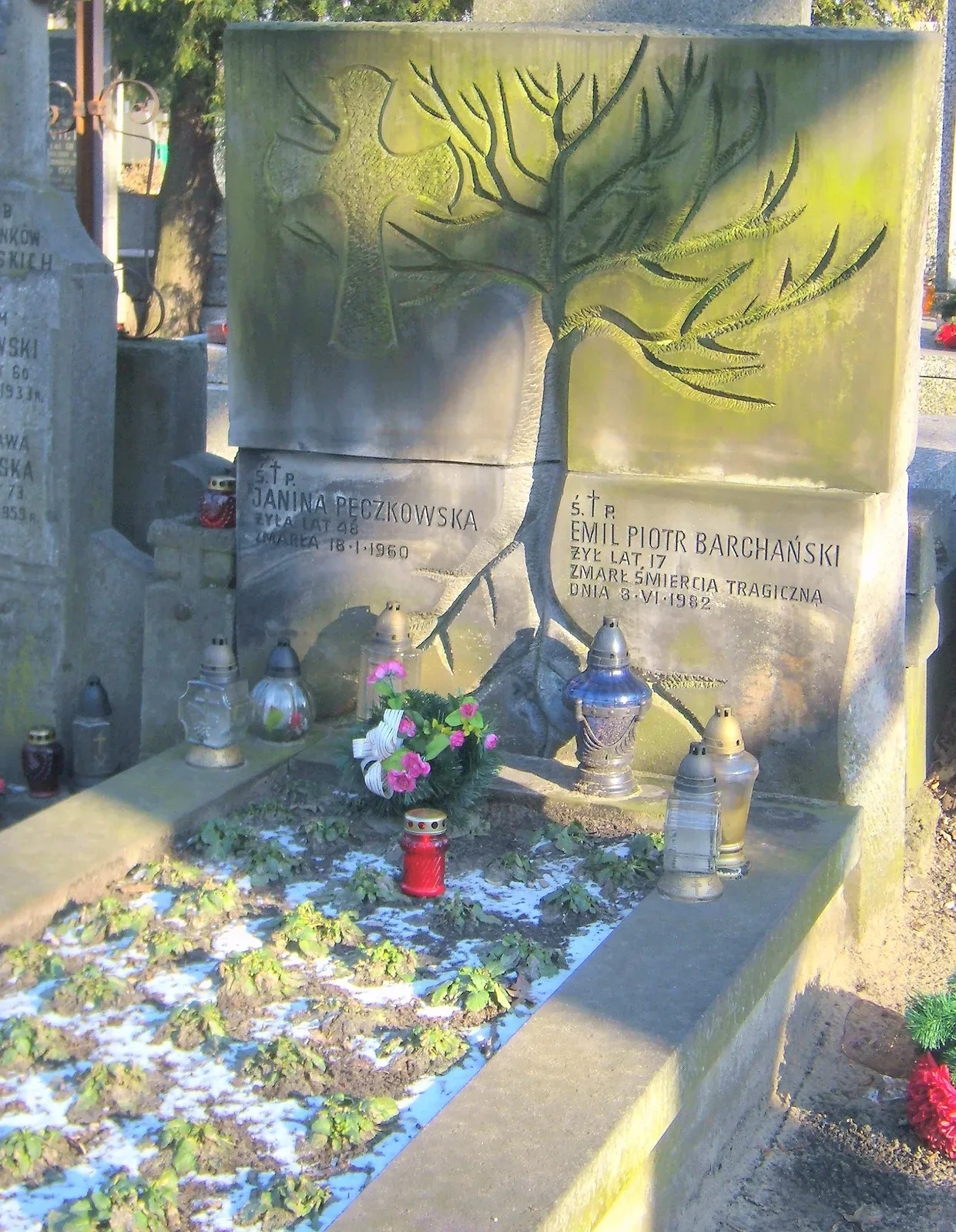
The gravestone is a large upright slab of pale stone, carved in bas-relief. A bare tree reaches its branches to the right, as though bent by the wind; on the left, inside the same figure, a cross with broad arms opens out. Tree and cross are not set side by side: they are a single drawing, and the trunk runs down until it becomes a root on the horizontal slab, worked in a chequer so that the grass may fill it.
The motif is not isolated in her work: the tree with its roots showing returns on several design sheets for graves, and on a second gravestone she made, where it crosses the two pages of a stone book. Here it is kept dry — no ornament, no figure — and lets the two inscriptions below do the speaking.
The photograph seen here is by a contributor to Wikimedia Commons: the grave is a public place, and someone photographed it and made it available to everyone. On the page of that file, however, the sculptor’s name does not appear — it is one of the corrections this archive still owes its source.