Funerary sculpture
Transience · 1982–2008
The theme of passing runs through all of Antonina’s work — birth, growth, transience — and at a certain point it steps down from the pedestal to enter the cemeteries. For more than twenty years she designs tombs: presentation boards with two or three variants to lay before those who asked for them, and a repertory of bronze reliefs to be set on the stones — the face of Christ, the Madonna with Child, the Black Madonna of Częstochowa and the Madonna of Ostra Brama, the shrine of her native Vilnius.
The vocabulary is the same as that of the museum sculpture, and often it is born first on the sheets as an autonomous search: the open stone book, the tree with its roots exposed, the drop, the cross obtained by taking matter away. And once, in 1982, one of these commissions became public history.
The bronze and the stone
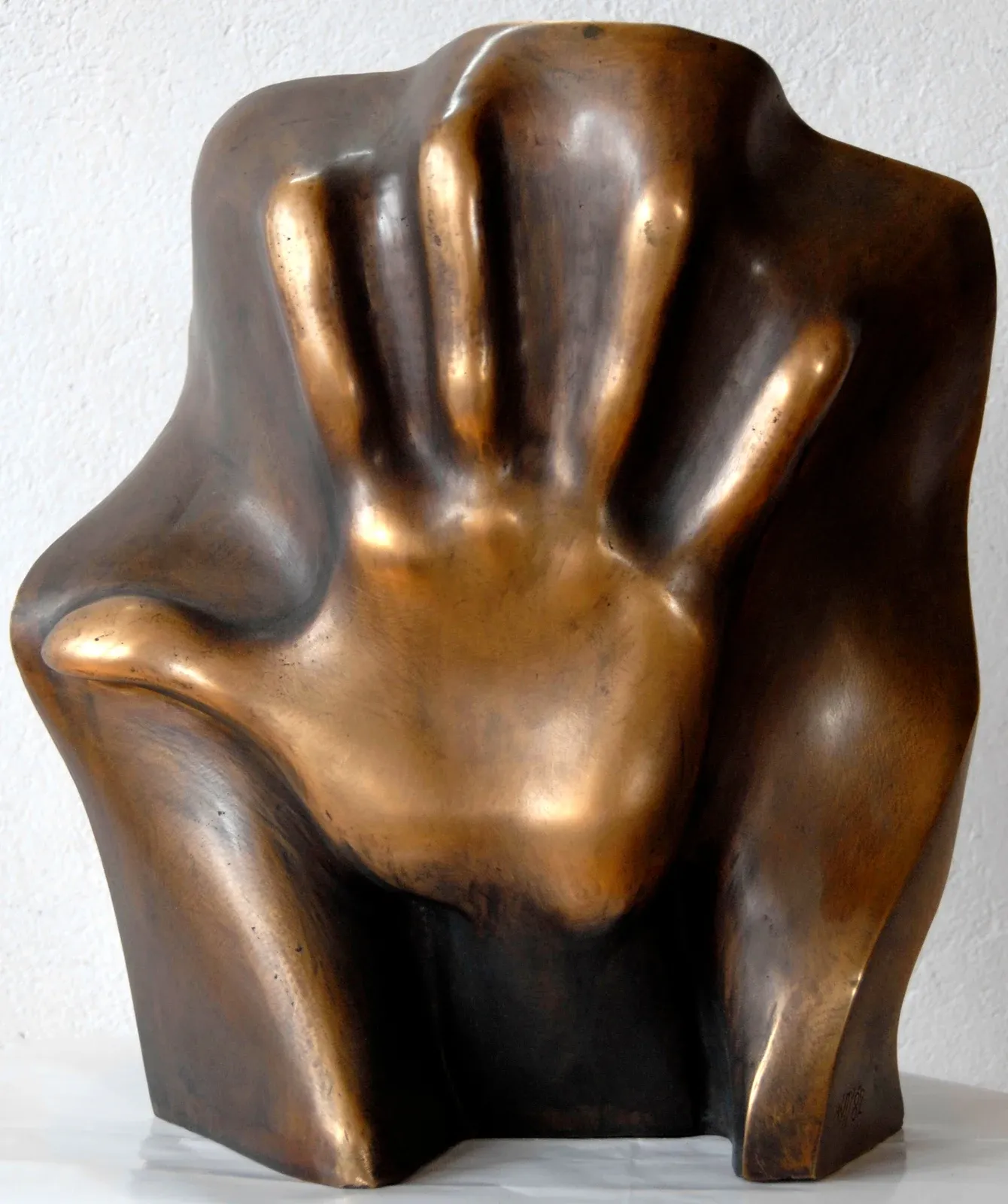
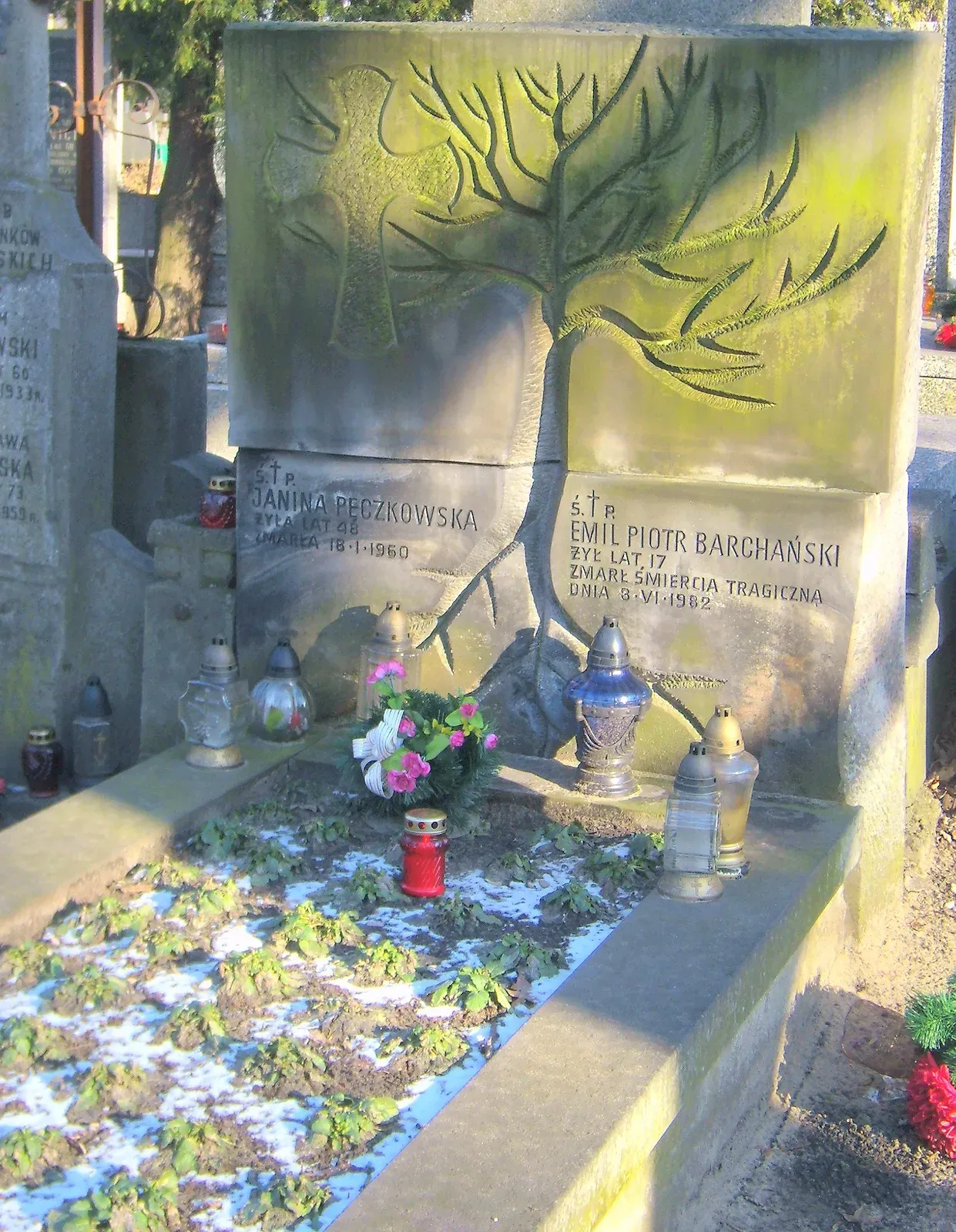
The two works Antonina signs for Emil Barchański, listed separately in her CV. The bronze is shown in colour, the stone in black and white.
-
 Enter the room →
 AW.S.0018 Pamięci Emila „B”
In memory of Emil B.1982 · bronze · h 42 cm
Muzeum Regionalne, SiedlceAcquired by the Centrum Rzeźby Polskiej at Orońsko as early as 1983.
-
 Enter the room →
 AW.S.0158 Nagrobek Emila Barchańskiego
Tomb of Emil Barchański1982 · light stone, bas-relief
Warsaw, Bródno CemeteryThe tree and the cross are a single figure; the stone is still in its place.
The photograph of the tombstone is by Stefs (Wikimedia Commons, CC BY-SA 3.0); the bronze is from the family archive.
The story
Warsaw, 1982Emil Piotr Barchański is a pupil at the Rej high school in Warsaw. In February 1982, two months after the proclamation of martial law, sixteen years old, he takes part with some schoolmates in a protest action against the monument to Feliks Dzierżyński in the centre of the city. He is arrested. On 3 June 1982, while waiting to testify at the trial, he goes out towards the Vistula and does not come back: the body is found two days later, on the eve of his seventeenth birthday. He is considered the youngest victim of martial law in Poland.
Antonina signs two works for him, which her CV lists separately. In that same 1982 the bronze «Pamięci Emila B.» — forty-two centimetres, memory entrusted to an initial — which the Centrum Rzeźby Polskiej at Orońsko acquires the very next year; and the tombstone at the Bródno cemetery: a bare tree, bent by the wind, entwining itself with a broad-armed cross until they become a single figure, the roots descending among the inscriptions.
The tree with its roots is not an isolated motif: it returns again and again in the study sheets of the archive, beside the stone book and the drop, and in another tombstone she made it passes through the pages of an open book. On the Bródno stone the inscription says that Emil «lived 17 years, died a tragic death». The tomb is in section 46 of the cemetery.
- the stone book open, its pages carved
- the tree with its roots the figure of Emil’s stone
- the drop the tear made stone
- the cross by subtraction obtained by taking matter away