Kolejne odbicia
Further reflections · mahogany, two elements
Two masses of mahogany born from a single block: the edges that separate them are broken in a zig-zag and fit together, tooth for tooth. On each of them a face surfaces, and the line of the cut passes exactly there — neither of the two faces is whole.
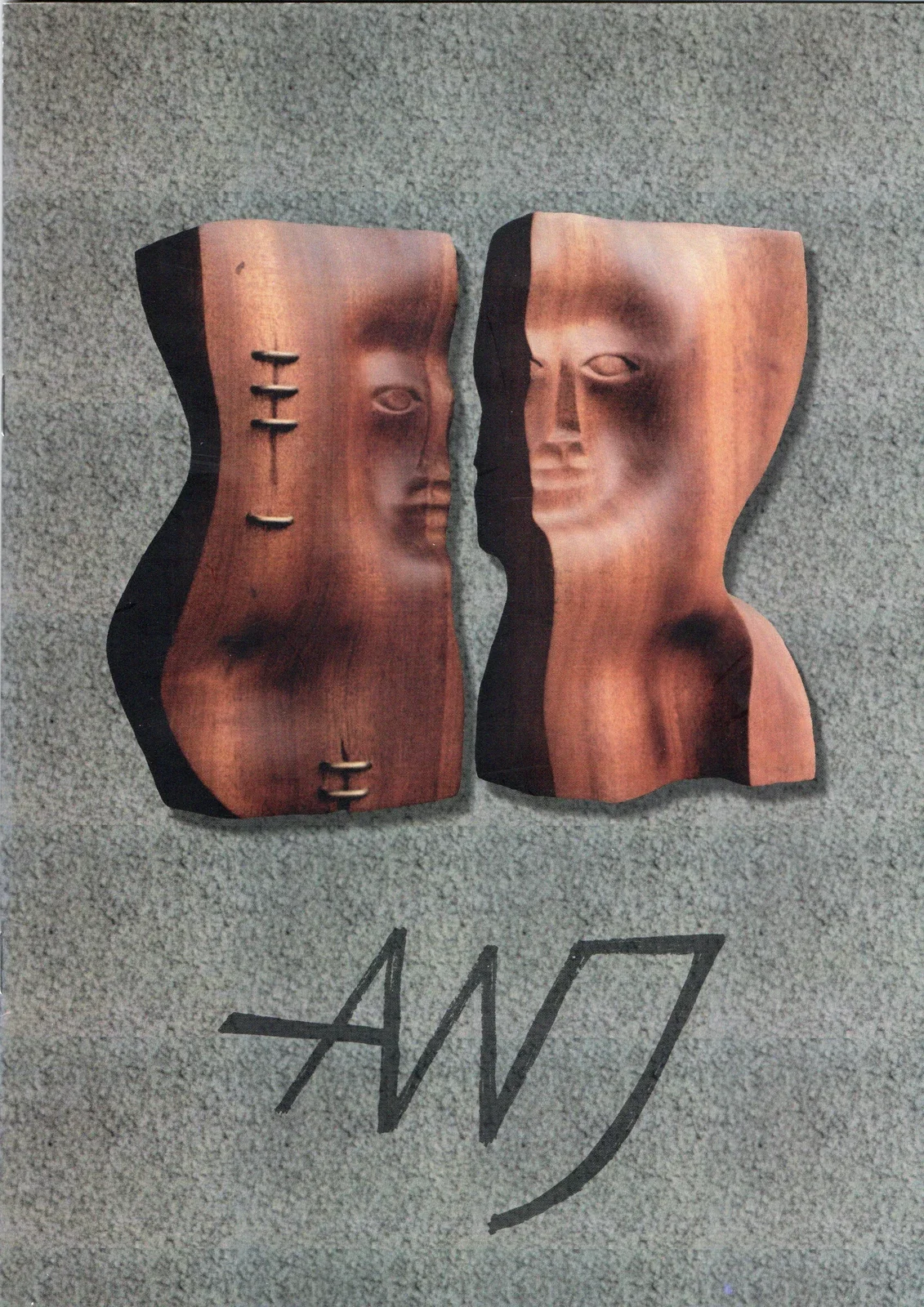
The title speaks of reflections, plural and successive. The two halves stand on their own and can be set out in more than one way, and the photographs in the archive preserve two of them. In 1999, when the Galeria Rzeźby in Warsaw gives Antonina her most extensive solo exhibition, the catalogue puts this work on its cover.
The work
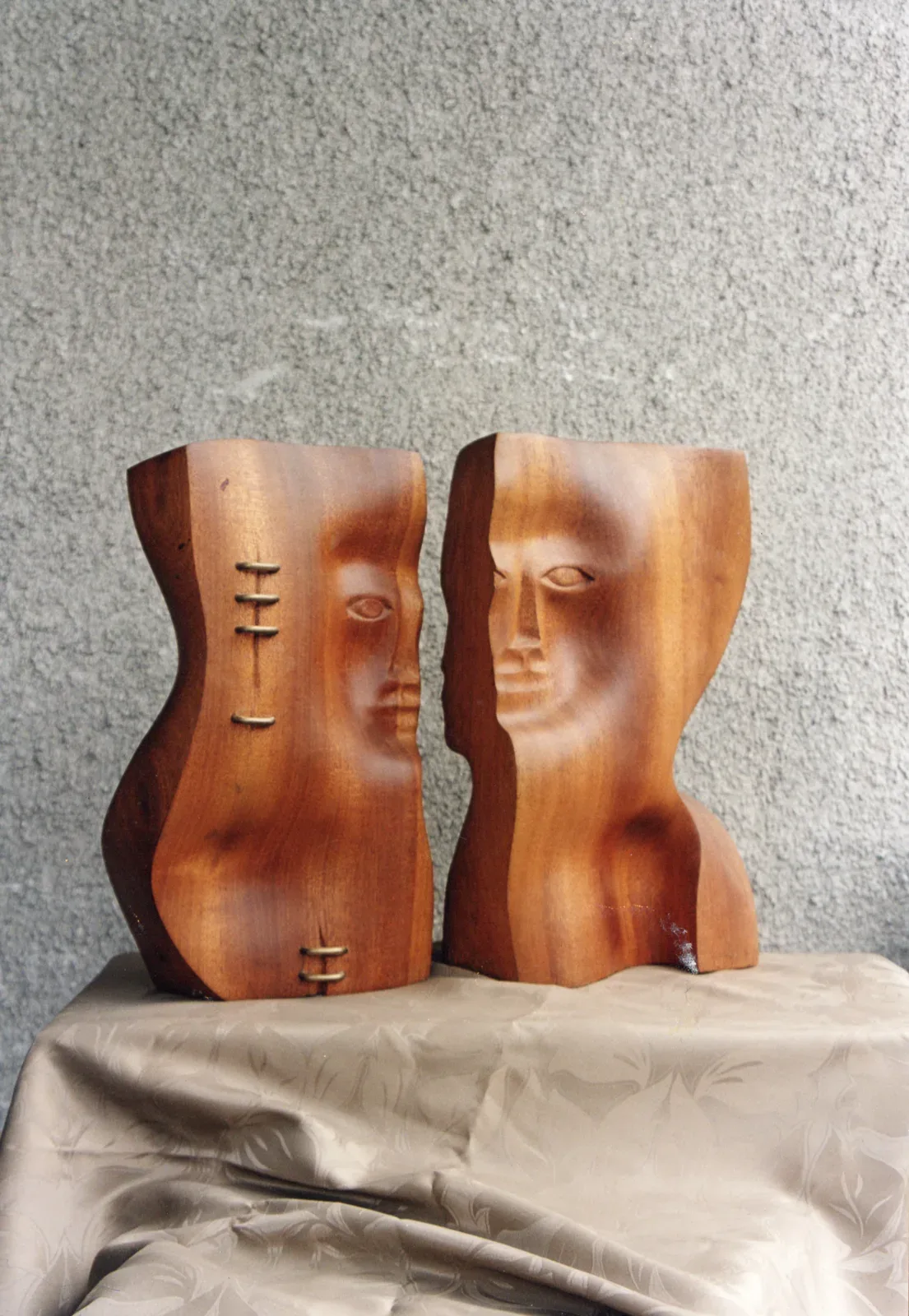
The two halves drawn together, the edges almost touching: it is the view from which the 1999 catalogue cuts its cover.
Photograph: the family archive, scanned from a period print.
The cut runs through the face
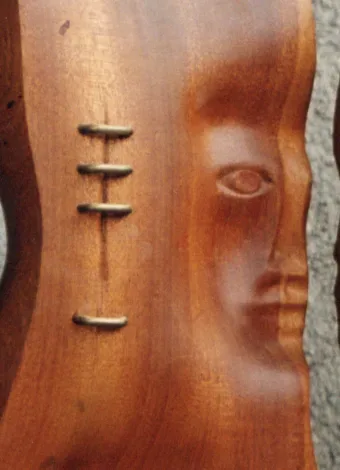
What is seen close toOn each of the two halves there is a face in relief, hollowed inside a shallow basin, and the split runs across it: on the left it carries away half a mouth, on the right it runs along the nose. The two faces are not of the same size — the right-hand one is larger — and set together they do not make up one face. They are two faces, and the cut has taken both.
On the left-hand half the wood has opened along the grain as well. The split is stitched by four metal cramps, and two more close a second opening lower down. They remain in view on the principal face, and it is like this, with the cramps, that the work goes on the cover in 1999.
Ignacy Trybowski, who in 1988 writes the text for the Kraków solo exhibition, gathers these sculptures under a single formula.
…popiersia i twarze zamknięte w graniastosłupach. Przy ich otwarciu ukazuje się pozytyw i negatyw… busts and faces shut inside prisms; on opening them, the positive and the negative appear
Two positions
The photographs in the archiveThe two halves are fixed to nothing, and the position they are put in changes what is seen. In the prints kept by the family they appear in two arrangements.
In the first they stand side by side and face whoever is looking: the two faces are read together, the broken edges almost touch, and the block seems on the point of closing again.
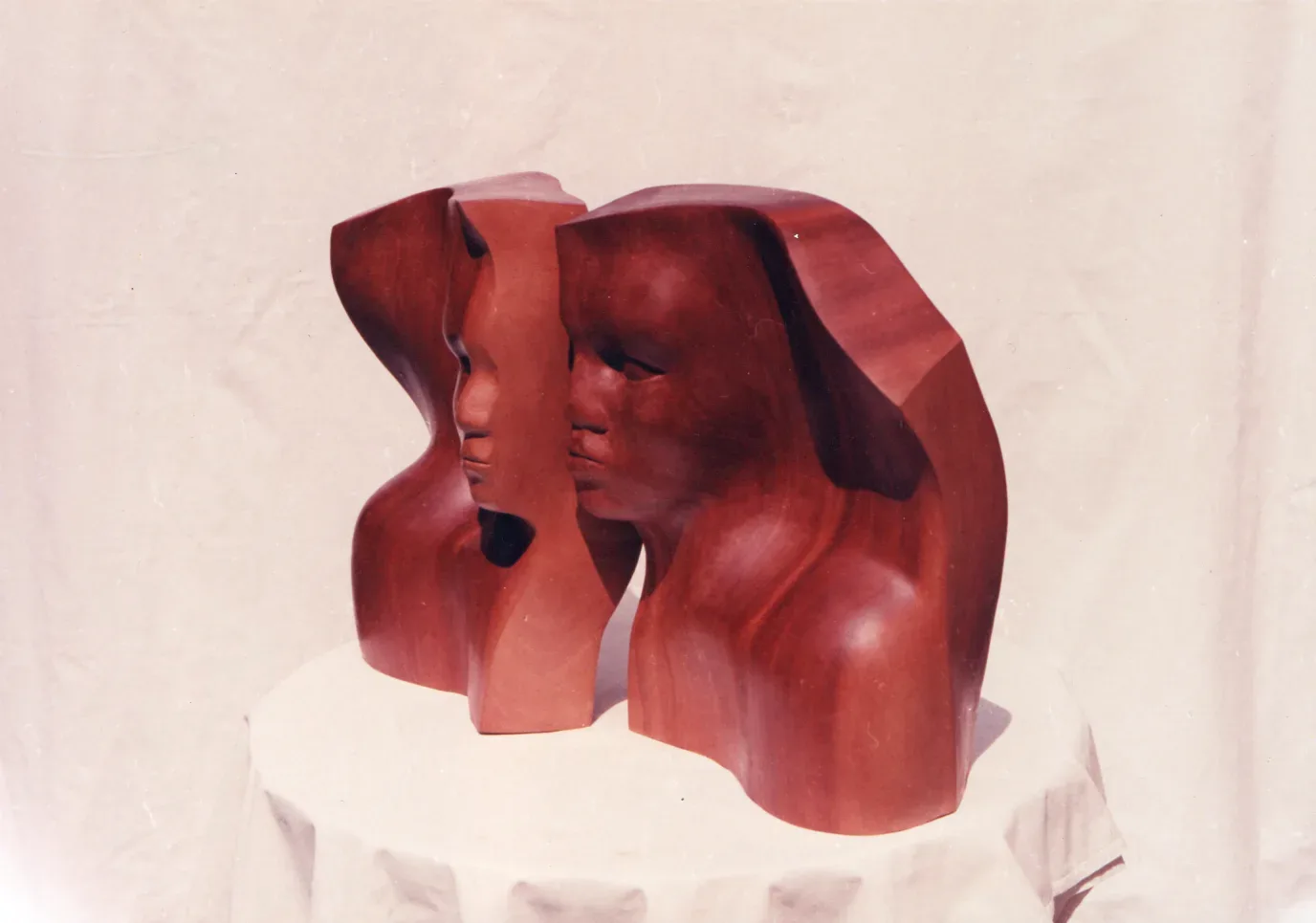
In the second they are turned towards one another. What face each other are the two faces of the cut, and the two portrait faces become profiles that come within a finger’s breadth of one another, at the height of the mouth. The block is no longer to be seen.
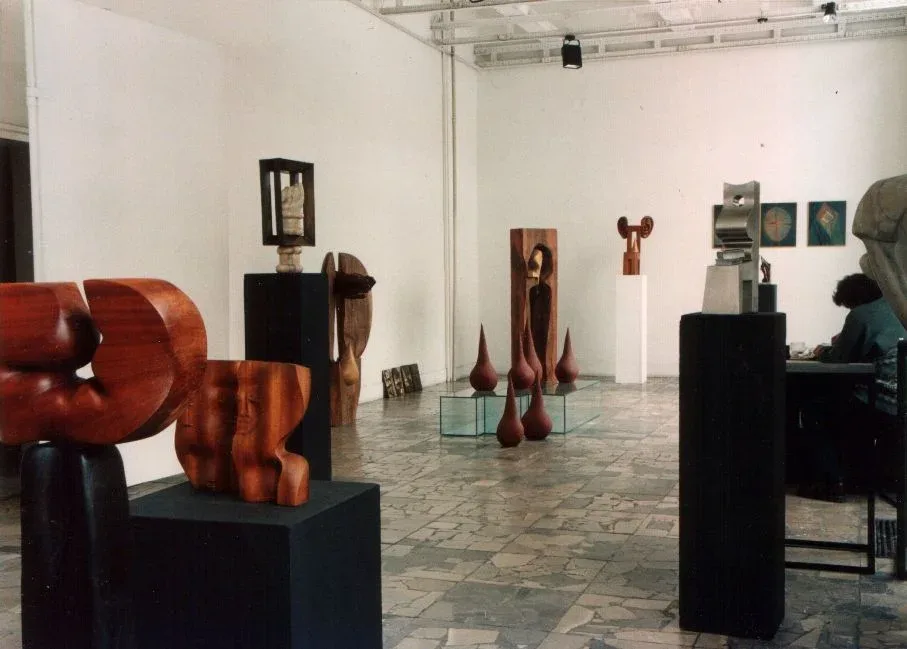
In the gallery of the 1999 retrospective they stand on a black plinth, drawn together, among the great wooden pieces; the photograph takes them obliquely.
The cover
Warsaw, February 1999From 17 February to 14 March 1999 the Galeria Rzeźby in Warsaw holds the solo exhibition that gathers Antonina’s work from the sixties onwards. The catalogue that comes out of it is the most extensive document that exists on her work, and it underlies a good part of this archive.
On the cover goes Kolejne odbicia. The two halves are cut out of the photograph and set apart on the grey ground, spaced: on the page the block is open. Below, large, the artist’s signature — the same one this site uses as its mark.
Inside, the catalogue reprints the text Trybowski had written eleven years earlier for the Kraków exhibition, with the figures brought up to date in square brackets: the sculptures in parks had been nine, «at present seventeen».