Odbicie
The reflections · 1989 and 1992
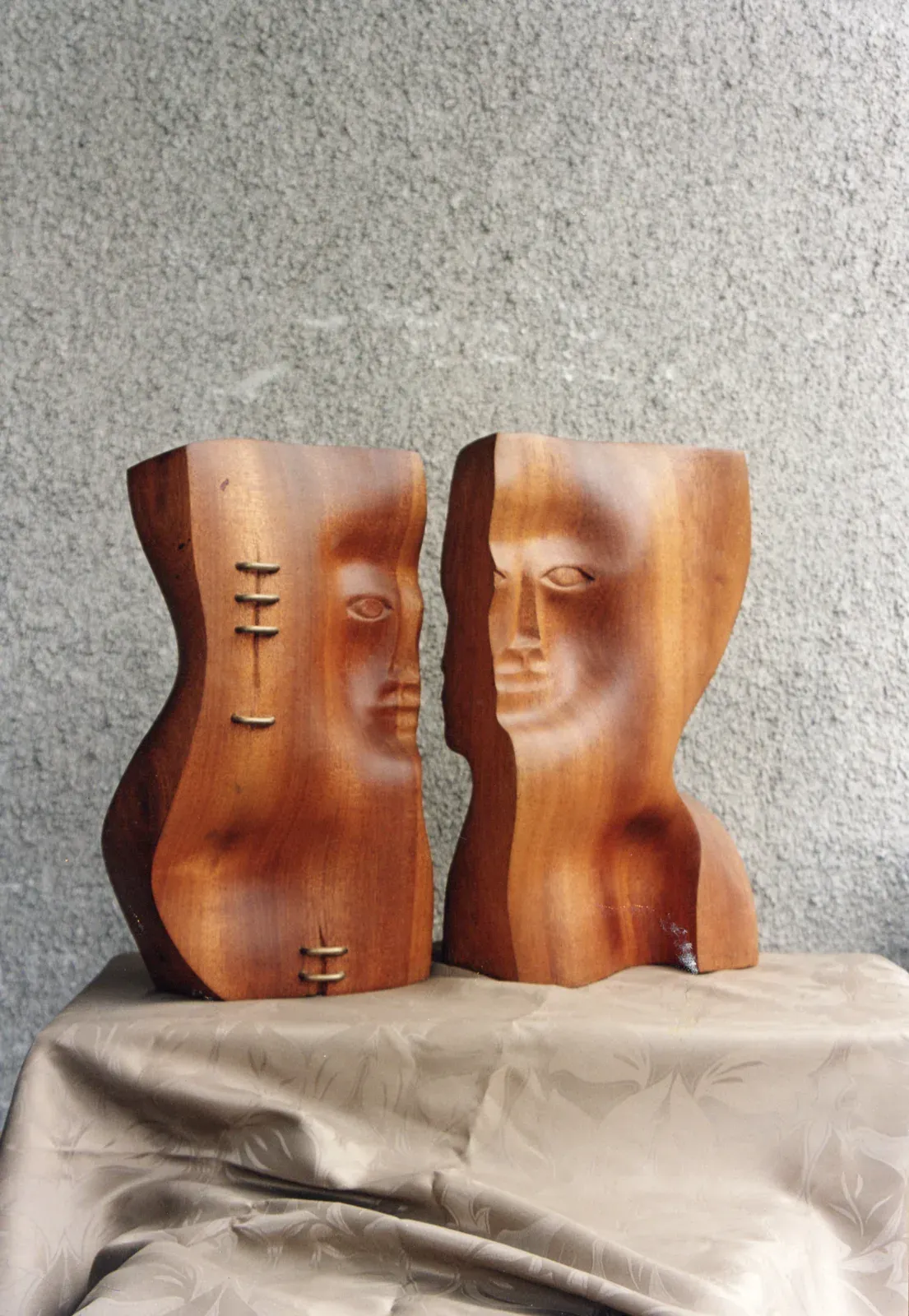
A face shut inside a prism. As long as the block is closed it is an abstract form, a solid of wood or bronze; opened, it shows the face twice — the positive and the negative, the relief and its imprint. The two images complete each other: neither, alone, is the whole face. The relation between the face and its imprint gives shape to the theme of presence and its trace.
The word returns across her whole career — there is an «Odbicia w niepamięci», reflections into oblivion, already among the terracottas of 1969 — and the motif finds its full form in the two «Kolejne odbicia» around 1990: first in mahogany, then in bronze.
The two halves
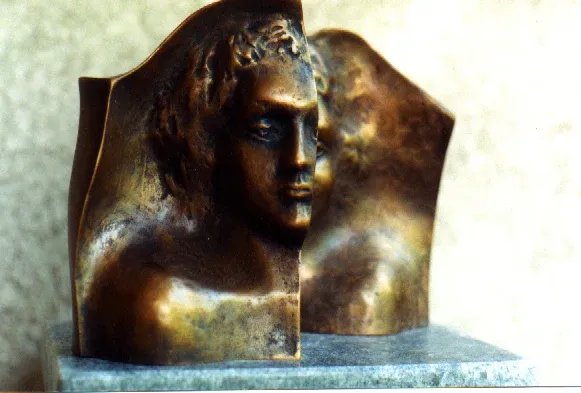
The two sculptures that carry the title. The mahogany is shown in black and white, the bronze in colour: the patina is part of the work.
-
 Enter the room →
 AW.S.0041 Kolejne odbicia
Further reflections1989 · mahogany · h 40 cm, two elements
Muzeum Regionalne, SiedlceThe two halves close into a single block; opened, they show the positive and the negative of the face.
-
 Open the catalogue entry →
 AW.S.0051 Kolejne odbicia
Further reflections1992 · bronze and marble, three elements
Muzeum Regionalne, Siedlce
Opening the block
The artist’s wordsIn the catalogue accompanying the 1988 Kraków solo exhibition, Ignacy Trybowski describes these works in one simple sentence: busts and faces shut in prisms — open them, and the positive and the negative of the likeness appear. Two images seeking each other: one is the form, the other the space the form has occupied.
And it is the artist herself who hands the critic the image that gives the series its meaning: the block that holds the two halves is «like a sarcophagus of our life» — what remains of us pressed into the things and the people we pass through. The reflection, here, is not a copy: it is the form presence leaves behind.
The mahogany of 1989 keeps the two halves stitched with brass clamps, like the points of a suture; the bronze of 1992 opens them on a marble base, the face in front and its shell at its back. And the word was already there twenty years earlier, in a 1969 terracotta named for the reflections that slide into oblivion: the motif is born as a question about what remains.
«To jakby sarkofag naszego życia…» like a sarcophagus of our life