Łza poznania
Tear of knowledge · Belluno, 1993
A trunk a metre and a half tall, worked all over with the gouge: not a hand’s breadth is left smooth, and the light settles on the scalloping as it does on a pine cone. High up, two cavities cut deep into the wood, divided by a thin wall behind which the light passes right through; below, the mass comes down solid to the ground.
It is made in the square, in front of whoever walks by, during the week of Saint Martin in 1993: the eighth international Ex Tempore of wood sculpture in Belluno, with Antonina as the guest who has come from Warsaw. On 14 November the jury awards her one of the Consorzio Centro Belluno prizes.
The work
The trunk standing: the gouge marks over the whole surface, the two cavities at the top and the wooden wall that separates them.
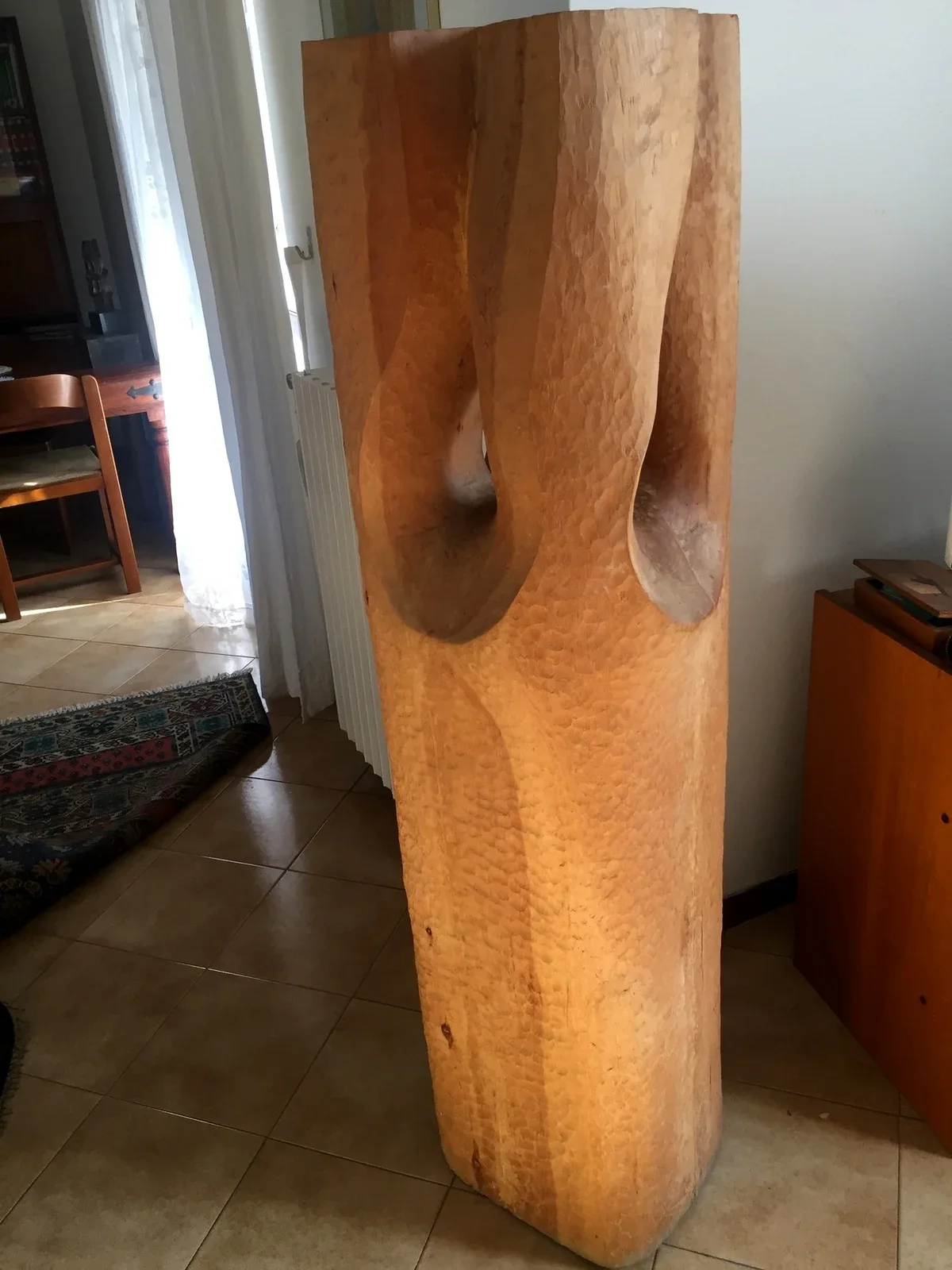
Photograph: family archive.
The square as a workshop
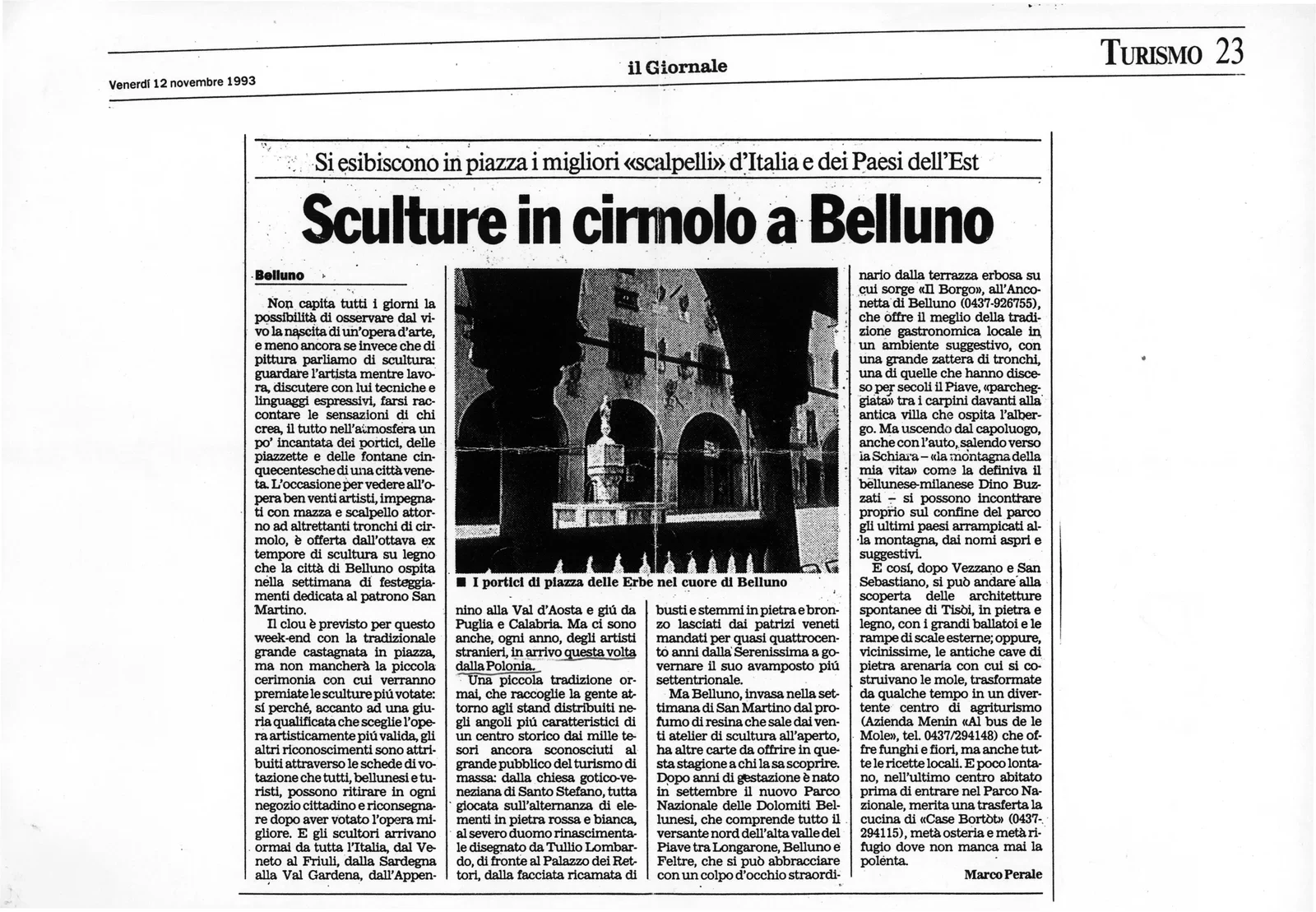
Belluno · the week of Saint Martin, 1993In Belluno the patron saint’s feast has been marked for eight years by a sculpture contest. Twenty artists, twenty trunks of Swiss pine, and for each of them a station where the town walks past: the work is done in the open for the days of the feast, and whoever passes stops to watch.
The most persistent are the schoolchildren, who — the local chronicle reports — take the stations by storm and bombard the artists with questions. The national daily covering the event presses the same point, and puts it first:
Non capita tutti i giorni la possibilità di osservare dal vivo la nascita di un’opera d’arte: guardare l’artista mentre lavora, discutere con lui tecniche e linguaggi espressivi. It is not every day that you get the chance to watch a work of art being born: to watch the artist at work, to discuss techniques and languages of expression with them.
None of this is new to her. At Hoyerswerda in 1977 and at Rostock the year after she had carved inside two zoological gardens, with visitors walking past the site all summer long. In Belluno the time is different: there it was two months, here it is the days of a town’s feast, and the wood has to be hollowed out before the patron saint arrives.
The chronicle lists her among those who had come from far away — from the capital of Poland, Warsaw — beside a South Tyrolean sculptor who works in Scandinavia and another who had come up from Lecce.
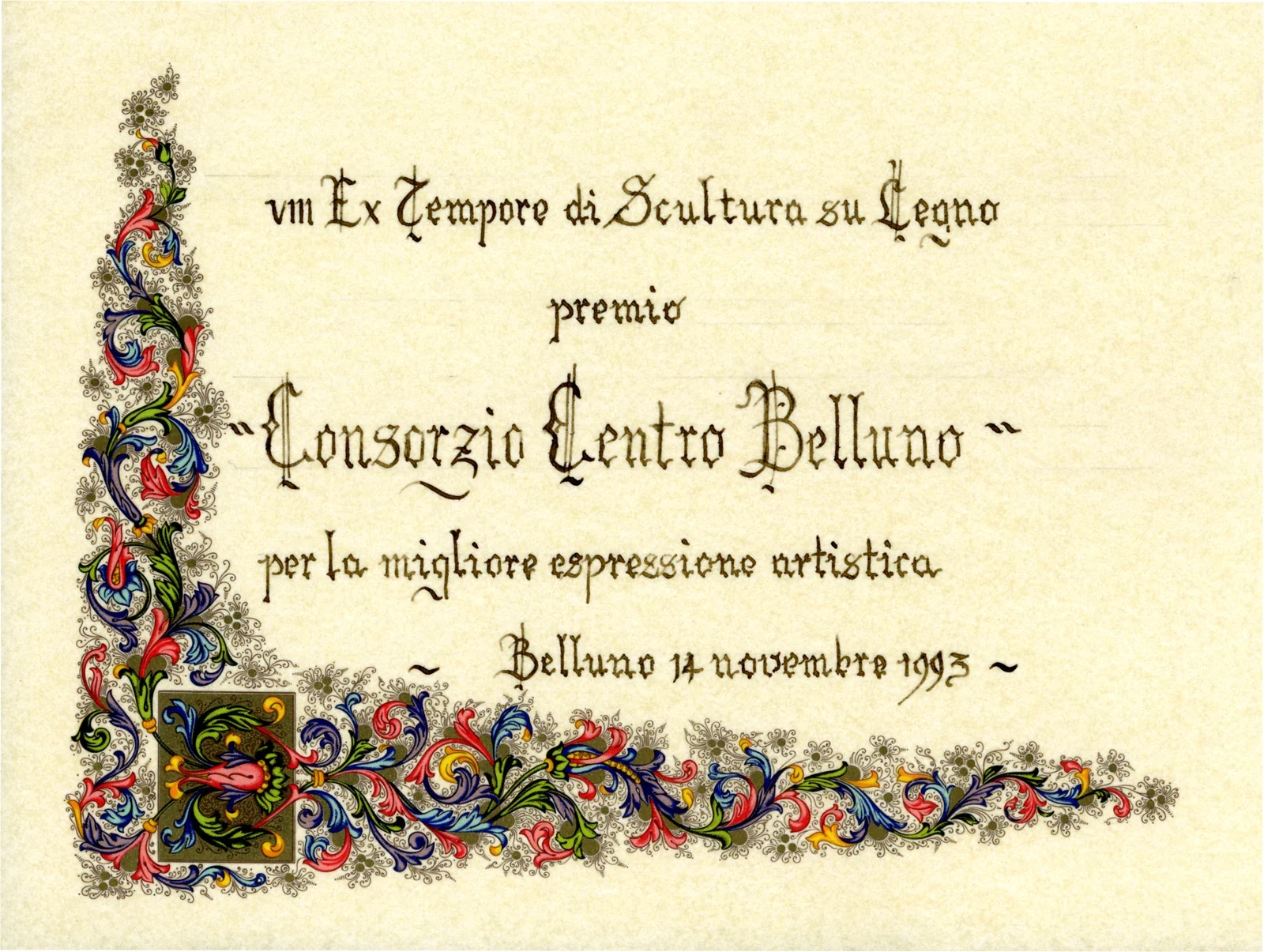
The diploma and the chronicle
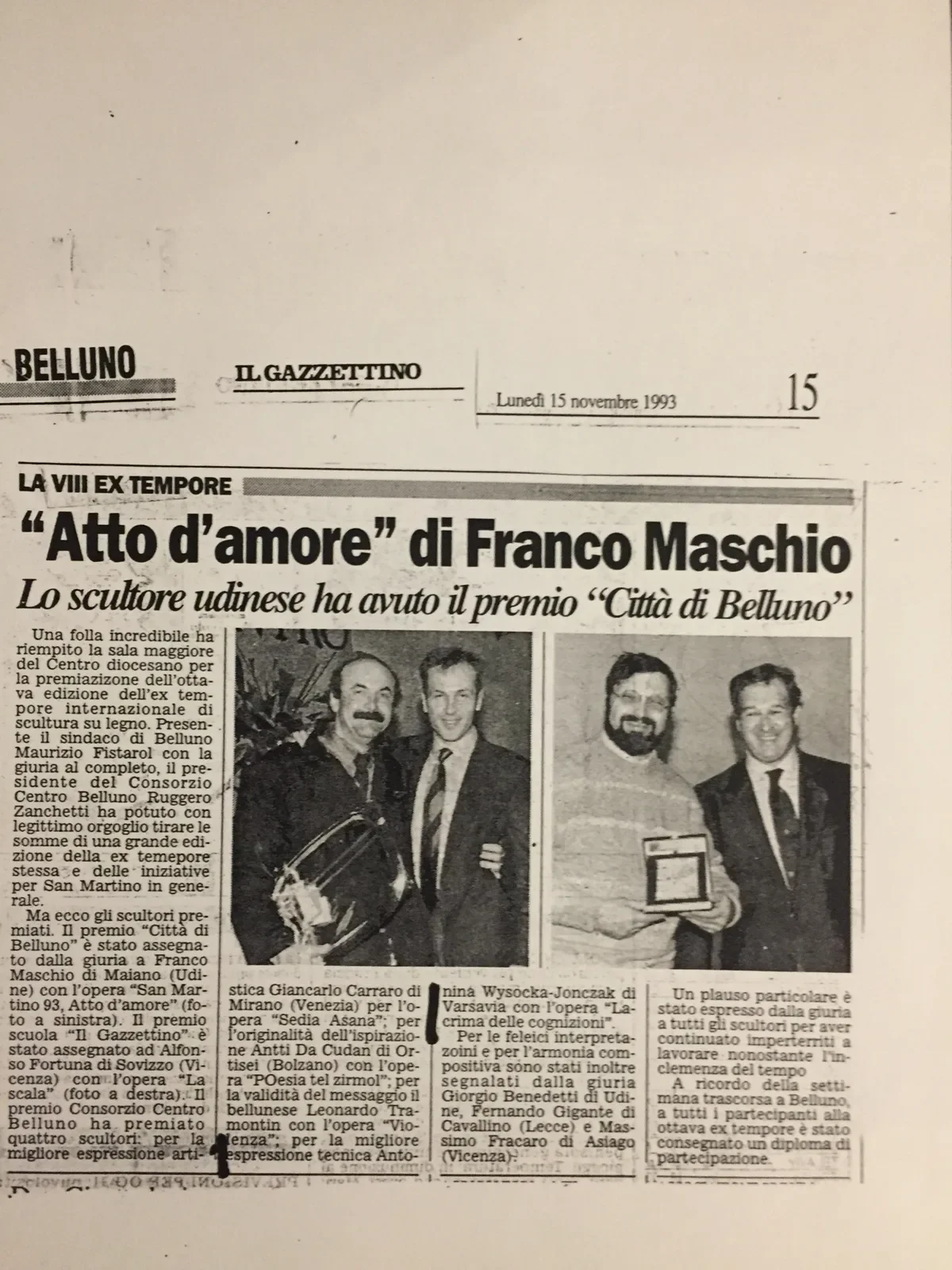
Belluno · 14 November 1993On 14 November, in the great hall of the Centro diocesano, the prizes are given out to a crowd. The «Città di Belluno» prize goes to Franco Maschio of Maiano, for a work called «San Martino 93, Atto d’amore»; the Consorzio Centro Belluno awards four more, and one of them is hers.
Il Gazzettino’s report says what for: for the best technical expression, Antonina Wysocka-Jonczak of Warsaw, with the work «Lacrima delle cognizioni». The parchment she took home — gothic calligraphy, an illuminated frieze running down the margin, the date at the foot between two flourishes — carries two other words: for the best artistic expression. That prize, according to the same paper, had gone to another sculptor, Giancarlo Carraro of Mirano.
No name appears on the sheet. It is a document that names the category and not the person, and which of the two formulas belongs to her is told by the chronicle, not by the calligraphy.
The year after
Belluno · November 1994She comes back. On 12 November 1994 Il Gazzettino introduces the five sculptors of the ninth edition, one short profile each, and hers is the first: Vilnius 1942, the Academy of Fine Arts in Warsaw from 1960, the diploma under Professor Marian Wnuk in 1966. Then the paper tries to say how she works.
Ama lavorare esclusivamente con le mani, Antonina, e con i pochi, antichi strumenti che da sempre appartengono alla sua arte, per non disperdere i messaggi della materia che sta lavorando, per poterne cogliere, attimo dopo attimo i cambiamenti, anche minimi, e potere da questi stessi venire ispirata. Antonina likes to work with her hands alone, and with the few old tools that have always belonged to her art, so as not to lose the messages of the material she is working, so as to catch its changes moment by moment, however slight, and to draw her inspiration from them.
It is one of the few times her poetics were written down in Italian, and they were written by a newspaper’s local pages while she was at work under the arcades. That year too the jury gives her a prize, and the work is «Mój dom», my house: a trunk a metre forty tall, the head a smooth cap above two barely marked shoulders, and on the chest a stepped relief that reads as a staircase or as a house seen edge-on.
In a photograph from that week Antonina stands beside the freshly finished wood, under the white awning of her station: behind her the arcades of the square, at the foot of the trunk the shavings.