Narodziny
Birth · two bronzes
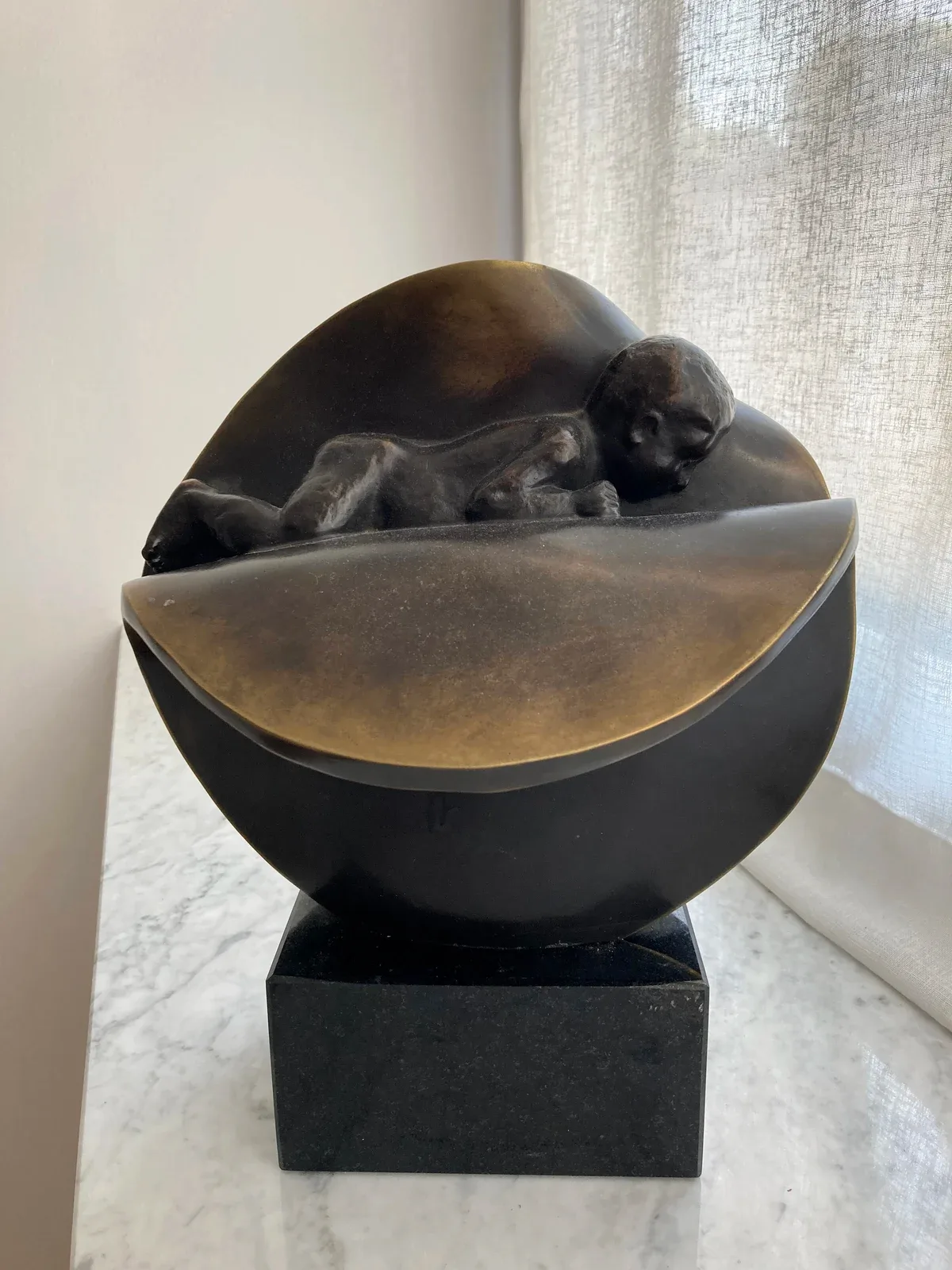
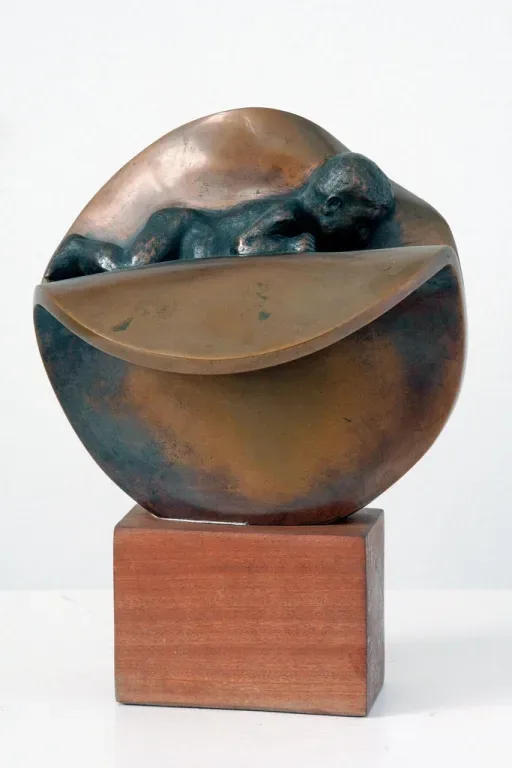
Twenty-nine centimetres of bronze, small enough to hold in two hands. The sphere is cut across by a lens-shaped opening, and the cut divides the colour as well: outside the patina is dark and matt, inside the exposed surface stays pale, almost golden. On that inner plane a newborn lies, a finger long.
There are two bronzes of this work, one in Warsaw and one in the collection of the Centrum Rzeźby Polskiej at Orońsko — and they are not the same cast repeated: the second time round the newborn was remodelled. Before either of them there is a pencil sheet, dated in the artist’s hand.
The work
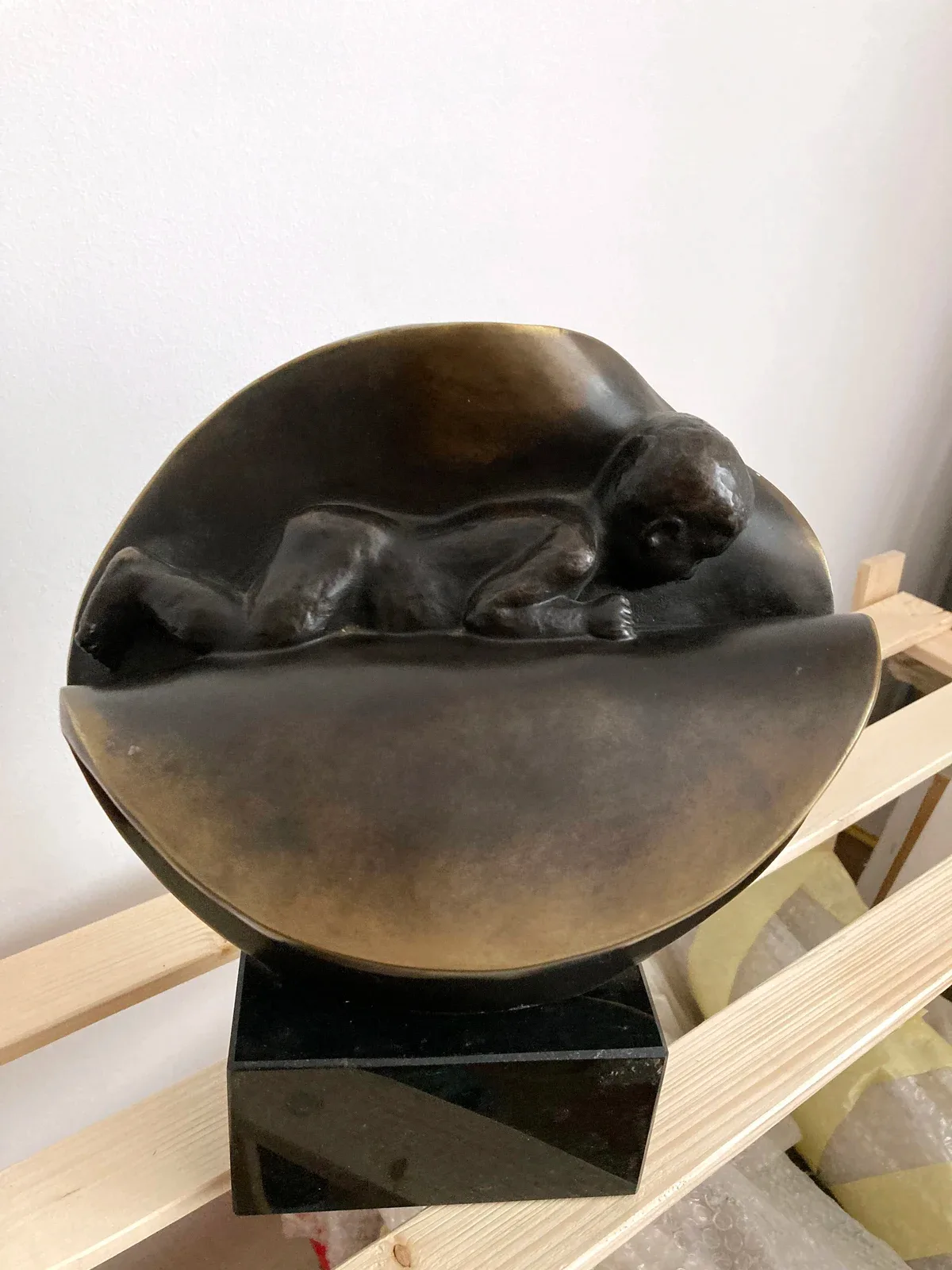
Two archive views of the same cast: from the front, and from a little above, where the newborn can be seen whole.
The sheet of 12 March 1984
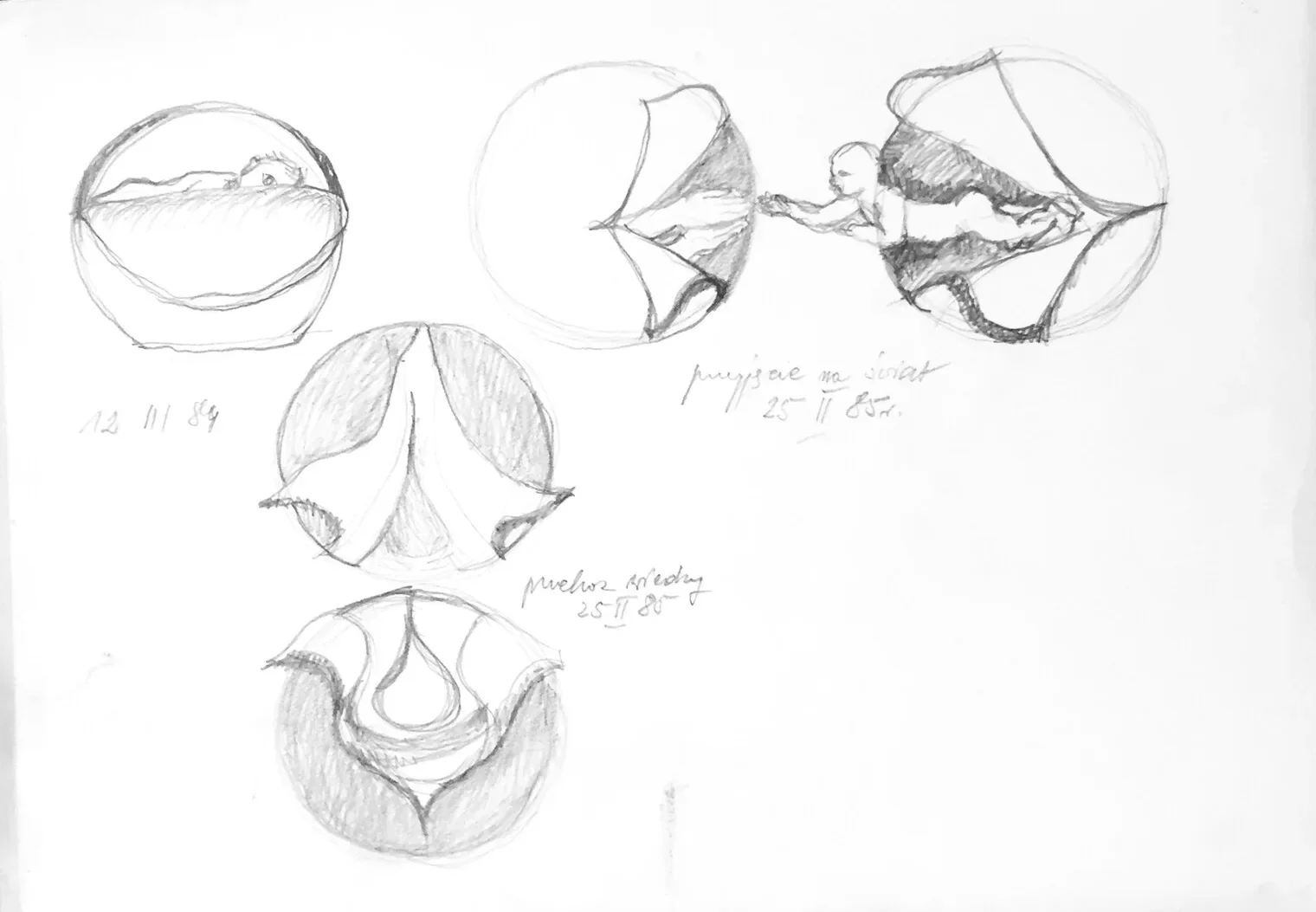
Five circles, three datesA landscape sheet, five circles in pencil on two registers, and three notes written by hand between them. Top left, under the date, the sculpture is already there: the sphere opened by the lens-shaped cut, and the newborn laid on the inner lip. The drawing is summary — a few lines and a smudged shadow — but the device is the one that was cast, and the date beneath it reads «12 III 84».
The other circles are a year later and carry two titles written out in full, both dated 25 February 1985. The first is «przyjście na świat», the coming into the world: two spheres side by side, opened by surfaces that stretch like sails, and between them a child’s figure passing horizontally from one to the other. The second is «przekaz wiedzy», the passing on of knowledge: a circle opening into lobes, like a bud seen from above.
At the bottom a last circle encloses a drop, drawn in outline within the dark field of the disc. It is the same motif that in those same years comes back to her hand in four works and in some fifty sheets.
Two bronzes
Warsaw and OrońskoThere are two bronzes of this work. One is the one in the family photographs, standing on a black granite plinth. The other is in the collection of the Centrum Rzeźby Polskiej at Orońsko, which publishes it on its artist page: a pale wooden block instead of granite, and a patina turning green and copper where the other stays brown.
The shell is the same — the same sphere, the same lens-shaped cut, the same ridge. The newborn is not. In the Warsaw bronze the head lies flat on the plane, the face turned to the front and tilted down, and the hand reaches forward clear of the face; in the Orońsko one the head is raised and turned in profile, the neck stretched, and the forearm folds beneath the chin. This is not a matter of viewpoint: in one the face is frontal and the hand is separate, in the other the face is in profile and the hand is under the chin, and the two cannot be the same thing seen from two sides.
So these are not two casts from one mould but two versions: the second time round the figure was remodelled. Which means the «II» with which the museum records its own reads literally, and not as an inventory number. The year stays open, and there are three sources for it: the museum says 1985, the archive’s master sheet gives 1986, the project sheet is from 1984.
The other Birth
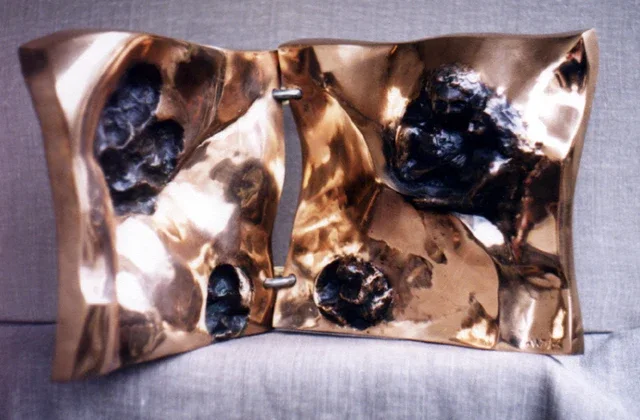
From the cycle «Przemijanie» · 1988Two years later the same title returns on a work that resembles it in nothing. «Narodziny z cyklu Przemijanie» — Birth, from the cycle «Passing» — is a bronze of hammered plates pinned together like the pages of an open book; small dark figures are lodged in the folds of the sheet. Birth here is not something that opens: it is something that is leafed through.
Between the two lies a decade in which Antonina worked almost always in the same way — a closed mass and, inside it, one single thing carved from life. In 1999, presenting her solo show at the Galeria Rzeźby in Warsaw, whoever wrote the catalogue text set the title of this work beside the titles of the busts:
Patrzę z wielkim podziwem na rzeźby Antoniny Wysockiej-Jonczak zatytułowane Subiektywny, Narodziny, Integracja. I look with great admiration at the sculptures of Antonina Wysocka-Jonczak entitled Subiektywny, Narodziny, Integracja.
These are the bronzes the artist kept at home and took to exhibitions for twenty years: the one that opens onto the newborn, and those with the barred face. In 2009 they go to Siedlce together, in the large solo show that takes its name from the 1988 cycle.