Skupienie
Recollection · 1986–87
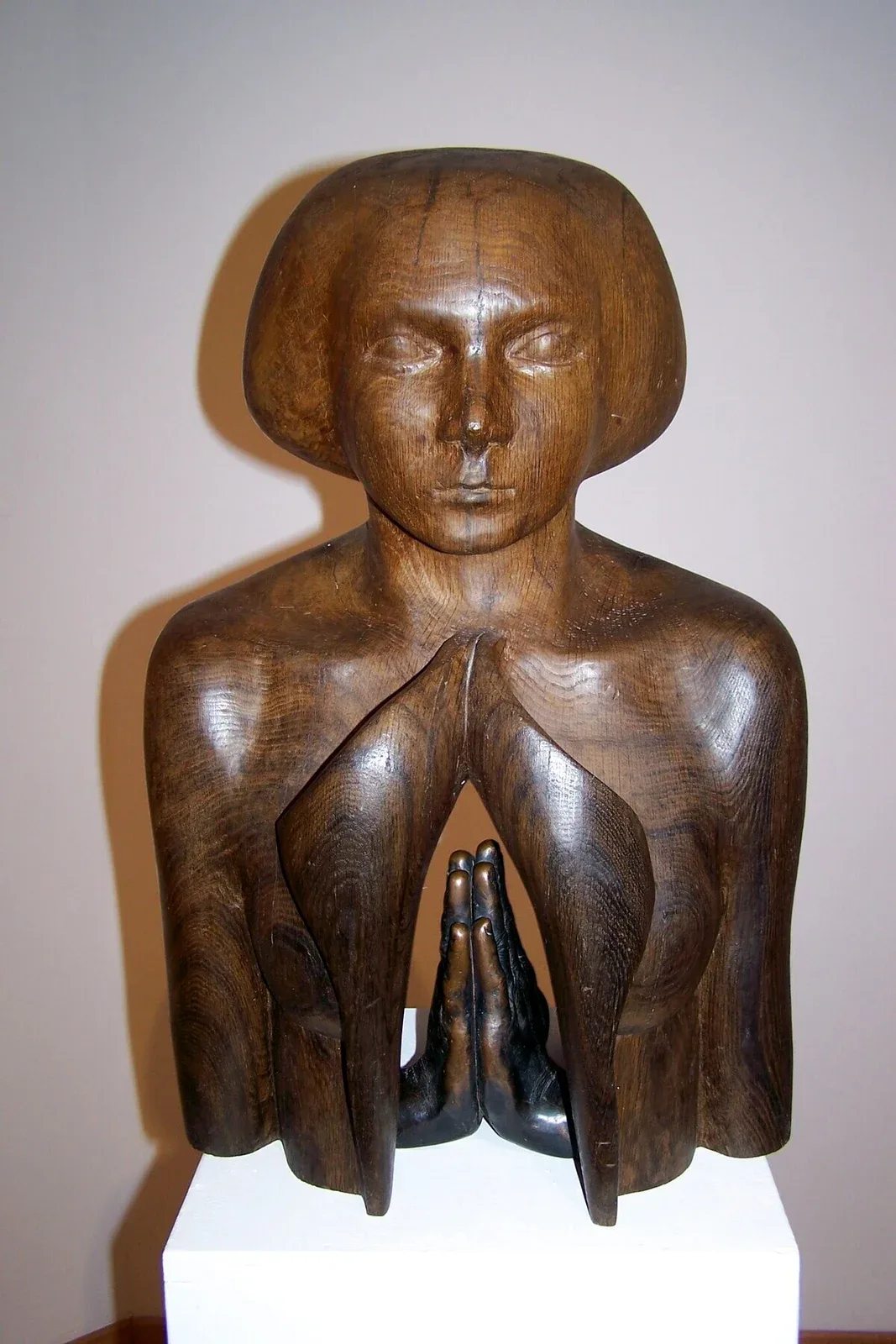
A bust of black oak, polished until it gives back the light: a woman with hair cut level with the jaw, her eyes closed, her face still. The breast opens in two flaps, like a cloak drawn aside, and inside the opening — low down, where the heart would be — are two joined hands of bronze.
They are the only thing that is not wood: all the rest is closed, and they are gathered at the centre.
The work
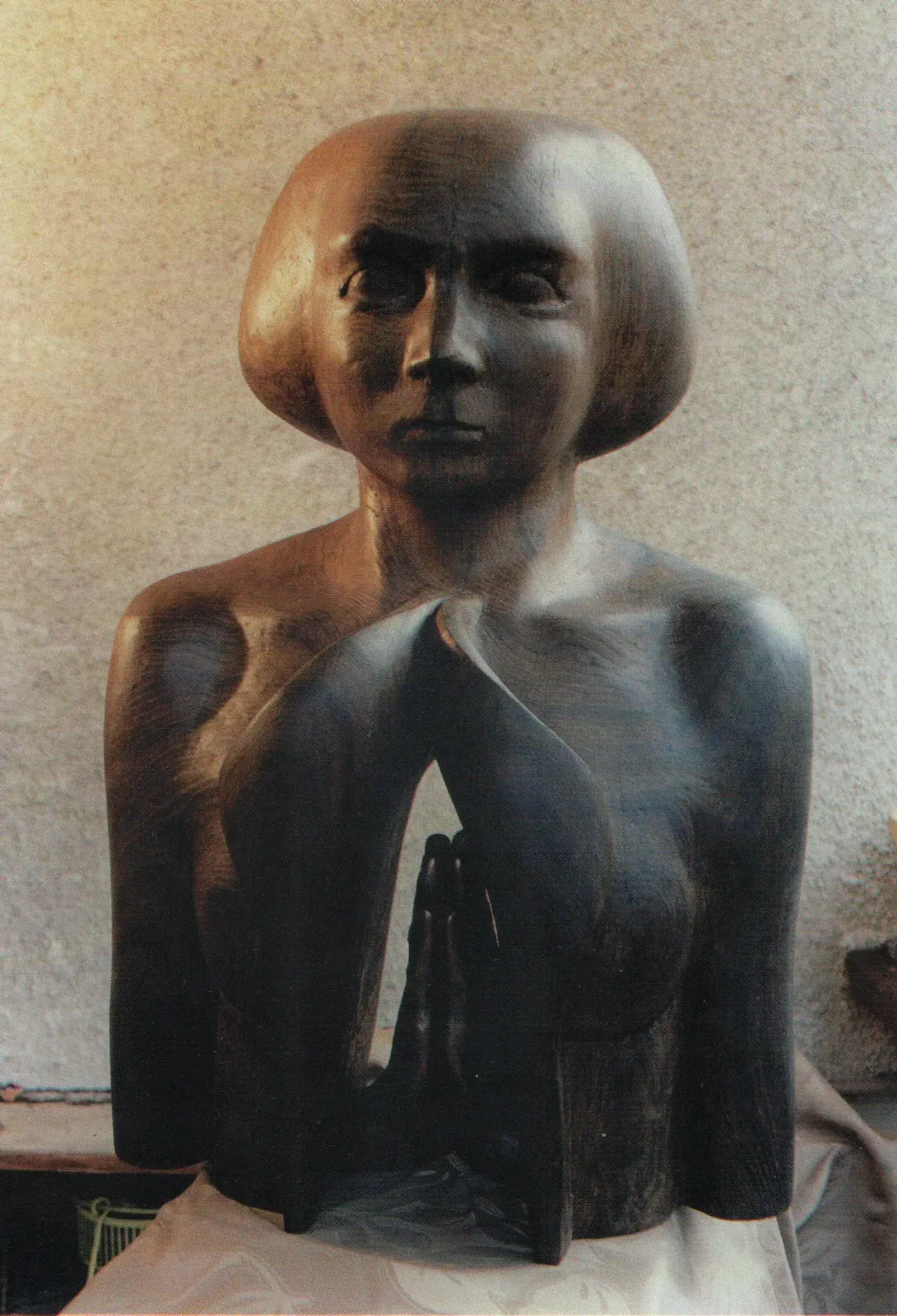
The bust from the front and the catalogue plate: two elements, two materials, a single figure.
Half a year of black oak
The artist’s words · 2009She tells the making of this work too, in the same interview in which she explains the Dyskobol and the Hiroszima. It begins with a drawing made for herself, in some notebook; then it takes her nearly six months, because the material does not forgive. Black oak is wood that has lain buried or under water for centuries: it hardens, it takes in sand, and every gouge blunts on it.
Miałam kawałek czarnego dębu i musiałam się w niego wpasować. Czarny dąb jest twardy. Ma w sobie piasek i jest bardzo trudny do obróbki. […] Tak się w nie wpisać […] żeby nie zmarnować ani grama z tego drewna. I had a piece of black oak and I had to fit myself into it. Black oak is hard. It has sand in it and is very difficult to work. […] To write oneself into it […] so as not to waste a single gram of that wood.
The sentence became the title of the interview, and it says how she worked: not the form imposed on the material, but the form that is inside it. The block decides the height, the width of the shoulders, how far the breast may open; her part is to get inside it with nothing left over.
An exhibition photograph says how large that piece of wood is: fifty-seven centimetres, the height of a terracotta bust in a studio. Half a year of work is all in there.
The void and the hands
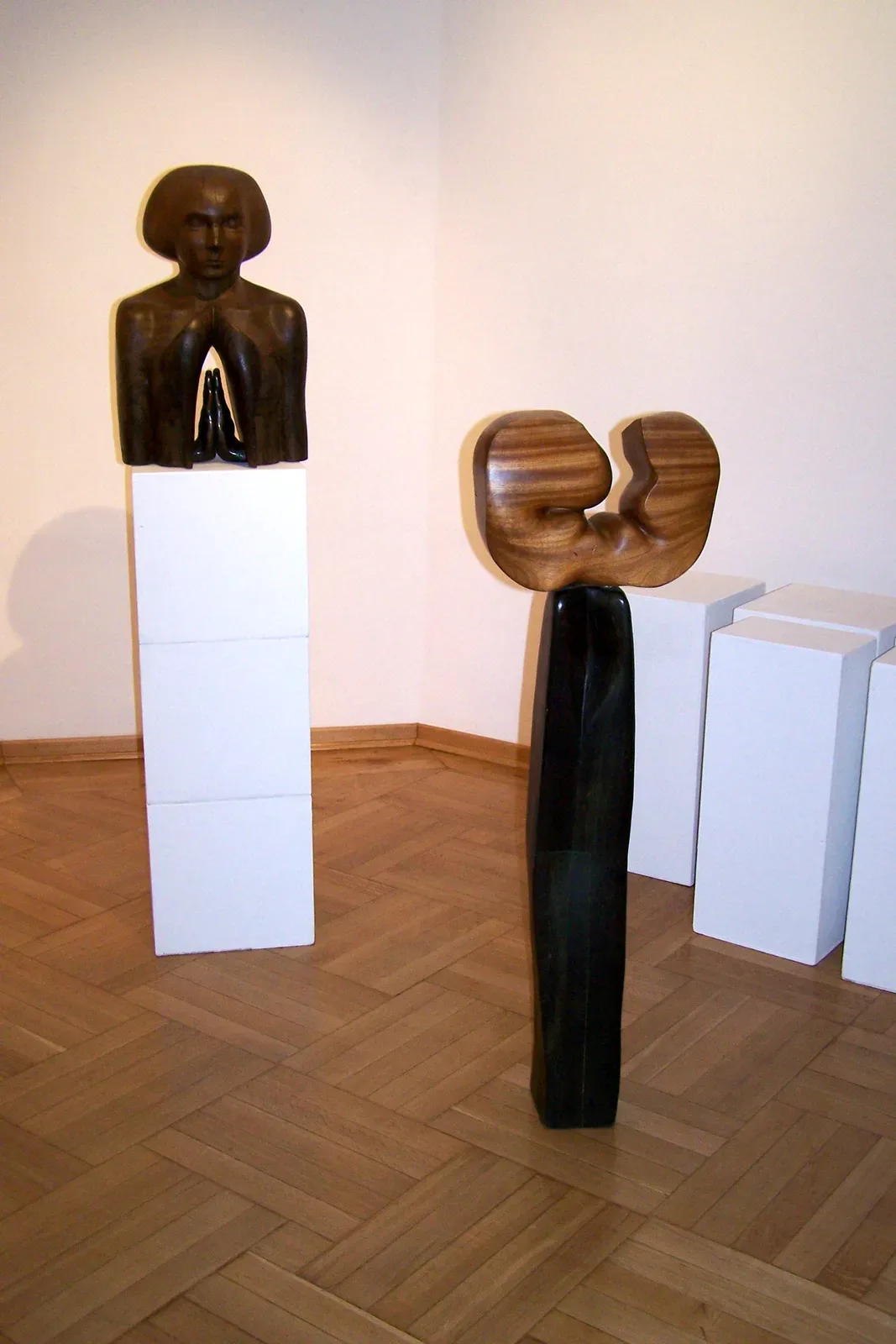
Beside «Rozdarty» · 1999At the 1999 retrospective this work stands beside another: «Rozdarty», the Torn one. The «Życie Warszawy» review looks at the two together and notes that they are built in the same way — two wooden busts with the chest thrown open — and that the whole difference lies in what is inside:
Zostały one bardzo podobnie zaaranżowane — przedstawiają drewniane popiersia […] z rozdartymi klatkami piersiowymi. W pierwszej, w pustce pozostałej po przepołowieniu nie ma nic. W „Skupieniu” rzeźbiarka umieściła dłonie złożone jak do modlitwy. They are arranged very similarly — they are wooden busts […] with the ribcage torn open. In the first, in the void left by the splitting, there is nothing. In «Skupienie» the sculptor has placed hands joined as if in prayer.
Two works and a single question: what is left when a person opens. In one the answer is nothing; in this one it is a small gesture, in bronze, resting at the bottom of the opening and invisible from any distance — one has to come close to the wood to notice it.
The notebook sheet
7 May 1984In the 2009 interview the sentence about the black oak is not the first. Before it comes another, short line, which says where the work begins:
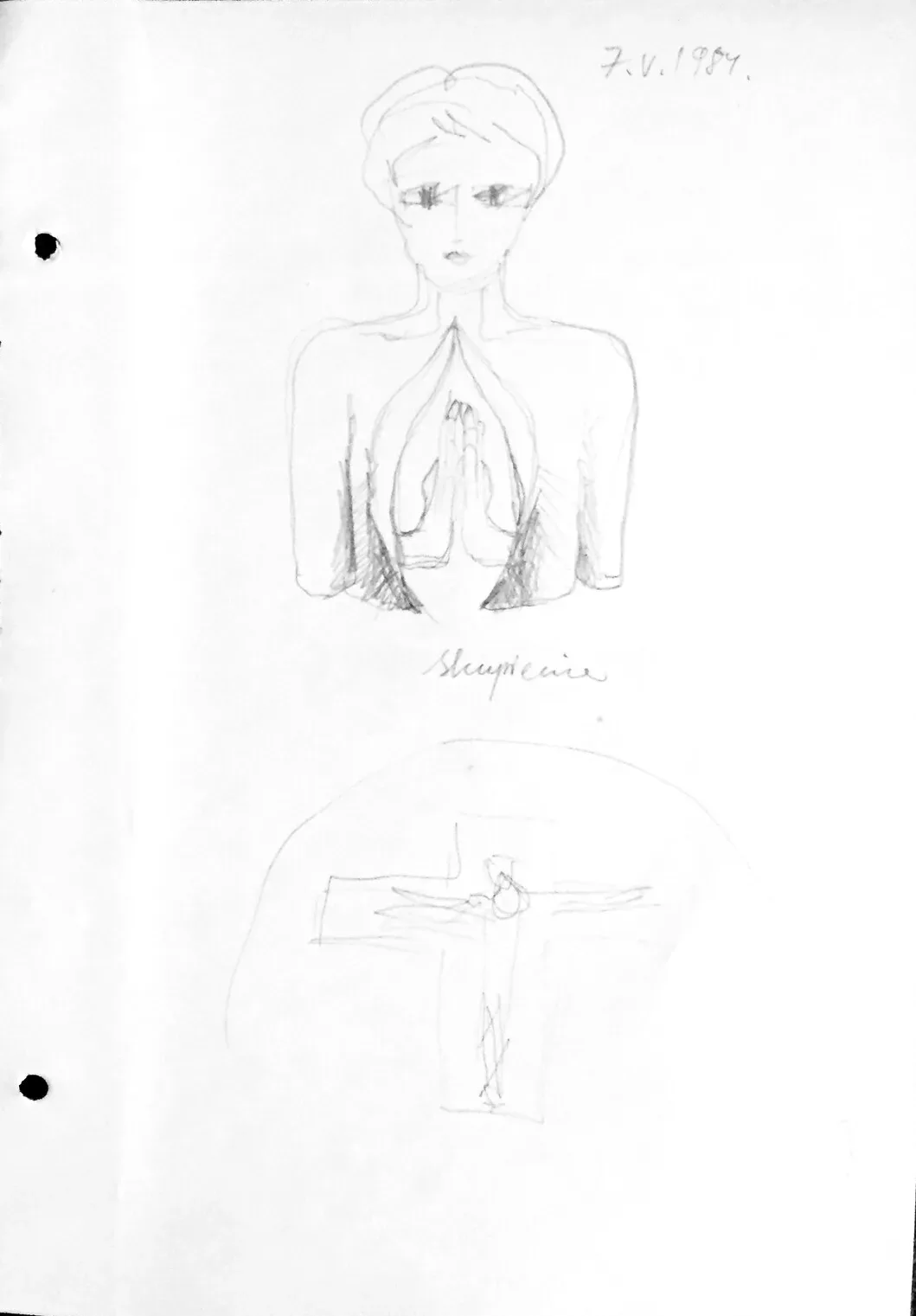
Np. rzeźbę „Skupienie” narysowałam sobie w jakimś notesie. For instance the sculpture «Skupienie» — I drew it for myself in some notebook.
That sheet exists. It is a page torn from a notebook, with the two binding holes along the margin; at the top right it carries the date written out in full — 7 May 1984 — and below the drawing, in cursive, one word written by the artist: Skupienie.
The bust as drawn is already the work. The hair cut level with the jaw is there, the shoulders cut clean across, the arms rising towards the centre until the hands meet palm to palm. And there are, to right and left beneath the arms, two wedges of hatching so dense that they go black: in the oak those two wedges are the shadowed hollows flanking the arms, and the bronze hands surface between them, at the centre of the opening.
Between the pencil and the wood more than two years pass — the bust dates from 1986–87 — and in those two years one single thing changes, but it is the thing. On the paper the hands are large: they fill the whole opening, they rise to the throat, they are the first thing seen. In the oak they have shrunk to a small gesture set at the bottom of the opening, the only piece of bronze in a work of wood, and from a distance it cannot be seen. The half year of work went into this as well: into making the thing that matters smaller.
On the same sheet, below the bust, a second drawing runs, barely indicated with the edge of the pencil: a field closed by an arch, a broad cross, and on the cross a minute figure. On 7 May 1984 the same hand designs on one page a bust and a gravestone — the two crafts she held together all her life, one above the other.