S.O.S. Natura
Krastal · Villach · Millstatt, 1992
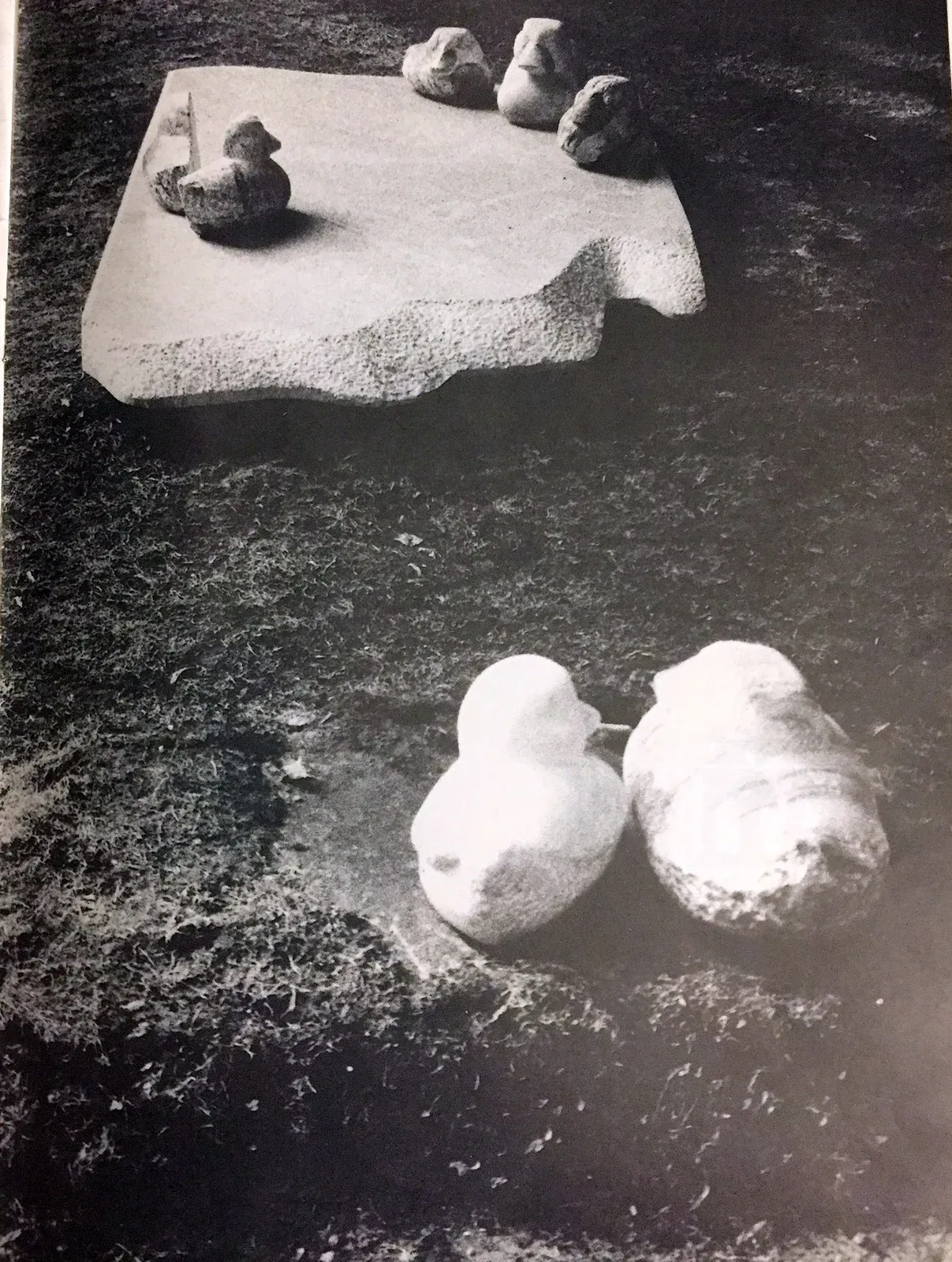
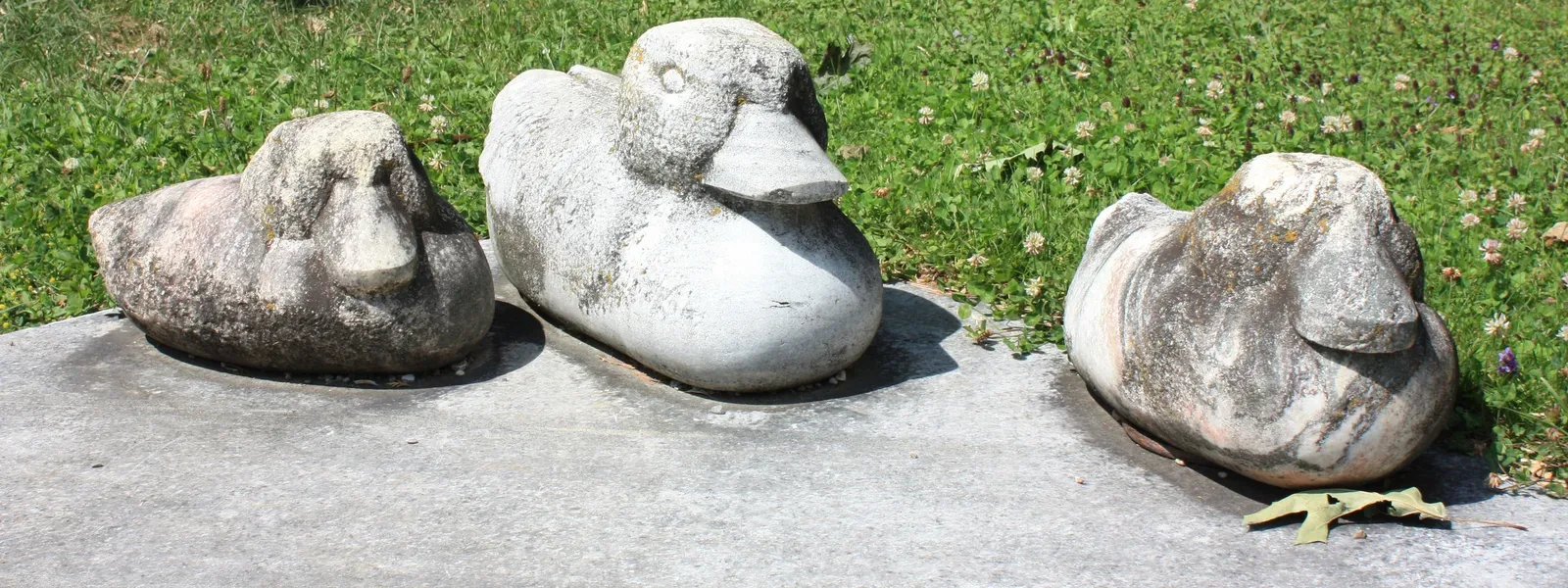
A slab of marble laid on the grass like a sheet of water, and on it a group of stone ducks: one crouched, one listening, one upended with its tail in the air, dipped into the slab the way ducks dip into a pond to feed. The title explains it in three letters: S.O.S.
It dates from 1992, and it is the only work in the catalogue that tells itself as a scene.
The work
The period photograph, with the slab-pond just laid on the grass, and the work in the park at Millstatt thirty years later: the same group, with its weathering on it.
The quarry and the park
Krastal · Villach, summer 1992The Krastal symposium, in Carinthia, celebrates its twenty-fifth edition in 1992, and that year it splits in two: the title it gives itself is «Stone · Quarry · City Park», and these are the three stations of the work. The first phase is at the quarry, from the end of June to mid-July, where the sculptors choose their blocks, rough them out and argue over subjects; on 20 July the sculptures are carried down into the city park of Villach, and there the work goes on in front of the town until 8 August. It is the first time the symposium comes down from the quarry into the square.
The municipal bulletin, in September, tells how it went: at the start the sculptors were looked at askance, and taken by some neighbours for troublemakers; by the end the neighbours were bringing them cake and wine. The ten blocks of marble, some of them monumental, had been given by the quarry firm. At the foot of the chronicle are the names of those who worked in the park, eleven sculptors from seven countries — Antonina is the only Pole, and the paper, to say what she is making, writes only: «with a group of stone ducks».
- Varda Ghivoly israel
- Ilan Gelber israel
- Gillian Forbes great britain
- Jun Furukawa japan
- Andreas Theurer germany
- Roman Wenzel czechoslovakia
- Antonina Wysocka-Jonczak poland
- Christian Feierle austria
- Elisabeth Juan austria
- Helmut Machhammer austria
- Wolfgang Wohlfahrt austria
The closing party is on 8 August; the works stay on show in the park until the end of the month. Then each goes where it was destined: the pond of ducks takes the road to Millstatt, on the lake, where it still stands when it is photographed.
The duck pond
The artist’s words · 1992The symposium catalogue is titled after its own route — «Stone · Quarry · City Park» — and for each sculptor it prints a page: the biography, the materials, the dimensions, and the artist’s text. The two lines Antonina writes for her work, in German and in English, are the one case in which she declares the intention of a piece before anyone else interprets it.
Der Ententeich bietet dem Betrachter den Zugang zur Natur an und ruft ihn dazu auf, diese zu bewahren. The duck pond offers the beholder an access to nature, and calls on them to preserve it.
The cry for help in the title is not put in the ducks’ mouths: it is put in the hands of whoever is looking. The ducks are perfectly well — one dives, one rests — on a water that is stone: a pond that can neither dry up nor be polluted.
It is also the one time her work turns light. The material is the same as the great park stones — quarry marble, worked by hand, in the open air — but the subject is taken from everyday life, and whoever walks through the park at Millstatt recognises it without needing to know anything.
-
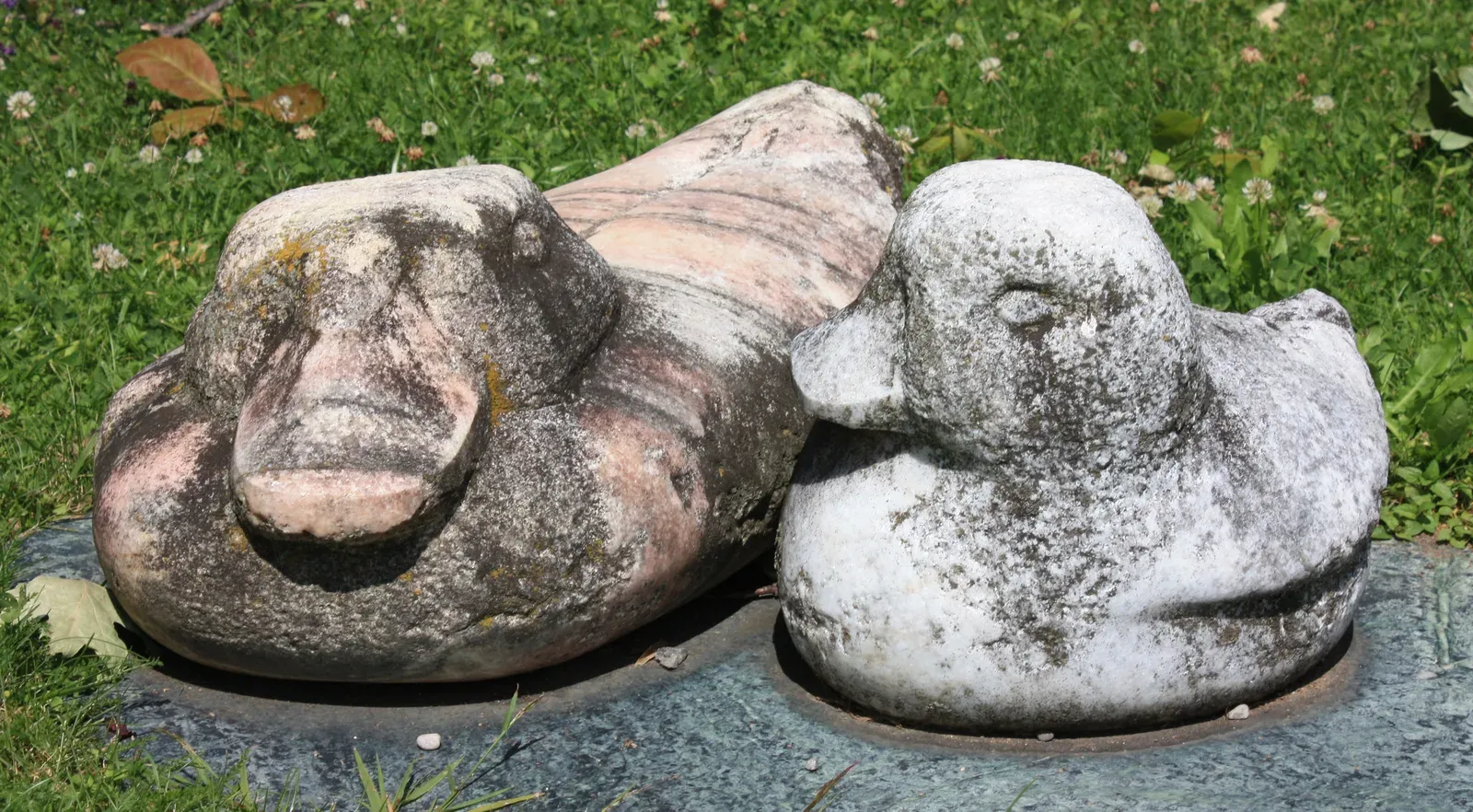
The two large ducks close to: the marble has taken lichen, and the pinkish veins of the block run along the back. Photograph: Mefusbren69, Wikimedia Commons, public domain -
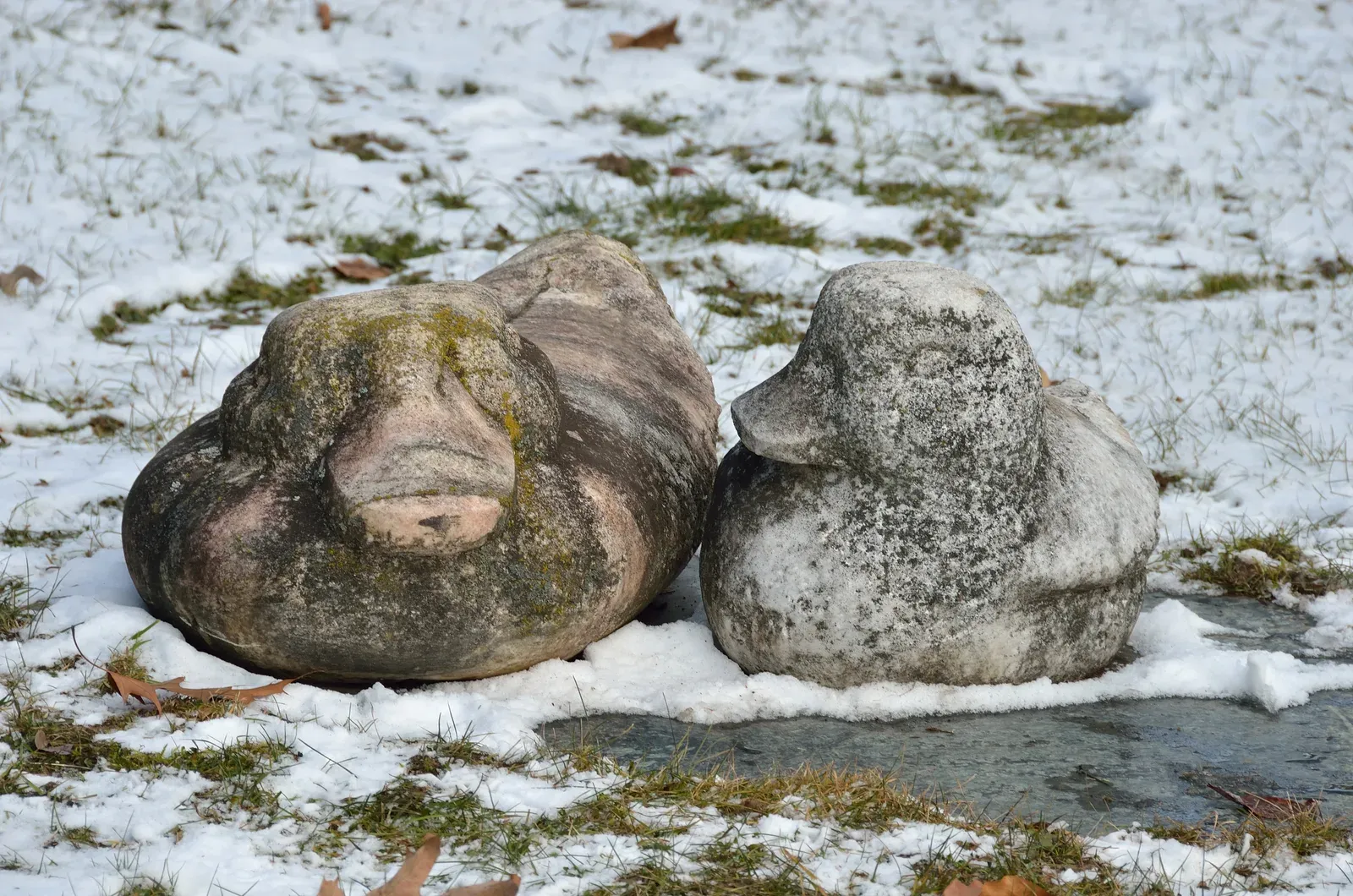
In winter the slab is covered with snow, and the stone water comes to look like a frozen pond again. Photograph: Herzi Pinki, Wikimedia Commons, CC BY-SA 4.0 -
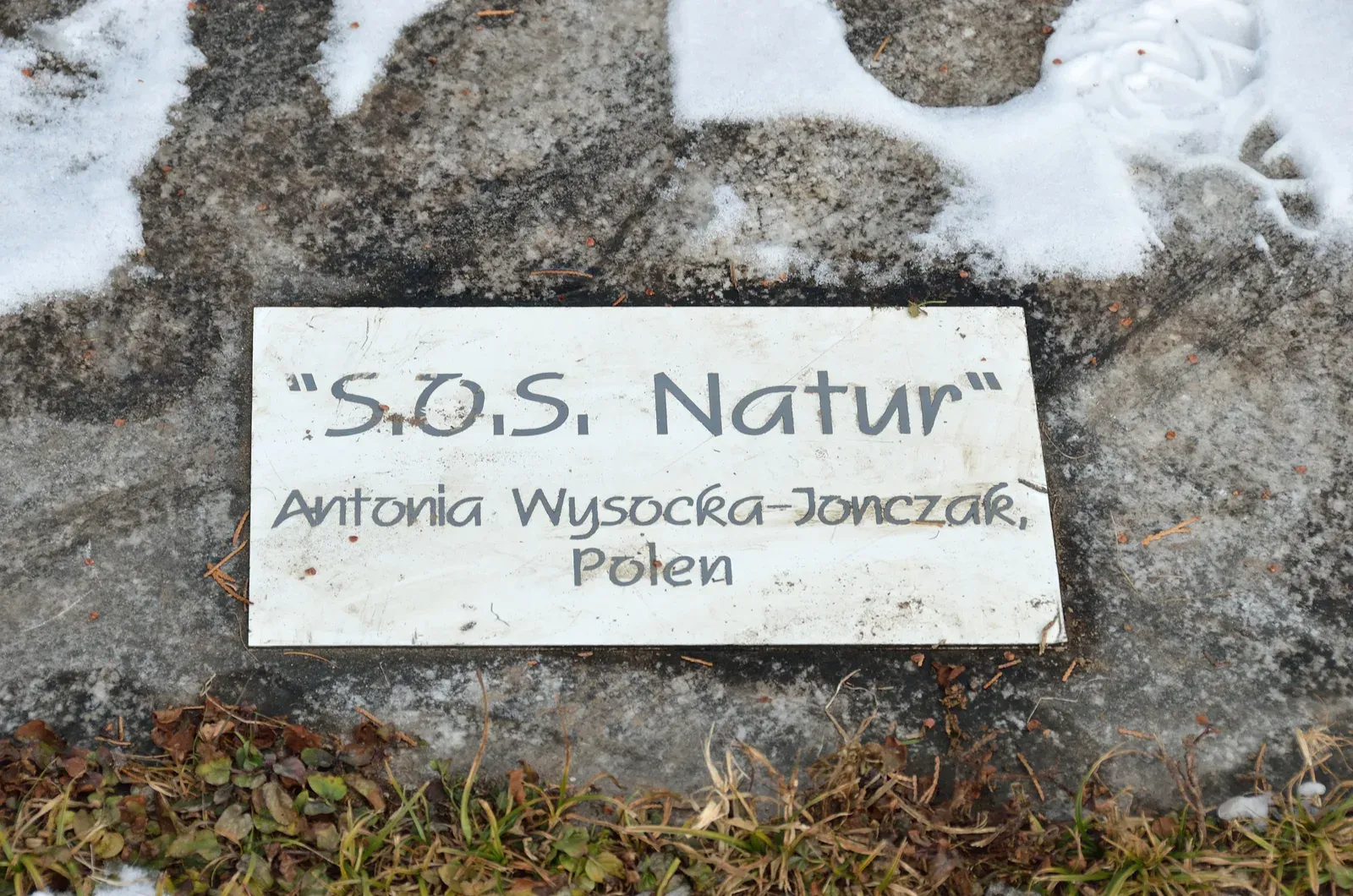
The plate laid on the slab: the title, the artist’s name and the country. Whoever engraved it lost a letter of the surname on the way. Photograph: Herzi Pinki, Wikimedia Commons, CC BY-SA 4.0