Wygnanie
Exile · Orońsko, 1968
Ten elements: mahogany figures as tall as people, wrapped in the wood as in a cloak, the faces barely surfaced; and among them, set on the ground, great bare feet carved in pale elm. Wygnanie — Exile — is the first of the large wooden compositions, and Antonina’s first work made of many figures: a crowd on the move, carved at twenty-six.
This room tells its half century on stage: the birth at Orońsko, the reading the critics gave it, the exhibitions from 1969 to 2021 — and the rule, entirely her own, by which no installation resembles the one before.
The work
The same group twice, half a century apart: newly made, out among the trees, and today in the gallery of the museum that keeps it — where all ten elements can be counted.
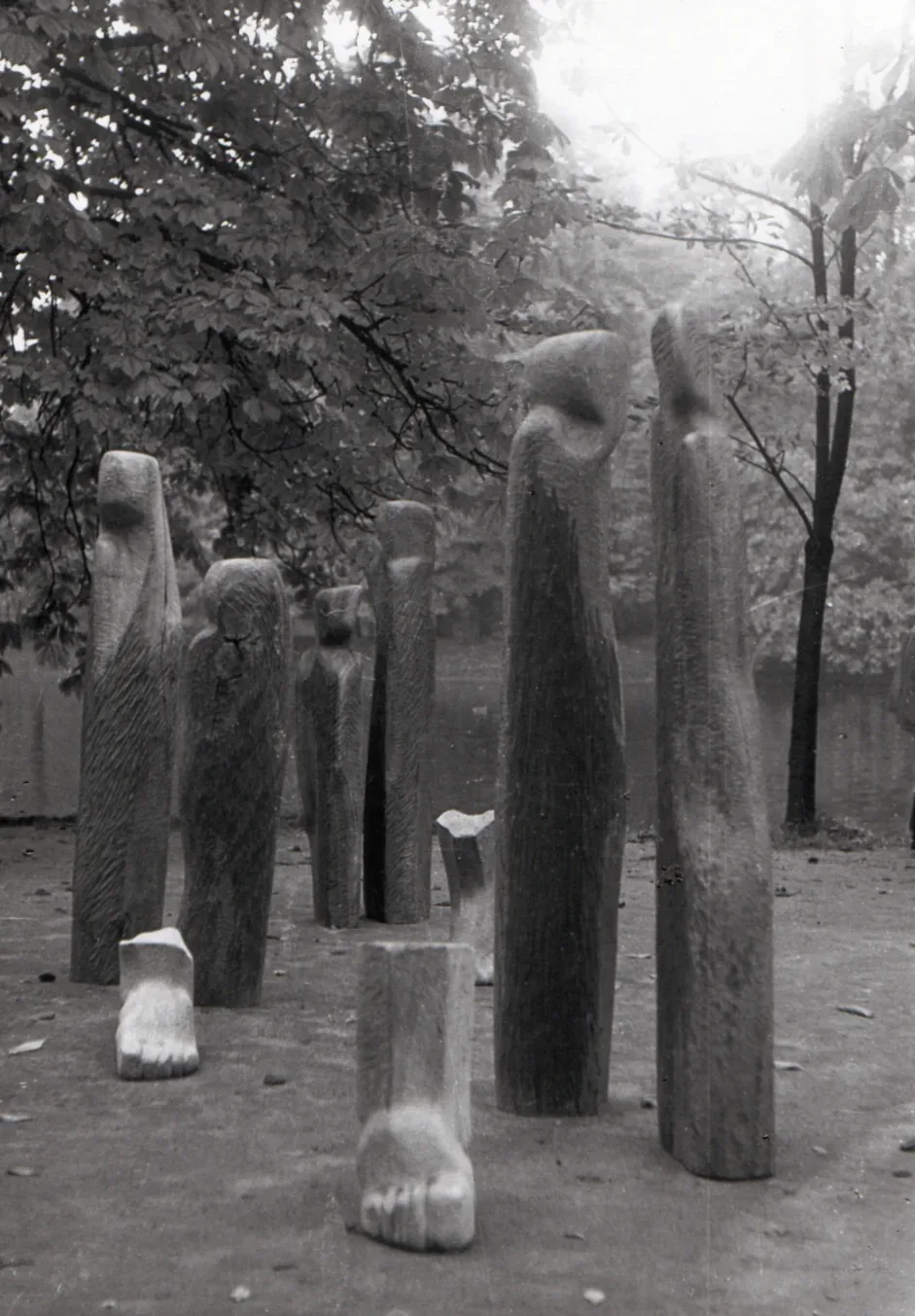
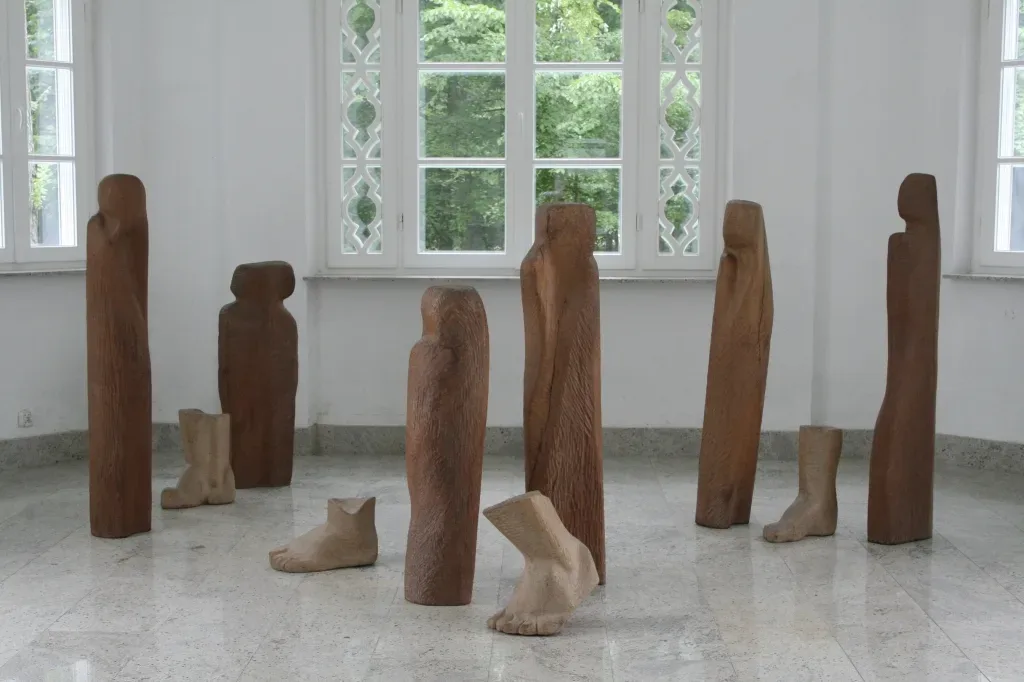
Photographs: the family archive and the Centrum Rzeźby Polskiej, Orońsko.
The walking
A crowd in exile · 1968The group is made at Orońsko in 1968, at the beginning of the season of the great wooden pieces. The subject is wandering: upright, almost mute figures, logs set walking, holding together like a column of refugees — and the very next year the work is on show in Warsaw, in the group exhibition «Warszawa w sztuce».
1969 is the year it first appears, and it does not appear alone. In the catalogues of that season’s group shows Wygnanie stands beside a design for a monument at Oświęcim and a series of terracotta plaques titled Martyrologia: the group is born inside the work of a generation carving the war and its aftermath. But the title the artist chooses does not name an event — it names a condition, that of the one who walks.
Whoever saw it then looked down first. Elżbieta Dzikowska, in the weekly «Stolica» of October 1969, writes that in the composition the sculptures of human feet are more expressive still than the figures. The following year, at the great survey in the Zachęta, the review in «Słowo Powszechne» describes it thus:
„Wygnanie” Antoniny Wysockiej-Jonczak, świetnie rzeźbione w drzewie i przedstawiające samotnie wędrujące postacie ludzkie […] i stopy — symbole udręki, odchodzenia. Na całość kompozycji składa się 10 dużych elementów. «Wygnanie» by Antonina Wysocka-Jonczak, superbly carved in wood, shows human figures wandering alone […] and feet — symbols of torment, of departure. The composition consists in all of ten large elements.
Forty years on the reading does not change, and grows more precise. In the essay for the 2011 solo exhibition at Orońsko the curator calls the figures «ludzie-kłody», log-men, and the feet «zmutowane», mutated: enlarged because that is where the sense of the work lies — for those in exile the feet are the hope of a better tomorrow, and the log-men follow them with no will of their own.
In 2015 the group enters the collection of the Centrum Rzeźby Polskiej: the donor is Teresa, the artist’s sister, and the museum records it as a signed work in ten elements. Wygnanie returns in this way, for good, to the place where it was made.
- «Warszawa w sztuce» zpap foksal, warsaw · 1969
- Rzeźba młodych national exhibition · 1969
- «25 lat rzeźby warszawskiej» zachęta, warsaw · 1969–1970
- Stara Kordegarda łazienki, warsaw · 1974
- KMPiK «Mały Rynek» kraków · about 1988
- «Przemijanie» siedlce · 2009
- «Zatrzymana w drodze» orońsko · 2011
- «Wspomnienie» siedlce · 2021
The documented exhibitions of the group: fifty years of galleries, from the Warsaw group shows of 1969 to the Siedlce solo exhibition of 2021.
The scene
Every exhibition, an arrangementA work of many elements has no fixed pose: the figures are set out anew for every exhibition — on sand, on cloth, in a garden or in a gallery — and the arrangement belongs to the installation, not to the work. Two different arrangements are not two works: it is the same crowd, halted at another point of the walk.
The photographs of the installations show this better than any rule. In one period print the group stands on a low platform against a backdrop of pale drapery, and the parts can be counted one by one: six figures and four feet, ten — exactly the number the Zachęta reviewer had put in writing. In a museum gallery the figures gather in a corner, the feet scattered among them across the parquet; at Siedlce, in 2021, they open into two groups along the wall. The same work, never the same scene.
-
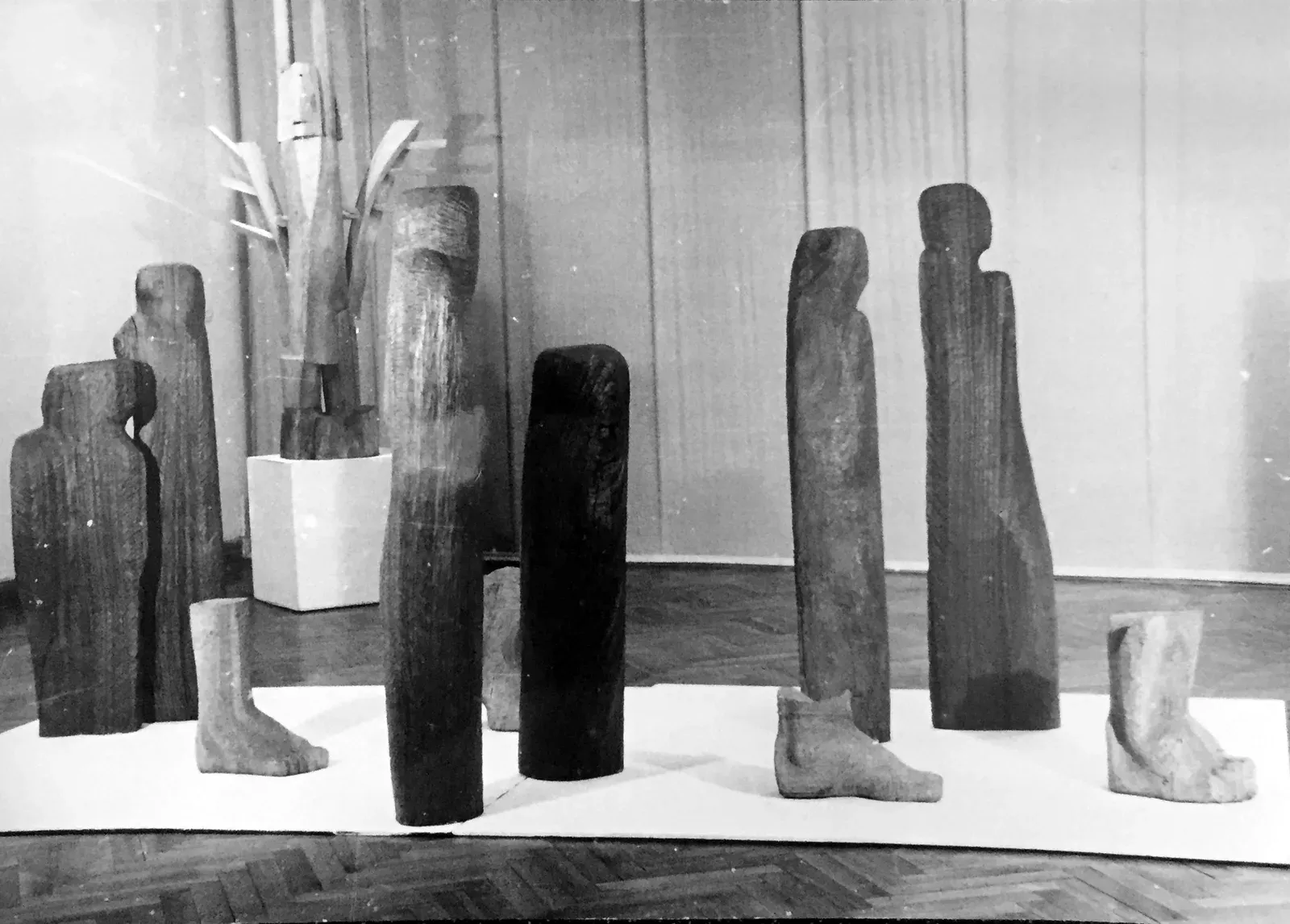
The group on a platform, in a period print: six figures and four feet, all ten elements at a glance. -
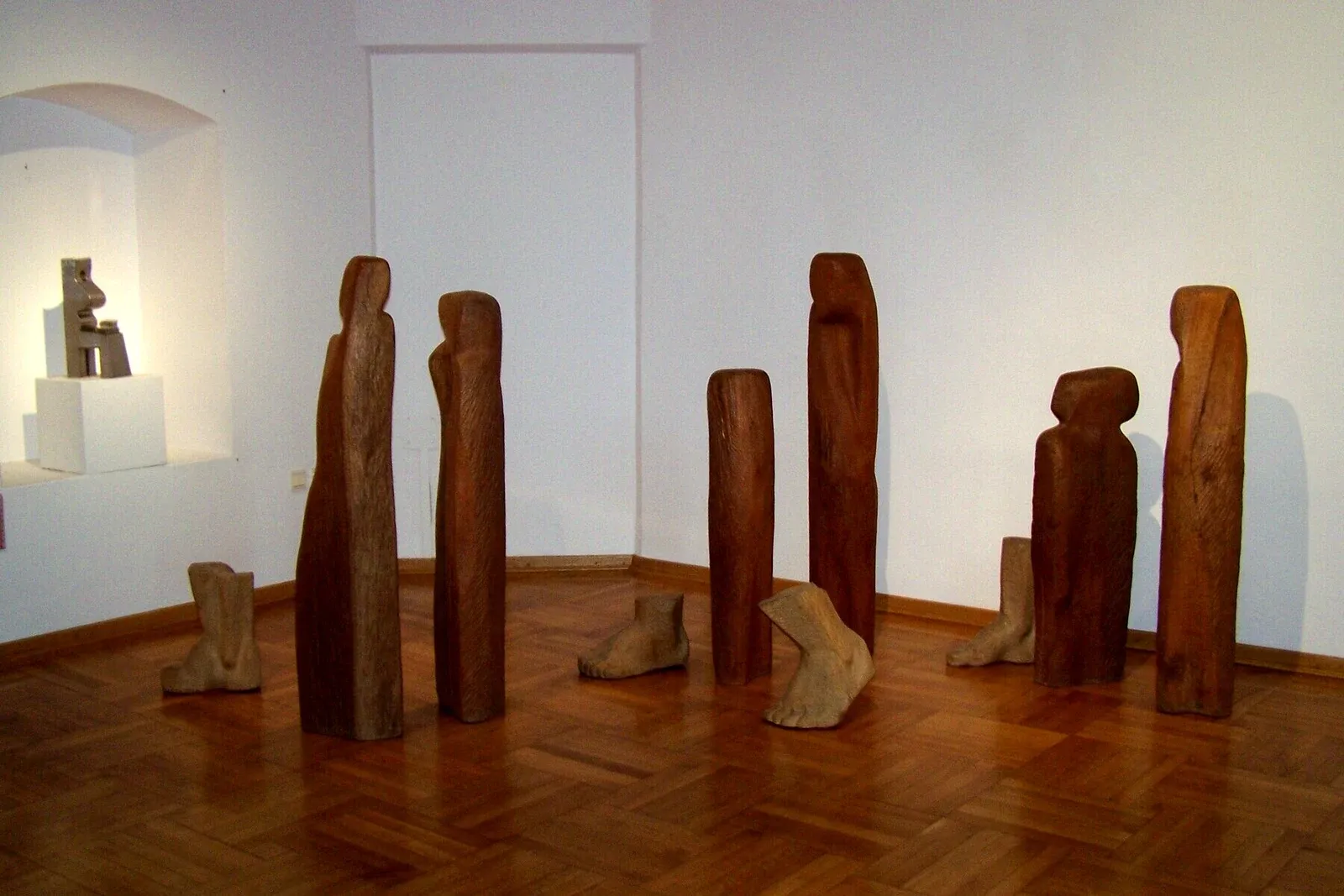
The figures and the feet gathered in the corner of a gallery, in one of the museum installations. -
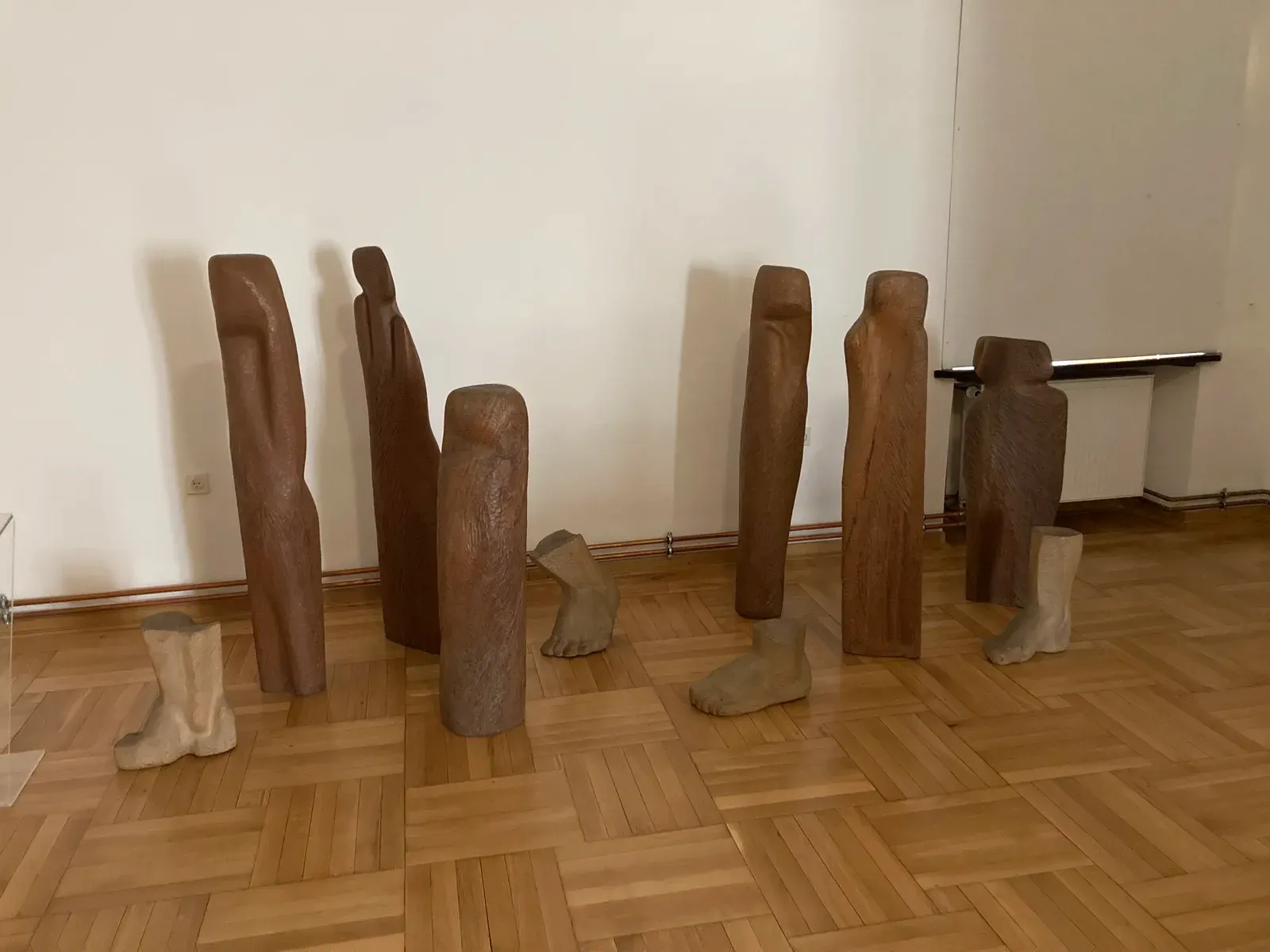
Wygnanie at the solo exhibition «Wspomnienie», Muzeum Regionalne, Siedlce, 2021.
Her own words
The artist’s vocabulary · 2009In 2009, introducing her solo exhibition at Siedlce, Antonina writes a single page about herself. She says that every form carries a message, and that carving serves to break the learned pattern and build the world of sensation anew. Then she says what she can show through form: and it is seven words in a row.
- płacz weeping
- droga the walk
- ból pain
- wzniosłość exaltation
- przemijanie passing away
- wygnanie exile
- nadzieja hope
The title she had given a group of wooden pieces forty years before is, in her mouth, a category of her own work: not the subject of one sculpture, but one of the ways in which she looks at people — «what is and has been close to me, important, and at the same time legible to others». The page closes with the image that holds all the rest together:
W pewien umowny sposób określając formę przez znak, skrót, symbol, archetyp mogę odkrywać mój świat i dzielić się z innymi, są to moje linie papilarne w rzeźbie. Defining form by convention — by sign, by shorthand, by symbol, by archetype — I can uncover my world and share it with others: these are my fingerprints in sculpture.