Zmaganie
Struggle · Nieporęt, 1982
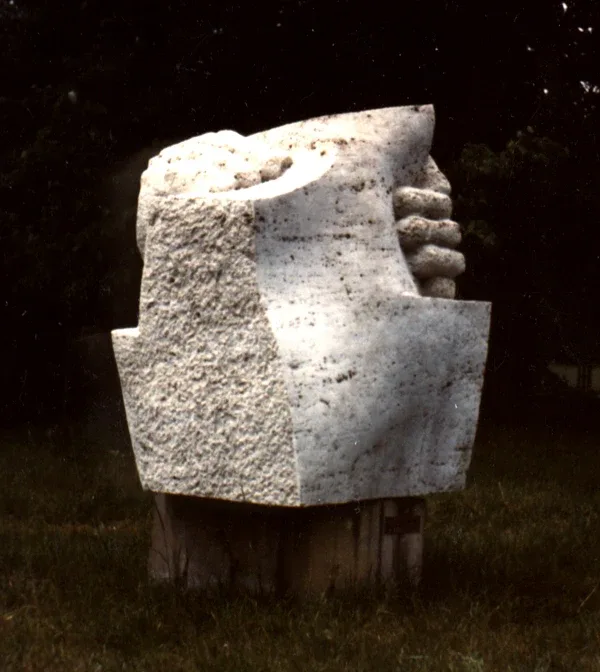
A block of white travertine, as tall as a person; on its flank, four thick fingers fold over the edge, like a hand gripping the block. One face is left rough, in dense blows; the other is smoothed, with the open pore of the travertine. The whole struggle of the title is there: between the hand and the block, between the surface won and the one still raw.
It is the only travertine in the catalogue, carved in 1982 at Nieporęt. This room tells it with the period print that shows it in the green, with the family photographs that give it scale, and with the motif — the hand — that here finds its most clenched form.
The work
The period print from the meadow: the travertine on its stump, the fingers on the flank, the rough face and the smoothed one.
The grip
Nieporęt · 1982The travertine is born in 1982 and stands at Nieporęt, on a skwer — a small tree-lined square north of Warsaw. It is not a place come upon by chance: eight years later Antonina returns there for another monumental stone, Wjazd, a three-metre sandstone at the edge of the town.
The year 1982 is one in which the work can take its time: the Ministry of Culture and Art has awarded her a grant for 1981–82 — one of several she receives in her career, and it is she herself who lists them one by one in the CVs she writes by hand. A creative grant, in practice, is this: months in which one can stand before a large block and stay there.
And in 1982 the hand is the centre of her work: in the same year, in the bronze for Emil B., a palm opens; here, in the travertine, a hand clenches.
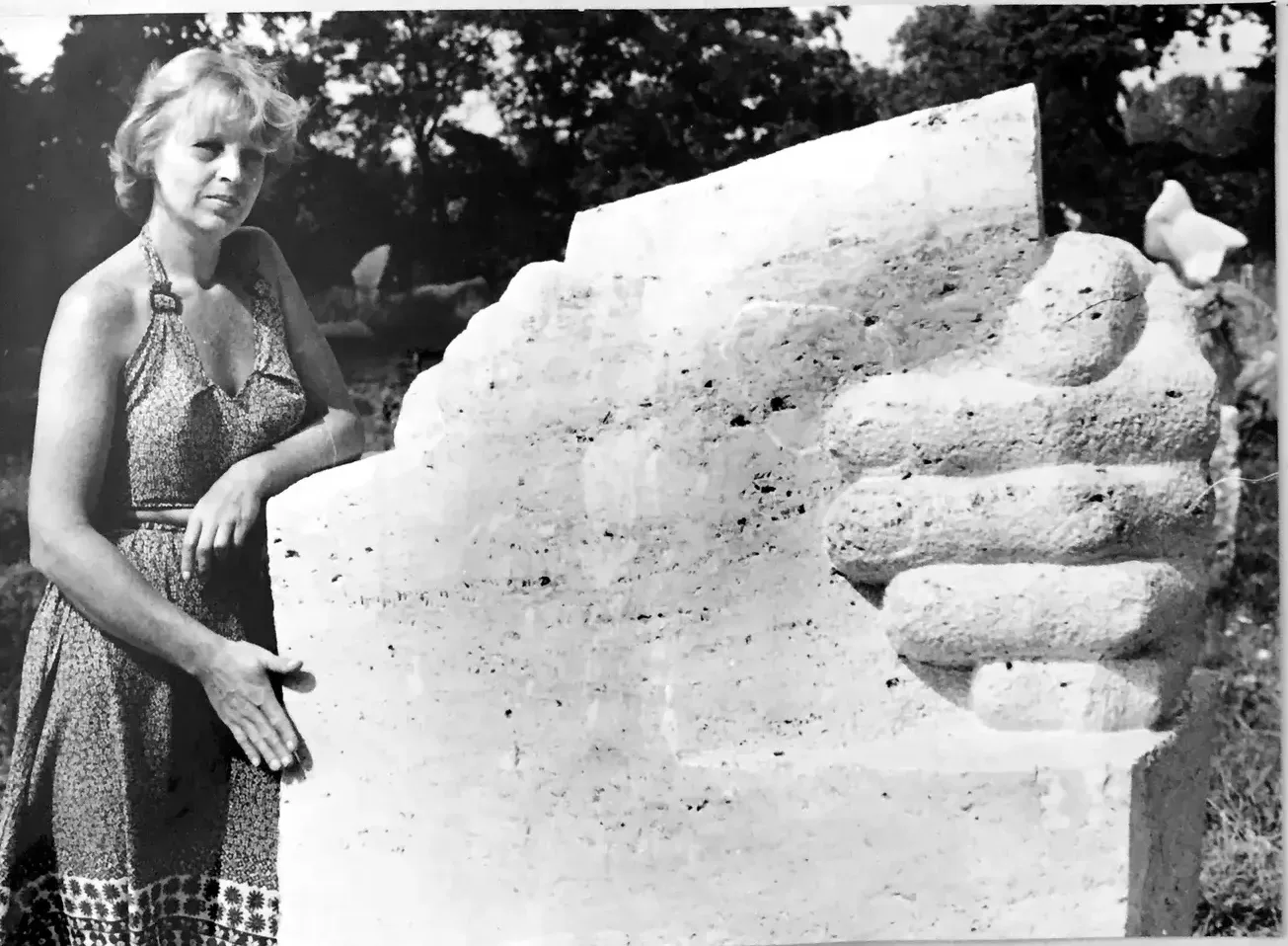
The black-and-white family print shows her standing beside the finished work, in summer, in a light dress, one hand resting on the stone: the block reaches her forehead, and the carved fingers stand at the height of her shoulder. It is the photograph that gives the measure of the work better than any number.
- W uwięzi, 1971 the hand closed between the valves
- Ręce, 1971 the hand that grips the oak
- Dyskobol, 1976 the hand that grips the disc
- Zmaganie, 1982 the fingers clenched in travertine
- Pamięci Emila B., 1982 the open palm in bronze
- Studies of hands, 1985 seven sheets, on paper
- Skupienie, 1986–87 the joined hands in bronze
The motif of the hand runs through half a century of the catalogue: the room of the Hands walks it work by work.
The struggle with fate
One word for the whole workZmaganie means struggle, and more exactly the contending with something one does not choose. In 1982 it is the title of a single sculpture: a block of travertine and four fingers gripping it.
Seventeen years later the same word returns, and not for a work. In a biographical note written for the catalogue of a Warsaw exhibition of 1999, all her sculpture is summed up in one line — and the line ends with the title of this stone:
Tematem jej prac pozostaje człowiek, jego los, zmaganie się z przeznaczeniem. Stąd zapewne metaforyczny wyraz wielu prac artysty. The theme of her works remains man, his fate, the struggle with destiny. Hence, probably, the metaphorical expression of many of her works.
It is the point at which the title of a single sculpture becomes the formula of a life of work: the word given to a travertine in 1982 lets whoever looks at the whole say what all the others do as well — the figures on their way, the busts opened in two, the cracked discs.
Ten years later, presenting her own exhibition in Siedlce, Antonina says it her own way. Over a travertine the sentence sounds more exact than anywhere else, because it speaks precisely of hardness and of lasting:
Każde trwanie, nawet w najtwardszym materiale, jest początkiem przemijania. Jestem. Więc to, co czynię, jest śladem mojej obecności. Every lasting, even in the hardest material, is the beginning of passing. I am. So what I make is the trace of my presence.
Travertine is a stone at once hard and porous: hard enough to remain, porous enough to let itself be marked. The hand gripping it is, literally, the trace of a presence.