Orzeł
Eagle · Moscow, 1978
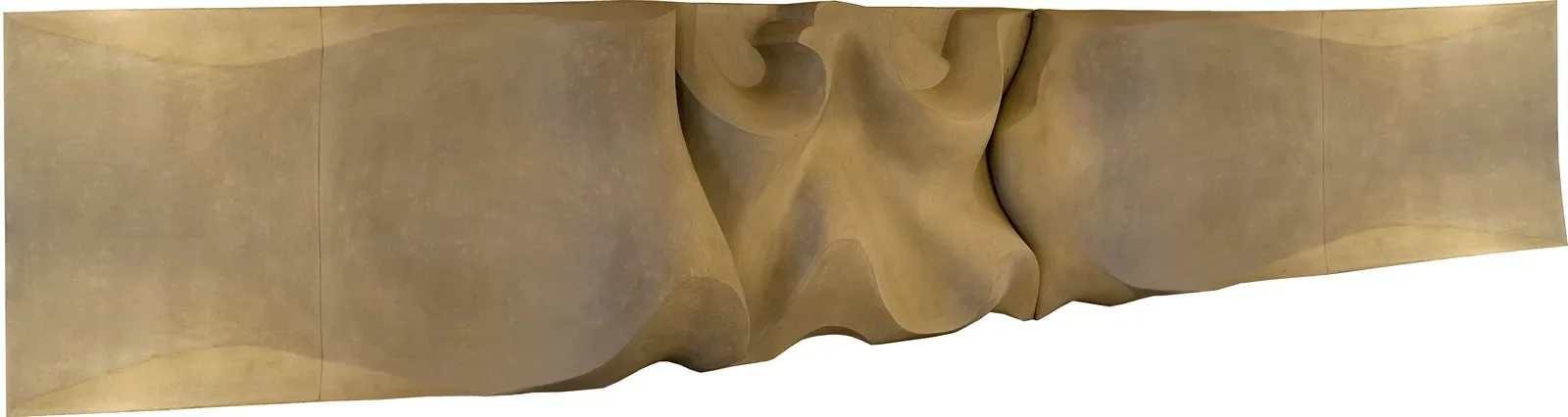
Seven and a half metres of sandstone on a wall: waves of stone that rise, curl and fall back, and among them — once the eye adjusts — a figure with open wings. There are no feathers, no beak, no talons: there is a movement, and whoever looks at it decides whether it is an eagle.
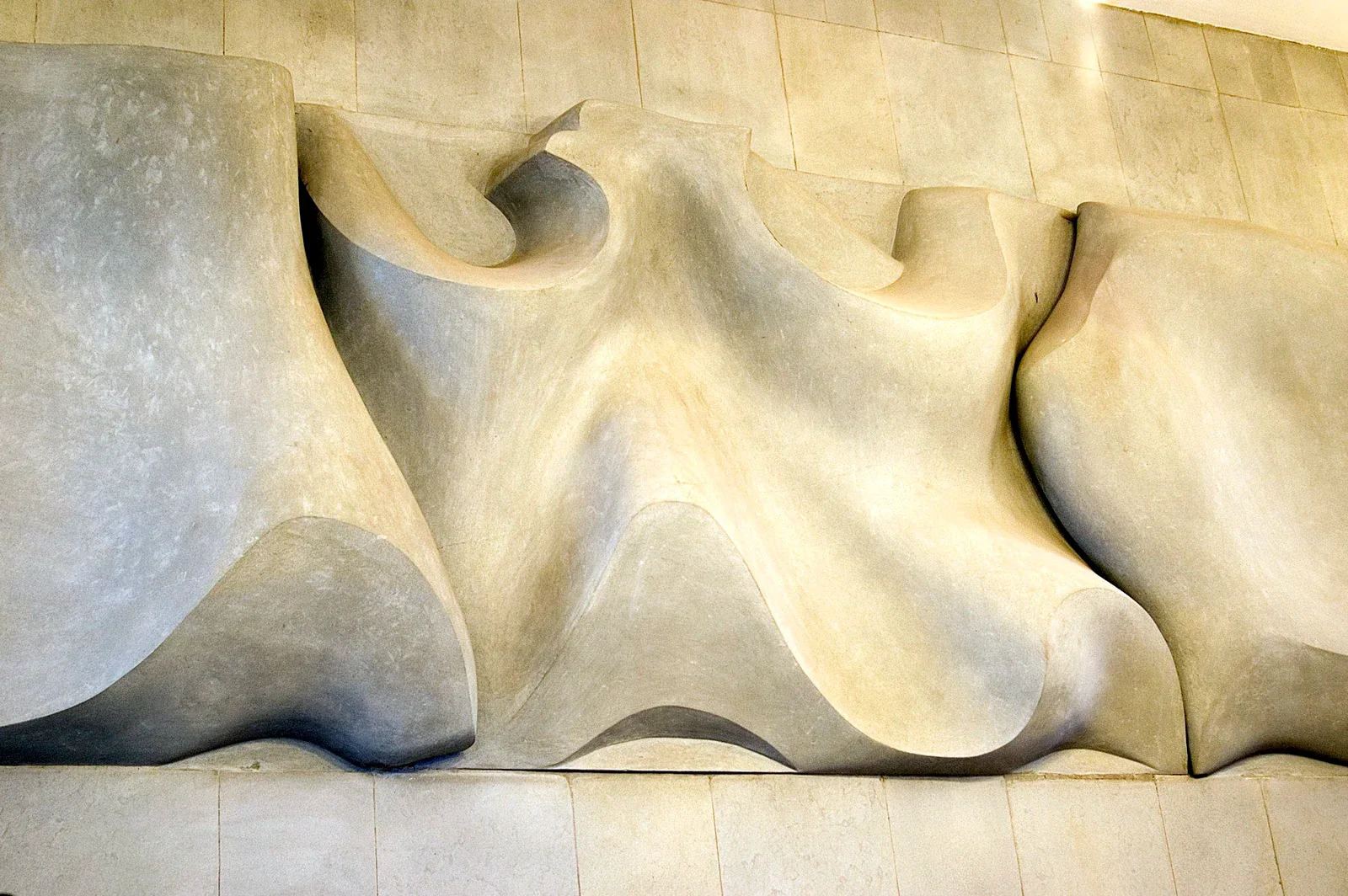
The relief stands in the entrance hall of the Polish Embassy in Moscow, where Antonina sets it in place in 1978. It is the largest work in her catalogue, and also the one almost nobody can see.
The work
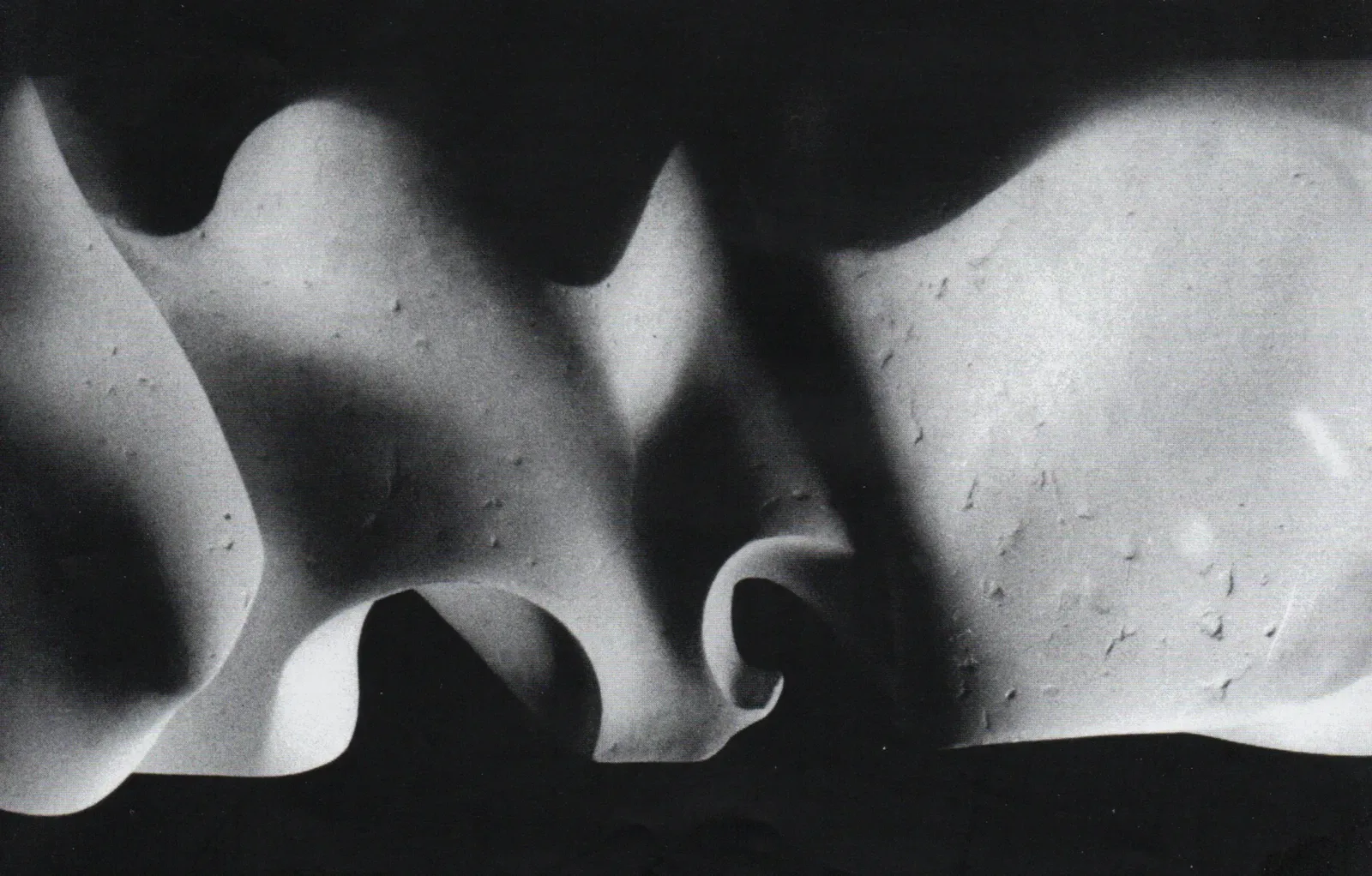
Above, all seven and a half metres in a single view — the only image that holds them together. Below, the relief on the wall of the hall and the detail of the wing from the catalogue plate: the same stone, in the light of the building and in studio light.
The competition and the worksite
Warsaw 1975 · Moscow 1978In 1975 Antonina wins the competition for the relief in the entrance hall: her CVs record it as first prize in a national sculpture competition, and the commission is for a building still going up — the new seat of the Embassy in Moscow, designed by the architects Bogusławski and Hinz.
In August 1977 she is at Hoyerswerda, carving Cywilizacja I in the zoological garden, and the local paper introducing her writes that she is also at work on a large sculpture for the Polish Embassy in Moscow: the two worksites run together. The relief goes up the following year, and she sets it in place herself while the building is still half a building site.
The rest she tells herself, many years later. While she was working there were always people around; someone spoke ill of what she was doing, and she answered:
jeszcze tu korony polskiej brakuje, ale będzie czas, że będzie. the Polish crown is still missing here — but the time will come when it is there.
It has to be read with the date in front of you: 1978, Moscow, a Polish artist on a scaffold inside an embassy of the bloc. The eagle with the crown is the arms of independent Poland, and in those years the crown is absent — it would return to the state eagle only in 1990. She does not carve it: she says that it will come.
An eagle, or just a bird
Form as coverThe story has a second act, and it concerns the building. Antonina relates that the Polish architects were summoned to account: the charge was that they had put an eagle in the entrance hall of an embassy in Moscow. They defended themselves by saying it was not an eagle — it was just a bird.
The defence could work because the stone allowed it. There is no heraldic attribute anywhere in the relief: there are masses that open and twist, an upward motion and two great lobes that can be read as wings or as waves. It is the same abstract language as her wooden pieces of the sixties, and here it does one thing more: it keeps the work under cover. Whoever is meant to see the eagle sees it; whoever needs to be able to say it is not there, can say so.
It is the only case in the catalogue in which the ambiguity of a form does work that is not merely a matter of style. And it is worth remembering that ten years later the critic who writes her first monographic text warns against precisely this misunderstanding:
Rzeźby Wysockiej-Jonczak nigdy nie bywają grą formy samą dla siebie, sferą eksperymentów abstrakcyjnych […]. Humanistyczną postawę artystyczną Wysockiej określa antropocentryczność większości rzeźb. Wysocka-Jonczak’s sculptures are never a play of form for its own sake, a field of abstract experiment […]. Wysocka’s humanist stance as an artist is defined by the anthropocentricity of most of her sculpture.
In the same text the Moscow relief is listed among her park sculptures in stone, beside Ab Ovo, Sfera and Zbliżenie: works made, the critic says, in Poland, Czechoslovakia, Yugoslavia, East Germany and the Soviet Union. Five countries, one decade: these are the years in which her stone travels more than she does.
The competition boards
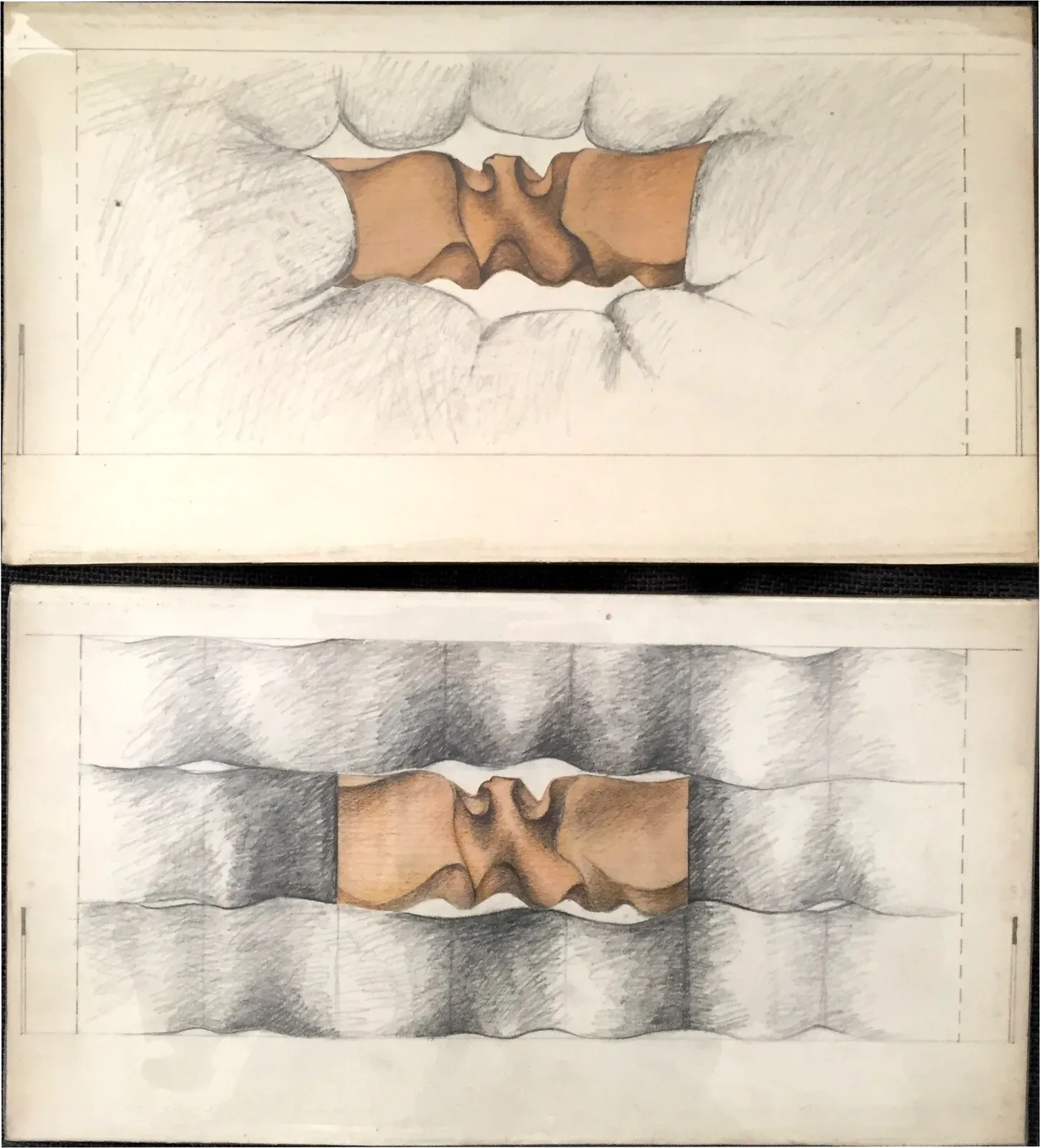
Four cards, and three solutions droppedA competition is won with sheets of paper. In the folder of drawings there are four that resemble nothing else: cards with a ruled border, tick marks for dimensions along both margins, and inside the border a very long band, six times wider than it is tall. There is no other work of that shape in the catalogue.
One of the four is the relief. Smooth grey stone at both ends, a worked, warm field in the middle; and within the field the symmetrical mass with the two opposed volutes above and the edge falling away in lobes — volute for volute, what stands on the wall of the hall.
The other three are roads not taken. In one the stone opens in a jagged horizontal rent; in another the core is shut inside a regular grid of undulating elements, a modular field that holds it like a net; in the third the rent is an ellipse from which rays depart. Three ways of making the same thing happen — that the wall should break in the middle — and the choice falls on the one in which the break is a movement and not an outline.
One detail says where in the work we are. On all four boards the core is coloured a warm brown inside a grey field, as though it were a piece let in from another material; the relief, however, is all of the same Brenna sandstone. Either the boards come from before the stone was decided, or that brown is already the sandstone and the grey is the wall around it.
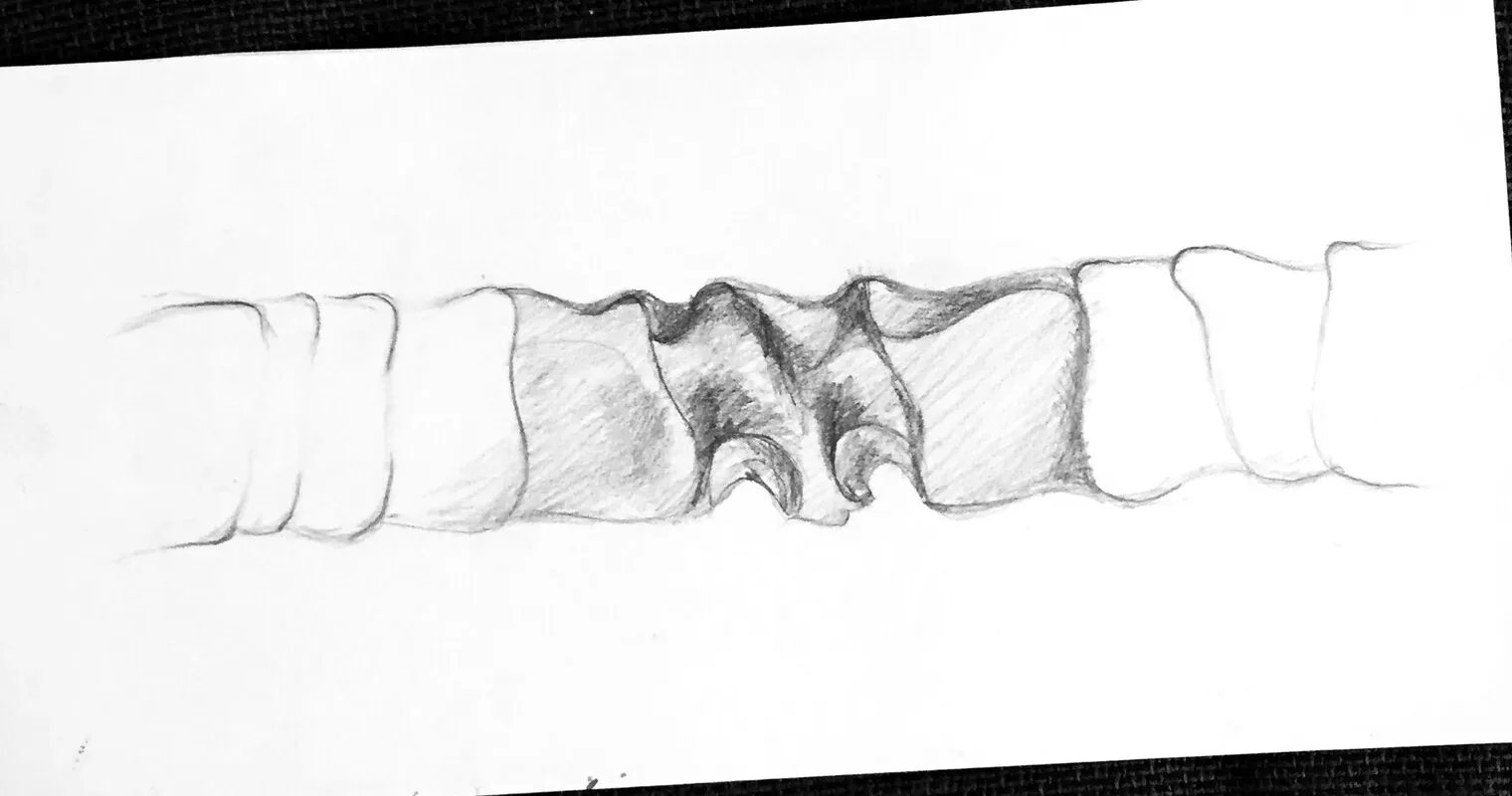
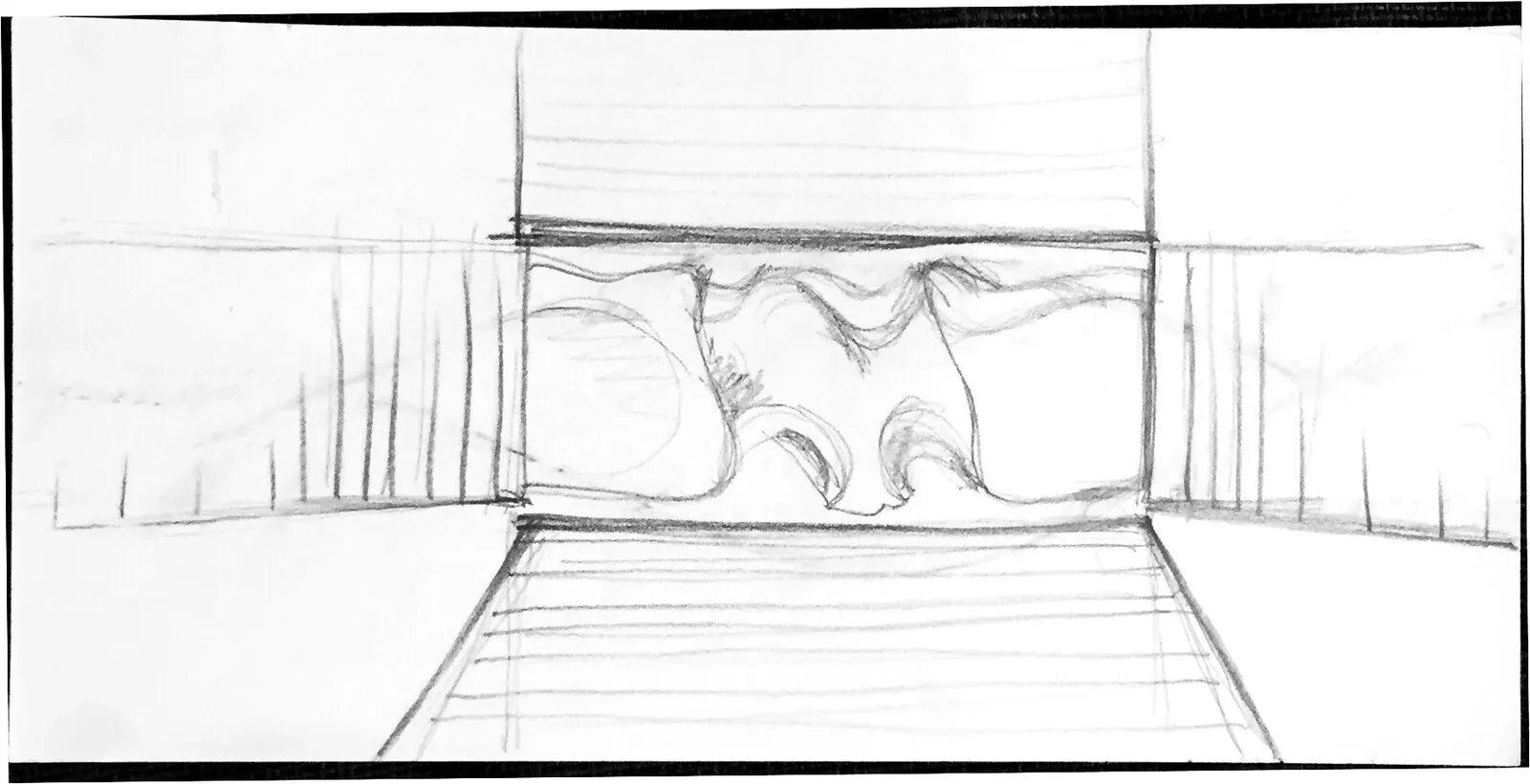
In the same folder three narrow, long cards take the frieze from three sides. The first simply draws it: a band of upright slabs set side by side, smooth at the flanks, which in the middle ripple and open in a two-lipped rent. The second tries it inside a recess sunk into a wall of horizontal courses, with the ribbed floor converging towards it. The third divides it into five numbered blocks and marks, with two steps at the joints, where the central block is to project. As it will be seen on entering, and as it will be cut at the quarry.
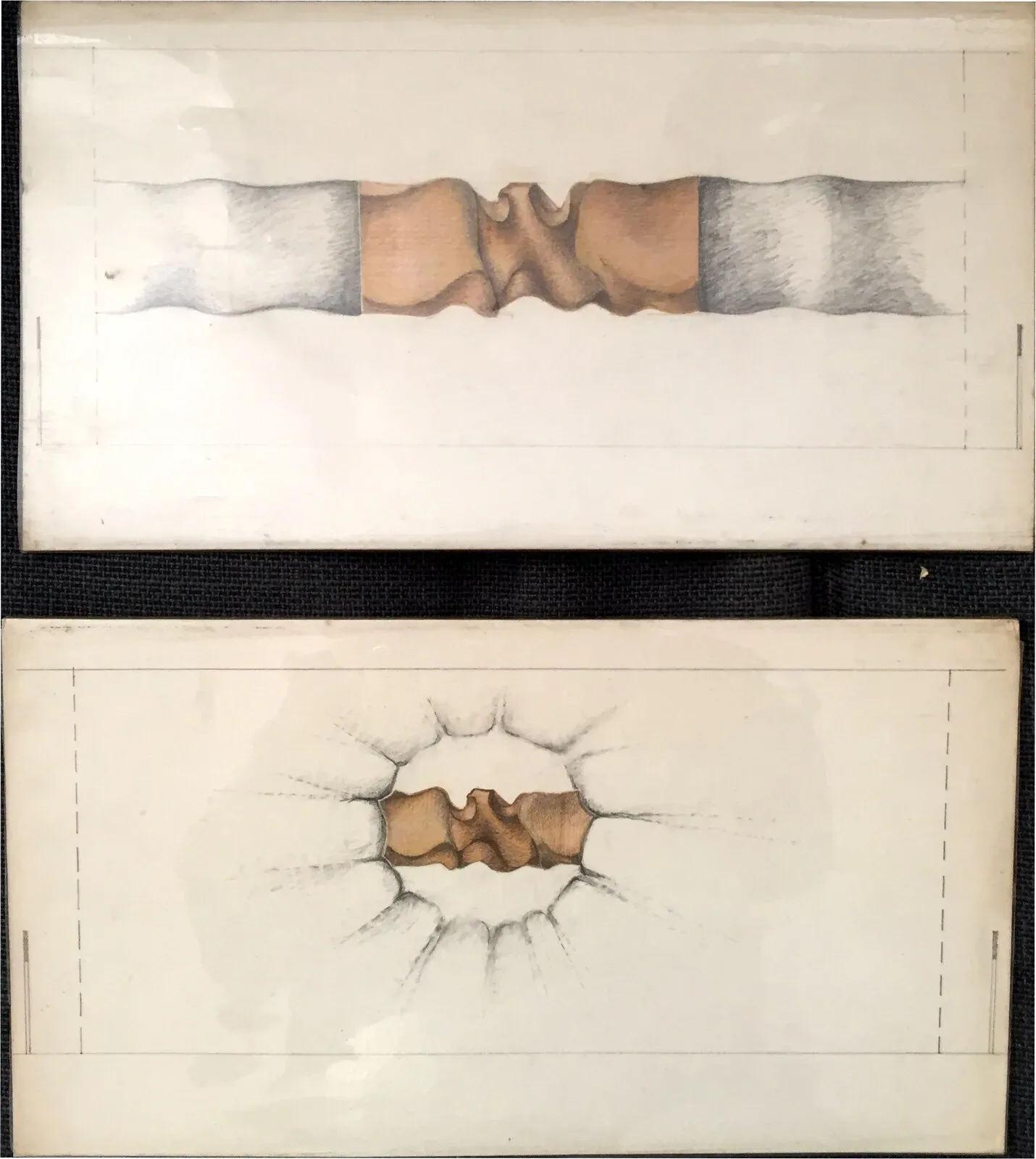
Photographs of the sheets: the family archive.