Sfera
Kostanjevica na Krki · Forma Viva, 1976
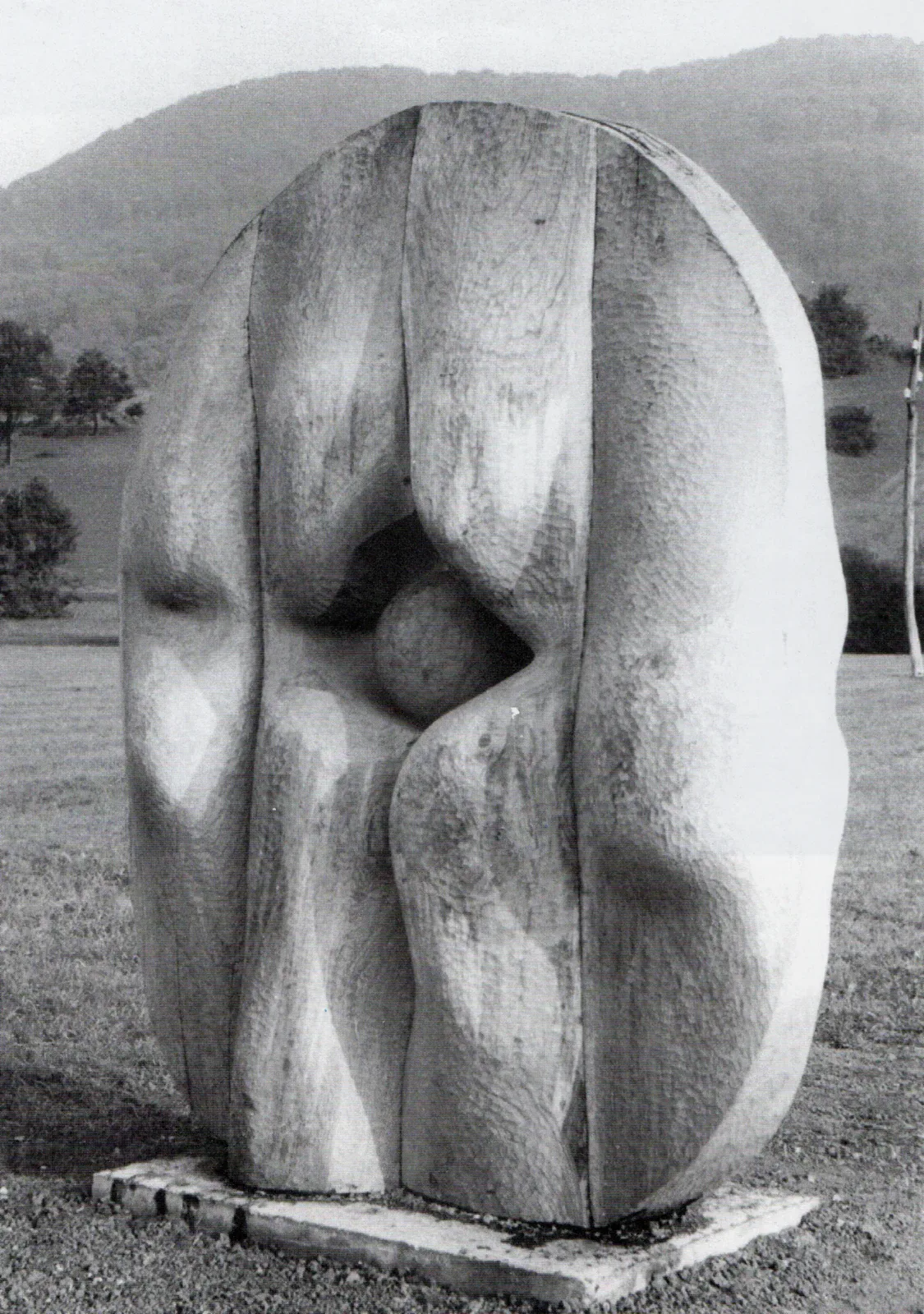
An oak ovoid three metres tall, swollen like a fruit, divided by vertical joints; at the centre, in a hollow where the volumes draw apart, a small solid sphere. The mass guards it like an eyelid: the Sphere is an eye — the form, the artist will say, of nature’s greatest creation, able to look and also to see.
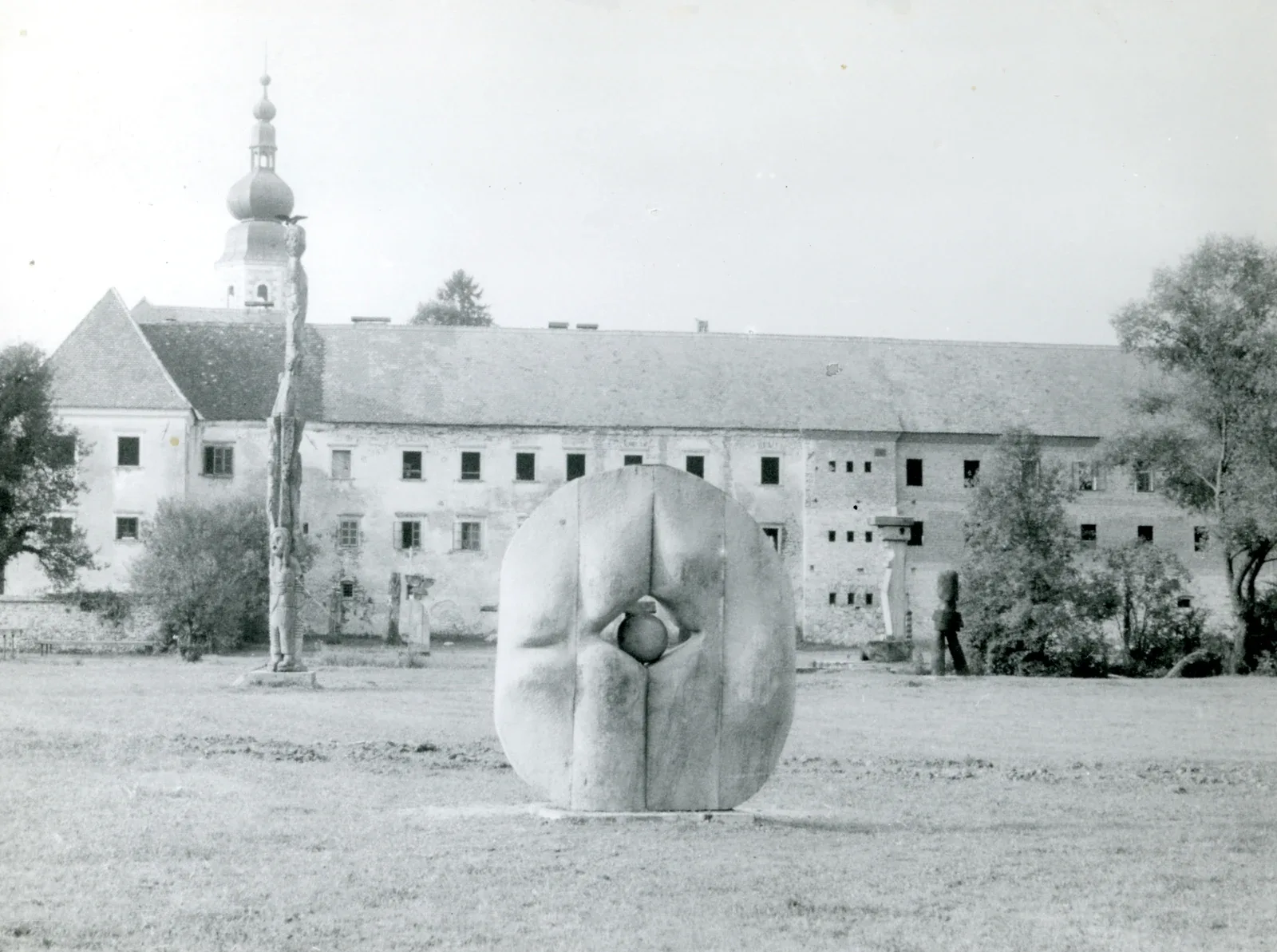
It is born in the summer of 1976 at the Forma Viva symposium of Kostanjevica na Krki, in Slovenia — where by rule the works do not leave with those who made them: the catalogue records it in the gallery’s park, among the sculptures of the other years.
The work
The catalogue plate and the period view of the park: the ovoid up close, with the small sphere in the hollow, and the Sphere in the meadow, before the Forma Viva gallery.
The summer of Kostanjevica
Forma Viva XVI · July–August 1976The Forma Viva of Kostanjevica na Krki is one of the great European wood symposia: every summer the invited sculptors work in the open in the meadow around the gallery, and the works stay there. Antonina is proposed for the sixteenth edition, that of 1976, by the Warsaw sculptors’ union; she arrives late, in mid-July, held back by commitments at home.
She had been converted to the wood symposia, six years earlier, by the Slovak sculptor Alexander Ilečko, at a Czechoslovak symposium: a name that returns in this archive, because Ilečko is one of the three home sculptors of Moravany nad Váhom, the 1971 symposium where Antonina carves Ręce. Kostanjevica is the third international event of the kind she takes part in. Of the Forma Viva gallery she will say that it is not only a gallery: it is a school for all sculptors.
On 5 August a Slovenian weekly sends a reporter to the meadow, and a portrait comes of it: the Polish sculptor who works above all in wood, less in stone and bronze; the 1966 diploma with Marian Wnuk; the great stone work on a Warsaw avenue, made together with six other sculptors. And then the motifs that keep returning to her hands, which she lists to the reporter one after another.
- kolona the column
- koraki the steps
- rojstvo birth
- roke the hands
- sheme molekul the schemes of molecules
Her repertoire, in the summer of 1976, in the Slovenian words with which the reporter set it down: the column and the steps live in the great wooden pieces, the hands will become a whole work, birth runs through all her sculpture — and at the end of the row, unexpected, the scheme of a molecule.
The symposium closes on Saturday 28 August, at five in the afternoon, in the Forma Viva gallery: the vice-president of the Executive Council of Slovenia speaks, the Viktor Parma mixed choir of Krško sings. Then the sculptors leave, and the works stay in the meadow: it is the Forma Viva pact.
The living wood
Antonina’s words · August 1976The article is titled «Life with wood», and it is not a title of circumstance: to the reporter who asks why she works above all in wood, Antonina answers with three statements that hold together — and that are the closest thing to a poetics preserved in her own voice.
Kamen je mrtev material […]. Les je del živega sveta, voljno sprejme dleto […]. Drevo umre, ko ga posekajo, vendar mu kipar z novo formo vdahne tudi novo življenje. Stone is dead material […]. Wood is part of the living world, it accepts the chisel willingly […]. A tree dies when it is felled, but the sculptor, with a new form, breathes into it a new life as well.
It is the thought that explains why a wood symposium resembled her more than anything else: there no one takes anything away, and a tree already felled is given a new form. Stone will serve her, and greatly — the symposia of the following years are almost all of stone —, but wood remains the only material she speaks of as she would of a person.
Then the reporter stops before the block she is working on, and the description becomes, without naming it, the Sphere:
Kroglasto oblikovana gmota z jedrom v sredini povzema formo očesa, to največjo stvaritev narave, ki je sposobno gledati in tudi videti. The spherically shaped mass, with its core at the centre, takes up the form of the eye: nature’s greatest creation, able to look and also to see.
The distinction between looking and seeing is her own, and it is the sense of the work: three metres of oak held open around a core, in a meadow where anyone passing can stop and look.